


Revised Form 161: CBDT Notification 134/2026 Explained
Revised Form 161: Key Changes Under CBDT Notification 134/2026
The Central Board of Direct Taxes (CBDT) has introduced changes to the Income-tax Rules, 2026, through Notification No. 134/2026 dated 8 October 2026. The notification introduces the Income-tax (Sixth Amendment) Rules, 2026, and replaces the existing Form 161 with a revised application form for seeking a waiver of penalty under Section 440(2) of the Income-tax Act, 2025.
The amendment provides a prescribed format for applicants to submit their personal information, assessment or reassessment details, tax calculations, payment records and required declarations.
In this article, we explain the key changes introduced by CBDT Notification No. 134/2026, the information required in the revised Form 161 and the important points taxpayers should understand before applying.
What Is CBDT Notification No. 134/2026?
CBDT Notification No. 134/2026 was issued by the Ministry of Finance, Department of Revenue, on 8 October 2026.
Through this notification, the Central Board of Direct Taxes amended the Income-tax Rules, 2026. The notification makes two principal changes: an amendment to Rule 231 and the replacement of Form 161.
The revised form is titled Application for seeking waiver of penalty under Section 440(2) of the Income-tax Act, 2025.
The notification states that the Income-tax (Sixth Amendment) Rules, 2026, come into force from the date of their publication in the Official Gazette.
What Are the Main Changes to Form 161?
The notification introduces two important amendments to the Income-tax Rules, 2026.
1. Amendment to Rule 231
The words "or waiver" have been inserted after the word "imposition" in Rule 231. This updates the wording of the rule to include a reference to waiver.
2. Replacement of Form 161
The existing Form 161 has been replaced with a revised application form for seeking a penalty waiver under Section 440(2) of the Income-tax Act, 2025.
The revised form specifies the information applicants must provide about themselves, the relevant assessment or reassessment order, the amounts payable and the payments made.
These changes establish the prescribed format for submitting the relevant application.
What Information Is Required in the Revised Form 161?
The revised Form 161 is divided into two main parts: personal information and details of the assessment or reassessment order and payments.
Part A: Personal Information
The first section collects the applicant's identification and contact details. The information requested includes:
- Full name of the applicant
- Permanent Account Number (PAN)
- Address
- Mobile number
- Email address
Applicants should ensure that these details are accurate and complete before submitting the application.
Part B: Assessment or Reassessment Order Details
The second section collects information relating to the relevant tax order and payment obligations.
The requested details include:
- Tax year
- Section under which the order was passed
- Document Identification Number (DIN) of the order
- Date of the order
- Date on which the order was served
- Due date for payment specified in the notice of demand
- Income assessed
- Details of under-reported income
The form distinguishes between specified categories of under-reported income associated with misreporting and under-reporting that is not in consequence of misreporting.
Providing accurate assessment details is important because they identify the relevant proceedings and the amounts recorded in the application.
How Are Tax and Additional Income-Tax Amounts Calculated?
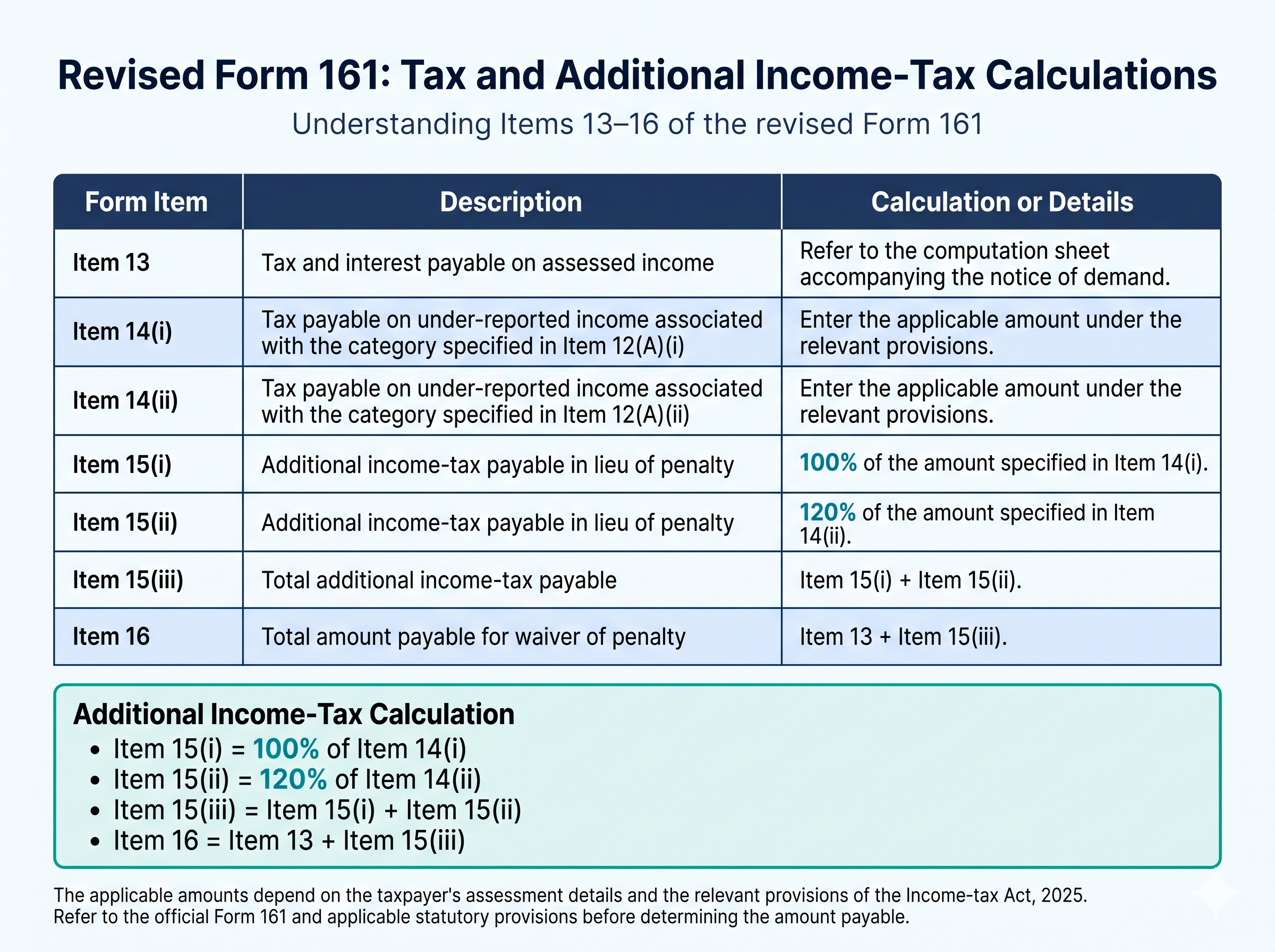
The revised Form 161 specifies the tax and additional income-tax calculations applicable to penalty-waiver applications under Section 440(2) of the Income-tax Act, 2025.
Items 13–16 explain the tax and interest payable on assessed income, tax payable on under-reported income, additional income-tax payable in lieu of penalty, and the total amount payable.
The following infographic explains the calculations specified in the revised Form 161.
What Payment Details Must Applicants Provide?
The revised Form 161 requires applicants to provide details of the payments made in connection with their tax liability. These details help identify and verify the relevant payments during the application process.
Applicants must provide the following information:
- BSR Code: The Bank/Branch Serial Number code associated with the payment.
- Date of Deposit: The date on which the payment was deposited.
- Challan Serial Number: The serial number of the payment challan.
- Amount Paid: The amount deposited.
Item 17 of the revised Form 161 contains these payment fields and allows additional payment entries when required. The form also states that some information may be pre-filled to the extent possible.
Applicants should verify their payment information against the relevant challans and tax records before submitting the application. The Income Tax Department also identifies proof of payment of tax and interest as a requirement for processing Form 161 applications.
What Declaration Must Be Made When Applying for a Penalty Waiver?
The revised Form 161 includes a verification section in which the applicant declares that the information provided is true to the best of their knowledge and belief.
The declaration also includes confirmation that no appeal has been filed in respect of the order mentioned in Part B. In addition, the applicant undertakes that no appeal will be filed in respect of the order before the expiry of the period specified in Section 440(5).
The applicant must provide the required signature, name, designation where applicable, place and date.
Applicants should carefully review these declarations and the applicable provisions before signing and submitting the form.
Does Revised Form 161 Automatically Guarantee a Penalty Waiver?
No. The introduction of a revised Form 161 does not mean that every taxpayer is automatically eligible for a penalty waiver.
The notification establishes the revised application form and the amendment to Rule 231. Whether a particular applicant qualifies for a waiver depends on the applicable provisions of the Income-tax Act, 2025, and the circumstances of the case.
Taxpayers should review their assessment or reassessment order, notice of demand, payment records and applicable statutory requirements before deciding whether to apply.
Where the legal conditions or payment calculations are unclear, consulting a qualified tax professional may help applicants understand their obligations.
Taxpayers who need assistance understanding their tax obligations can explore EasyTax's income-tax consultancy and filing services.
Where Can You Find the Official Notification?
Taxpayers and tax professionals can refer to the official notification to review the changes to Rule 231 and the revised Form 161.
Official source: CBDT Notification No. 134/2026 — Income-tax (Sixth Amendment) Rules, 2026
The notification should be read alongside the relevant provisions of the Income-tax Act, 2025, and the Income-tax Rules, 2026.
Frequently Asked Questions (FAQs)
1. What is revised Form 161 under the Income-tax Act, 2025?
Revised Form 161 is the prescribed application form for seeking a waiver of penalty under Section 440(2) of the Income-tax Act, 2025. It was introduced through CBDT Notification No. 134/2026 dated 8 October 2026.
2. What is the Income-tax (Sixth Amendment) Rules, 2026 notification?
It is the notification through which CBDT amended Rule 231 and replaced the existing Form 161 with a revised form for penalty-waiver applications.
3. What details are required in the revised Form 161?
The form requests personal and contact information, assessment or reassessment order details, assessed and under-reported income, tax and interest amounts, additional income-tax calculations, payment records and declarations.
4. What are the additional income-tax calculation rates specified in Form 161?
The form specifies 100% of the amount in Item 14(i) and 120% of the amount in Item 14(ii). Applicants must use the relevant figures and applicable statutory provisions when calculating the amounts.
5. What Is the Deadline for Filing Form 161?
According to the Income Tax Department's official Form 161 FAQs, the application must be filed within one month from the end of the month in which the assessment or reassessment order is received, in accordance with Section 440 of the Income-tax Act, 2025.
Applicants should check the date on which they received the relevant order and verify their filing deadline before submitting the application.
Official reference: Income Tax Department — Form 161 FAQs
6. Does filing revised Form 161 guarantee a penalty waiver?
No. Submission of the form does not automatically guarantee approval. Applicants must satisfy the conditions prescribed under the applicable law.
7. Where can I read Notification No. 134/2026?
The notification is available through the official Income Tax Department website. It contains the text of the Income-tax (Sixth Amendment) Rules, 2026, and the revised Form 161.
Conclusion
CBDT Notification No. 134/2026, dated 8 October 2026, introduces the Income-tax (Sixth Amendment) Rules, 2026. The notification amends Rule 231 and replaces the existing Form 161 with a revised application form for seeking a waiver of penalty under Section 440(2) of the Income-tax Act, 2025.
The revised form collects personal information, assessment or reassessment details, tax calculations, payment records and declarations. Taxpayers considering an application should review these requirements and verify the applicable legal conditions before proceeding.
Understanding the revised Form 161 can help taxpayers and tax professionals prepare the required information and better understand the application process.
For more tax-related information, explore our Income Tax guides and updates covering important tax topics and compliance requirements.
Disclaimer: This article is for general informational purposes only and is based on the cited notification. Taxpayers should consult the applicable legislation and official guidance for their circumstances before taking action.
EasyTax • Jaipur
Expert Assisted ITR Filing
Dedicated CA prepares, verifies, and files your ITR. Maximum refund, accurate deductions, zero notices.