

Private Limited Company Registration in India: Complete Guide
Private Limited Company Registration in India: Process, Documents and Requirements
Starting a business in India involves more than choosing a name and beginning operations. Selecting the right legal structure can affect ownership, fundraising, management, liability and ongoing compliance. A private limited company is a popular option for founders who want a separate legal entity with a formal shareholding and management structure.
This guide explains the private limited company registration process in India, including eligibility, documents, Digital Signature Certificates (DSCs), Director Identification Numbers (DINs), MCA SPICe+ filing, government fees and important responsibilities after incorporation. It is based on the Companies Act, 2013 and the Ministry of Corporate Affairs (MCA) guidance available at the time of review.
What Is a Private Limited Company?
A private limited company is a company incorporated under the Companies Act, 2013. It has a legal identity separate from its members and operates through its memorandum, articles and Board of Directors. It can own assets, enter into contracts, open bank accounts and undertake business in its own name.
In a company limited by shares, a member's liability is generally limited to the amount unpaid on the shares held by that member. This is an important distinction from a traditional partnership, but it should not be understood as an absolute guarantee that directors or shareholders can never face personal liability. Personal guarantees, fraud, statutory defaults and other legal circumstances may create separate liabilities.
The legal framework is set out in the Companies Act, 2013, including provisions dealing with company formation, incorporation, registered offices and directors.
Key Features of a Private Limited Company
A private limited company offers a formal ownership structure. Its members hold shares, while its directors manage the company's affairs subject to the Act, its articles and applicable decisions of the members.
The main features include:
- Separate legal identity: The company is legally distinct from its members.
- Limited liability: For a company limited by shares, member liability is generally limited to unpaid amounts on their shares, subject to applicable law.
- Minimum membership: At least two persons are required to form a private company.
- Minimum directors: A private company must have at least two directors.
- Transfer restrictions: Its articles must restrict the right to transfer shares.
- Member limit: A private company generally limits its membership to 200, subject to the statutory exclusions and exceptions.
- Continuity: The company's existence is not ordinarily dependent on the continued participation of a particular shareholder.
These requirements arise from sections 2(68), 3 and 149 of the Companies Act, 2013. Read the official text of the Companies Act for the complete legal provisions.
Eligibility and Minimum Requirements for Registration
Before starting the incorporation process, the proposed founders should confirm that the company structure is suitable and that the statutory requirements can be met.
01 Minimum two members
A private company generally requires at least two subscribers to its memorandum at incorporation. These subscribers become its initial members. The same individuals may also serve as directors if they meet the applicable requirements.
02 Minimum two directors
A private company must have at least two directors. Directors must be individuals and should be eligible for appointment under the Companies Act. At least one director must satisfy the statutory requirement of staying in India for a total period of not less than 182 days during the financial year. For a newly incorporated company, this requirement applies proportionately for the financial year of incorporation.
03 Registered office
The company must have a registered office capable of receiving official communications and notices. The proposed address should be supported by suitable documents and permission from the owner where required.
04 Proposed company name
The proposed name must comply with MCA naming requirements and should not be identical with or too closely resemble an existing company or LLP name, or conflict with applicable trademark restrictions. The name should also reflect the proposed business appropriately and use the required company-name ending.
05 Lawful business objects
The proposed company must be formed for a lawful purpose. Its main objects should be described accurately in the Memorandum of Association (MoA). Certain regulated activities may require separate licences or approvals before the company can carry on those activities.
Can one person register a private limited company?
One individual cannot incorporate a private limited company alone because the ordinary private-company formation requirement is at least two persons. A person starting independently may consider a One Person Company (OPC), which is a separate company structure with its own statutory conditions and nominee requirements.
Read more about One Person Company registration if you are planning to start a company as a sole founder.
Documents Required for Private Limited Company Registration
Prepare the identity, address and incorporation documents before beginning the MCA application. The exact attachments depend on the nationality and type of subscriber, the proposed directors, the registered-office arrangement and the structure of the application.
Documents for Indian individual subscribers and directors
- PAN card or other prescribed identity information.
- Aadhaar, passport, voter ID or another accepted identity document, as applicable.
- Recent address proof, such as a bank statement or utility bill, where accepted under the current filing requirements.
- Recent passport-size photograph, if required by the application or professional handling the filing.
- Contact details, including email address and mobile number.
- Digital Signature Certificate for individuals required to digitally sign the incorporation documents.
Registered-office documents
- Proof of the proposed registered-office address.
- Recent electricity, telephone or other accepted utility bill, as applicable.
- Rent agreement or lease deed where the premises are rented.
- No-objection certificate from the property owner, where required.
- Ownership document or other supporting address evidence, depending on the circumstances.
Incorporation documents and declarations
- Memorandum of Association (MoA), setting out the company's proposed objects and share structure.
- Articles of Association (AoA), containing the company's internal governance rules.
- Declarations and consents required from subscribers, directors and other relevant persons.
- Professional certification and supporting attachments required by the applicable MCA forms.
Foreign subscribers, corporate subscribers and certain non-resident individuals may need additional documents, notarisation, apostille or consularisation, depending on the applicable rules and circumstances. Do not assume that the Indian individual document checklist is sufficient for every applicant.
The MCA's SPICe+ and linked-filings guidance and the relevant MCA incorporation instruction kits should be checked before submission because form requirements and attachments may change.
What Are DSC and DIN?
Digital Signature Certificate (DSC)
A Digital Signature Certificate is used to digitally sign documents and forms submitted through the MCA portal. Subscribers and directors who are required to sign the electronic incorporation documents must arrange the appropriate valid DSC and complete the relevant MCA user-association requirements.
Director Identification Number (DIN)
A DIN is the identification number allotted to an individual who is appointed as a director. For eligible proposed first directors who do not already have a DIN, the DIN application can be made through SPICe+ Part B, subject to the applicable limits and conditions. Existing DIN holders should provide their correct details and ensure that their director records are in order.
DSC and DIN are different. A DSC is used for electronic signing, while a DIN identifies a director. Obtaining one does not automatically mean the other requirement has been completed.
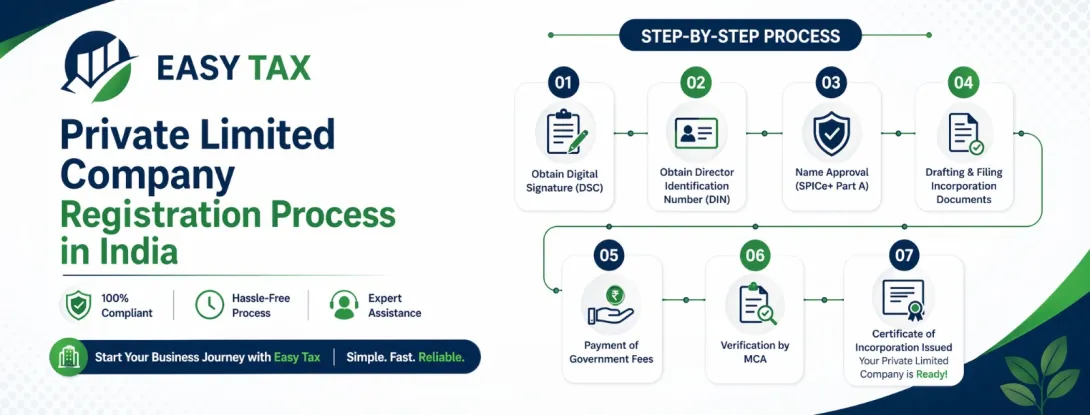
Private Limited Company Registration Process in India: Step by Step
Company incorporation is handled through the Ministry of Corporate Affairs. The central incorporation application is SPICe+, supported by linked forms and documents. The following steps describe the general process. The precise screens, attachments and filing sequence should be checked against the current MCA portal instructions.
01 Decide the company structure and ownership
Discuss the proposed business, founders, shareholding, initial capital, director appointments and registered-office state before preparing the application. Decide how shares will be distributed among the initial subscribers and ensure that the proposed ownership reflects the founders' actual agreement.
Also consider whether a private company is the right structure. A business with two or more owners may compare it with an LLP, while a sole founder may consider an OPC. EasyTax provides information about LLP registration for businesses evaluating that alternative.
02 Choose and check the proposed name
Prepare a name that is distinctive and consistent with the proposed business activity. Check for existing company and LLP names, relevant trademarks and MCA naming restrictions. A name that appears available in an informal search is not guaranteed to be approved by the Registrar.
SPICe+ Part A is used for name reservation. It may be filed separately for name reservation or together with Part B as part of the incorporation application. Where Part A is filed separately and approved, the name is reserved for the period specified by the MCA rules and guidance. Applicants should monitor the reservation expiry date and complete the next filing within the permitted period.
03 Obtain DSCs and prepare director details
Arrange DSCs for the subscribers and directors who are required to sign the incorporation documents. Collect accurate PAN, identity, address and contact details. Check whether any proposed director already has a DIN or needs to apply for one through the incorporation process.
04 Prepare the MoA and AoA
The MoA describes the company's name, state of registered office, objects, liability and share-capital details. The AoA contains rules governing the company's internal management, including matters such as share transfers, meetings and director powers.
These documents should be drafted to reflect the actual business and founder arrangements. Standardised clauses may not be appropriate where the company has multiple founders, special share rights, investor arrangements or a complex ownership structure.
05 Complete SPICe+ Part B
SPICe+ Part B contains the principal incorporation information. It includes details such as the proposed company structure, registered office, subscribers, directors, share capital, PAN and TAN information, declarations and required attachments.
Review every field carefully. Names, addresses, identity details, share allocations and registered-office evidence should be consistent across the application and its supporting documents.
06 Complete the linked incorporation forms
Depending on the company's circumstances, the linked forms may include e-MoA (INC-33), e-AoA (INC-34), the applicable declaration form and AGILE-PRO-S. Other forms or attachments may be required in specific cases, such as applications involving certain non-individual or foreign subscribers.
AGILE-PRO-S is linked to the incorporation process and covers specified registrations and services. GST registration is optional through this application where the applicant chooses it; whether GST registration is legally required depends separately on the GST law and the business's facts. Do not assume that every company must obtain GST registration merely because it is being incorporated.
See the MCA's official SPICe+ linked-filings FAQ and AGILE-PRO-S guidance for the current linked services and form sequence.
07 Sign and submit the incorporation application
Complete the required electronic signatures and professional certification. Upload the signed documents and submit the forms through the MCA portal. Pay the applicable filing fees and stamp duty shown by the portal for the particular application.
After submission, retain the Service Request Number (SRN), payment acknowledgement and copies of the submitted forms. Monitor the application dashboard and registered email for MCA communications.
08 Respond to resubmission or clarification requests
The Registrar may identify inconsistencies, missing attachments or other issues that require clarification or resubmission. If a query is raised, review the exact observations, correct the relevant information and submit the response within the time permitted by the MCA process.
Incorrect names, mismatched address evidence, incomplete declarations and inconsistent subscriber details can delay processing. A resubmission should address the specific observation rather than simply uploading the same documents again.
09 Receive the Certificate of Incorporation
Once the Registrar approves the application, the company is incorporated and receives its Certificate of Incorporation. The certificate includes the Corporate Identity Number (CIN). PAN and TAN are also communicated through the integrated incorporation process in accordance with MCA and Income Tax Department arrangements.
Check the certificate and company master data for errors in the company name, registered-office state, incorporation date and other particulars. Preserve the certificate and approved incorporation documents in the company's statutory records.
How Much Does Private Limited Company Registration Cost?
There is no single registration cost that applies to every private limited company. The amount payable depends on factors such as the proposed share capital, registered-office state, applicable stamp duty, MCA filing fees, name reservation choices, DSC requirements and professional assistance.
A complete cost estimate may include:
- MCA name reservation and incorporation filing charges, where applicable.
- State-specific stamp duty on incorporation documents.
- DSC issuance or renewal charges for the required signatories.
- Professional fees for preparing and reviewing incorporation documents.
- Additional costs for special circumstances, such as foreign subscribers or regulated business activities.
Check the current fee calculation and payment amount on the MCA portal before submitting the application. Do not rely on an old fee table or an online estimate that does not state the company capital, state and assumptions used.
How Long Does Company Registration Take?
The time required depends on name availability, the completeness and consistency of documents, DSC readiness, the nature of the proposed business, any resubmission and MCA processing. There is no universal guarantee that every application will be approved within a fixed number of working days.
Applicants can reduce avoidable delays by preparing the registered-office evidence, subscriber details, director information, MoA, AoA and declarations carefully before filing. They should also monitor the MCA dashboard and respond promptly to any resubmission request.
Any service-provider estimate should be treated as indicative and should clearly distinguish the provider's own preparation time from the time taken by MCA or another authority.
Important Compliance Requirements After Incorporation
Receiving the Certificate of Incorporation is not the end of the process. A newly incorporated company must complete certain initial statutory steps and then maintain its ongoing company, tax and business records.
01 Verify the registered office within 30 days
Under section 12 of the Companies Act, the company must have a registered office capable of receiving communications and notices. It must furnish verification of that office to the Registrar within 30 days of incorporation in the prescribed manner. The company should keep the supporting address records and ensure that the registered-office details remain accurate.
02 File the commencement-of-business declaration, where applicable
Under section 10A, a company incorporated with share capital after the relevant commencement of the provision must not commence business or exercise borrowing powers until the prescribed declaration has been filed within 180 days of incorporation and the registered-office verification requirement has been met. The declaration confirms that subscribers have paid the value of the shares they agreed to take.
The MCA uses Form INC-20A for this declaration. The requirement is subject to the statutory applicability conditions, so the company should confirm whether it applies to its circumstances.
03 Appoint the first auditor
For a company other than a Government company, the Board of Directors must appoint the first auditor within 30 days from the date of registration. If the Board does not make the appointment within that period, the members must be informed and appoint the auditor at an extraordinary general meeting within the period specified by section 139(6).
04 Hold the first Board meeting
Section 173 requires the company to hold its first Board meeting within 30 days of incorporation. The directors should address the initial business of the company, including statutory records, banking arrangements, share subscriptions and other applicable matters.
05 Issue share certificates and maintain statutory records
The company should complete its share allotment and share-certificate obligations in accordance with the Companies Act and applicable rules. It should maintain registers, minutes, accounting records and other statutory books as required. The exact requirements depend on the company's circumstances and applicable exemptions.
06 Review GST, tax and other registrations
Check whether GST registration is required based on the nature of supplies, turnover, location and applicable compulsory-registration provisions. Also assess any professional tax, Shops and Establishments, EPFO, ESIC, import-export, sectoral licence or local registration requirements relevant to the business.
EasyTax offers separate GST registration assistance for businesses that need help with the GST application process. GST registration should be assessed under GST law and not assumed to be compulsory for every newly incorporated company.
07 Plan annual ROC and tax compliance
Companies generally have continuing obligations relating to financial statements, annual returns, income-tax returns, accounting records, Board and member meetings and event-based ROC filings. The forms and due dates depend on the company's classification, financial year, transactions and applicable law.
For ongoing company filing support, see EasyTax's ROC filing services. The service scope should be checked against the company's actual annual and event-based filing requirements.
Common Mistakes to Avoid During Incorporation
Many incorporation delays arise from preventable errors. Founders should review the proposed name, subscriber information, director details and registered-office documents before filing.
- Choosing a name without adequate checks: A name may conflict with an existing company, LLP or trademark, or may not comply with MCA naming rules.
- Using inconsistent identity details: Names, dates of birth, PAN details and addresses should match the relevant records.
- Submitting incomplete office proof: The address evidence, owner consent and lease or rent documents should be consistent and legible.
- Preparing unclear MoA and AoA: The objects and internal rules should reflect the founders' actual business and ownership arrangements.
- Ignoring linked forms: SPICe+ and its linked filings should be completed in the sequence and format prescribed by MCA.
- Overlooking post-incorporation deadlines: Registration is followed by registered-office verification, the applicable commencement declaration, first auditor appointment and other statutory tasks.
- Assuming all registrations are automatic: PAN and TAN are integrated into incorporation, but GST and other registrations depend on their own laws and eligibility conditions.
Private Limited Company vs LLP vs One Person Company
The right business structure depends on the number of founders, fundraising plans, ownership arrangements, management preferences and compliance capacity. A private limited company is not automatically the best choice for every business.
| Factor | Private Limited Company | LLP | One Person Company |
|---|---|---|---|
| Owners | At least two members | At least two partners | One member, with statutory nominee requirements |
| Management | Board of Directors | Designated partners and partners | At least one director; one member |
| Ownership structure | Share capital and members | Partner contributions and LLP agreement | Single-member shareholding structure |
| Typical consideration | May suit businesses planning equity investment or multiple shareholders | May suit professional or closely held businesses seeking a partnership-based structure | May suit an eligible individual founder seeking a company structure |
This is a high-level comparison, not a substitute for legal or tax advice. Each structure has different incorporation, governance, tax and filing requirements. Review the LLP registration and OPC registration options before deciding.
How EasyTax Can Assist With Company Registration
Founders may choose to prepare the incorporation application themselves or seek professional support for document review, drafting, filing and post-incorporation planning. Professional assistance can be useful where there are multiple subscribers, foreign participants, complex shareholding arrangements or uncertainty about the applicable registrations.
EasyTax lists business registration, company compliance and ROC filing support through its services page. Before engaging any provider, confirm the exact scope, professional fees, government charges, documents required, expected provider-side timelines and what happens if MCA raises a resubmission or clarification.
No professional can guarantee MCA approval or a particular processing time. The application remains subject to the Registrar's review and applicable legal requirements.
Frequently Asked Questions
How many people are required to register a private limited company in India?
At least two persons are required to form a private limited company. The company must also have at least two directors. The same individuals may be subscribers and directors if they satisfy the relevant requirements.
Can a private limited company have only one director?
No. A private limited company must have at least two directors under section 149 of the Companies Act, 2013. An OPC has a different minimum-director requirement.
Can one person start a company in India?
An eligible individual may consider a One Person Company. An OPC is a separate type of private company with a single member and prescribed nominee requirements. It is not the same as a standard private limited company with two or more members.
Is a registered office compulsory?
Yes. A company must have a registered office capable of receiving official communications. Section 12 requires the registered office and its verification within 30 days of incorporation.
Is GST registration compulsory for every private limited company?
No. Incorporation does not automatically mean that every company must register under GST. GST applicability depends on the business's supplies, turnover, location and compulsory-registration provisions. The company should assess its position under the applicable GST law.
Does MCA issue PAN and TAN during company incorporation?
PAN and TAN are integrated into the SPICe+ incorporation process. Following approval, the Certificate of Incorporation communicates the allotted details in accordance with the MCA process.
How long does it take to register a private limited company?
There is no guaranteed timeline for every application. Processing depends on name approval, document completeness, DSC and filing readiness, resubmissions and MCA processing. Any estimate should be treated as indicative rather than a promise.
What is Form INC-20A?
Form INC-20A is the declaration of commencement of business under section 10A. It applies to companies having share capital that fall within the provision. The declaration must be filed within 180 days of incorporation, and the company must satisfy the registered-office verification requirement before commencing business or exercising borrowing powers.
Does company registration remove all personal liability?
No. Limited liability is subject to the Companies Act and other applicable laws. Personal guarantees, fraud, statutory defaults and other legal circumstances may create personal liability. Founders and directors should understand their responsibilities before incorporation.
Official Government References
The following primary sources should be consulted for the applicable law, current forms and filing requirements:
Conclusion
Private limited company registration in India involves checking eligibility, selecting a compliant name, preparing subscriber and director information, drafting the MoA and AoA, filing SPICe+ and its linked forms, and responding to any MCA observations. The process does not end with the Certificate of Incorporation. Registered-office verification, the applicable commencement declaration, first auditor appointment and continuing ROC and tax compliance should also be planned.
Before filing, founders should review the latest MCA instructions and obtain professional advice where the ownership structure, foreign participation, regulated activities or statutory obligations require additional consideration.
Was this guide helpful?
Related reading
Private Limited Company Registration Jaipur: Best CA Guide for Entrepreneurs
Learn private limited company registration in Jaipur, including eligibility, documents, SPICe+ steps, costs, GST, Udyam…
Private Limited Company Registration Cost in Jaipur — What It Actually Costs
Essential Aspects of Tax Most people searching for the cost of Private Limited Company Registration in Jaipur usually…

Can Freelancers Register a Private Limited Company in Jaipur? Complete Guide for 2026
Essential Aspects of Tax Can Freelancers Register a Private Limited Company in Jaipur ? Complete Guide for 2026 This…
Latest from the blog

SEO Agent connection test (temporary)
This is a temporary test post. It checks the connection between the EasyTax website and the SEO Agent publishing tool,…
Tax-Smart Tips for Salaried Employees: New Tax Regime
Tax-smart tips for salaried employees under the new tax regime: understand deductions, employer NPS, tax rebates,…
Tax-Smart Tips for Salaried Employees | EasyTax
Tax-smart tips for salaried employees under India’s new tax regime: compare deductions, employer NPS, rebates and…
EasyTax • Trusted by 10,000+ Clients
Company Registration in Jaipur
Incorporate your Private Limited, OPC or LLP in 7 days with complete SPICe+ filing, DIN, MOA/AOA & GST setup.