

Income-Tax Refund Delayed? Causes and Solutions in India
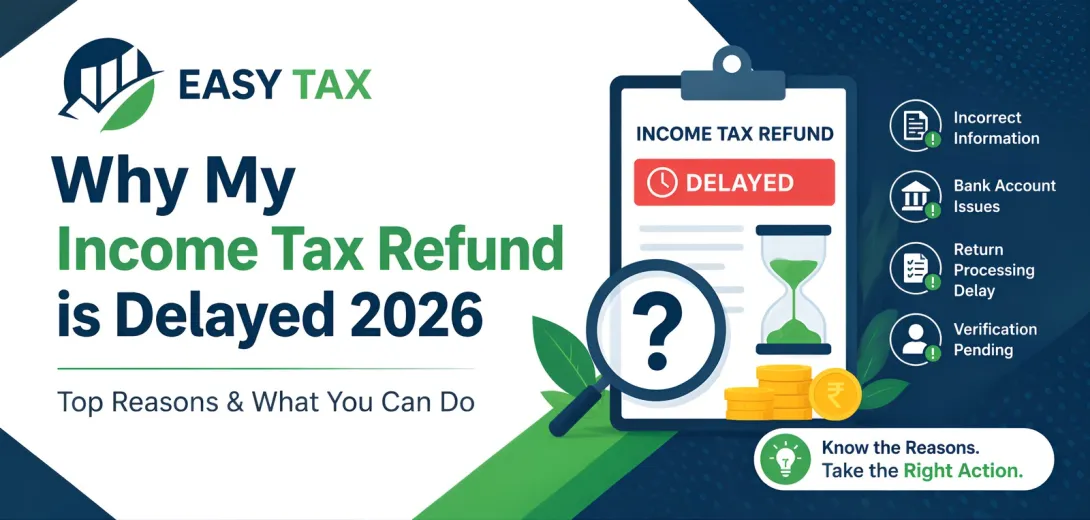
Why Is My Income Tax Refund Delayed? Causes and Solutions in India
Waiting for an income-tax refund can be frustrating, especially when you have filed your return, paid the applicable tax and expected the excess amount to be credited to your bank account. A delay does not necessarily mean that your refund has been rejected. It may be waiting for return verification, processing, an additional review, bank-account validation or resolution of an outstanding tax demand.
The first step is to identify exactly where your return stands. Filing an income-tax return, completing verification, processing the return, determining a refund and crediting that refund to a bank account are separate stages. Each stage can have a different reason for delay and a different remedy.
This guide explains why an income-tax refund may be delayed in India, how to check its status, what to do when a bank credit fails and how to request a refund reissue. It also explains the tax-law transition that applies from 1 April 2026.
Important: The official Income Tax Department e-Filing portal is incometax.gov.in. EasyTax is an independent tax-services provider and is not the Government's income-tax portal.
How Does the Income-Tax Refund Process Work?
An income-tax refund may arise when the tax paid or credited on behalf of a taxpayer exceeds the final tax liability determined under the applicable law. This can happen when an employer deducts more tax than ultimately payable, when advance tax payments exceed the final liability or when other eligible tax credits result in an excess payment.
However, the amount shown as a possible refund in a tax calculation is not necessarily the amount that will be credited. The Income Tax Department processes the return and determines the refund, if any, after considering the information reported and the applicable provisions.
It is useful to understand the different stages of the process:
| Stage | What it means | What you should check |
|---|---|---|
| Return filed | Your income-tax return has been submitted. | Confirm that the return was successfully submitted and save the acknowledgement. |
| Return verified | You have completed an approved verification method. | Check the verification date and status. |
| Return processing | The Department is processing the submitted return. | Review the portal for updates or communications. |
| Refund determined | The processing outcome shows a refund amount, subject to applicable adjustments. | Review the intimation and the final computation. |
| Refund issued | The Department has initiated the refund process. | Check the available refund-payment information and nominated bank account. |
| Refund failed | The attempted credit could not be completed. | Identify the failure reason and follow the refund-reissue procedure if available. |
| Refund adjusted | An amount may have been adjusted against an outstanding demand under the applicable procedure. | Review the communication and respond if you disagree with the demand. |
These stages should not be treated as interchangeable. For example, a return showing as processed does not automatically mean the refund has already reached your bank account. Similarly, a failed bank credit does not necessarily mean that the refund entitlement itself has been cancelled.
The Income Tax Department provides a Refund Status User Manual explaining how taxpayers can review their refund information.
How Long Does an Income-Tax Refund Take in India?
The time required for an income-tax refund depends on the return's verification, processing and payment status. According to the Income Tax Department's refund-status guidance, refunds usually take around four to five weeks to be credited after e-verification. This is general guidance, not a statutory guarantee that every refund will arrive within that period.
A return may take longer if it has not been verified, if the Department needs to process or examine information, if the return contains inconsistencies or if the nominated bank account cannot receive the payment.
The taxpayer should therefore check the actual status on the official portal instead of assuming that a refund is delayed simply because a particular number of days has passed.
If the usual period has passed and the refund has not arrived, first check whether the return was verified, whether processing is complete and whether any communication or refund failure message is available.
Do not rely on unofficial messages promising a fixed refund date or asking you to pay a fee to release a refund.
How to Check Your Income-Tax Refund Status Online
The official e-Filing portal allows taxpayers to view the status of filed returns and available refund information. Use the following process to investigate a delayed refund.
01 Open the official e-Filing portal
Visit www.incometax.gov.in and log in using your registered taxpayer account. Do not enter your PAN credentials or OTP on an unofficial website.
02 Open your filed-return information
Navigate to the section for viewing filed income-tax returns. Select the relevant assessment year or tax year and open the return details. The exact labels and navigation may change as the Department updates the portal.
03 Review the return status
Check whether the return is pending verification, successfully verified, under processing, processed or associated with a refund-related outcome. Read any available intimation or communication rather than relying only on a short status label.
04 Check the refund information
If the return has been processed and a refund has been determined, review the refund status and available payment details. If the payment failed, check the reason displayed by the portal before attempting a reissue.
05 Check your bank account and pending actions
Confirm that the account nominated for the refund is correctly entered and validated. Also review pending actions, outstanding demands and any communication that requires a response.
For further instructions, use the Department's official refund-status manual.
Common Reasons Why an Income-Tax Refund Is Delayed
01 The income-tax return has not been verified
Submitting a return is not the same as completing verification. The Department's refund guidance states that processing starts only after the return has been e-verified. If you filed the return but did not complete verification, the refund process may not move forward.
Check the verification status and complete an approved verification method if the return is still awaiting verification. If the prescribed period has passed, review the applicable delayed-verification procedure.
02 The return is still being processed
A return may remain under processing while the Department completes its checks. This does not automatically mean that the return has been selected for scrutiny or that a problem has been identified.
Check the portal for a processing update, an intimation or a specific communication. If the Department has requested information or a response, follow the instructions and deadline mentioned in that communication.
03 There is a mismatch in income or tax-credit information
Differences between the income reported in your return and information available to the Department may require attention. For example, salary figures, bank interest, dividend income, capital gains or tax deducted at source may not match your supporting records.
Review Form 16, bank statements, AIS and Form 26AS. Investigate differences before deciding whether a correction, response or other action is appropriate.
04 Your bank account is not validated
An invalid or unvalidated bank account can prevent a refund from being credited. The Department's guidance identifies issues such as an unvalidated account, a name mismatch and an invalid IFSC as possible refund-credit failure reasons.
Log in to the official portal and review the bank-account section. Confirm that the account details are correct, the account is active and the required validation has been completed. Also check whether the account is properly nominated for refund purposes.
05 Your bank account details have changed
If you have closed an account, changed banks or updated account details after filing, the nominated account may no longer be suitable for receiving the refund.
Review the bank accounts registered in your e-Filing profile. Add or update the correct account through the official portal and complete the required validation before requesting a refund reissue.
06 An outstanding tax demand may affect your refund
An outstanding tax demand may be considered for adjustment against a refund under the applicable legal process. The taxpayer should not assume that every demand shown on the portal is final or correct.
Review the demand details and the relevant communication. If you disagree, submit the appropriate response through the portal within the stated period and retain the acknowledgement.
07 The refund has been issued but the bank credit failed
Sometimes the Department initiates a refund but the payment cannot be credited to the nominated account. This is different from a return that is still being processed.
Check the refund failure reason. If the portal provides the refund-reissue facility and the bank details have been corrected and validated, follow the official reissue process.
08 The return contains incorrect or incomplete information
Incorrect income details, tax-credit claims, bank information or other return particulars can lead to processing differences or further communication. A taxpayer should compare the filed return with the source documents and the Department's processing intimation.
Do not submit a revised return or other response automatically. First establish whether the applicable law permits the proposed action and whether the relevant deadline is still open.
What to Do If Your Income-Tax Refund Is Delayed
The correct remedy depends on the stage at which the refund is delayed. Work through the following checks in order rather than submitting multiple requests without understanding the problem.
First, confirm that the return was successfully filed and verified
Open the filed-return section and check the acknowledgement and verification status. If verification is pending, complete it through an approved method. If the normal verification period has expired, read the Department's guidance on delayed verification and any required condonation request.
Next, review the processing result
If the return is still being processed, check whether the Department has issued any communication. If it has been processed, download and read the available intimation. Compare the income, deductions, tax credits and final computation with your records.
Then, check your bank account
Confirm that the account nominated for the refund is active, correctly entered and validated. Check the account holder's name and IFSC carefully. If the bank account has changed, update the information through the official portal and complete validation.
Review any outstanding demand
If the portal shows an outstanding demand or a proposed adjustment, read the details and decide whether the demand is correct. If you disagree, use the appropriate response facility and provide the supporting information requested.
Request refund reissue if the credit failed
If the Department's status indicates a failed refund and the reissue option is available, correct the bank details first. Then follow the official refund-reissue process and retain the acknowledgement or transaction reference.
Seek assistance if the issue remains unresolved
If the refund status is unclear, the processing result appears incorrect or a communication requires a technical or legal response, consider getting qualified assistance. Keep the filed return, acknowledgement, processing intimation, bank validation details and relevant tax statements ready.
For help with return-related discrepancies or departmental communications, taxpayers can review EasyTax Income Tax Notice Assistance. For support with return preparation and review, see EasyTax Expert-Assisted ITR Filing.
What If Your Income-Tax Refund Has Failed?
A failed refund means the payment could not be credited through the bank details used for the refund. It does not necessarily mean that the Department has withdrawn the refund amount. The reason for failure should be identified before taking further action.
Common issues include an unvalidated bank account, an incorrect account number, a name mismatch, an invalid IFSC or an account that cannot receive the payment.
How to request a refund reissue
Log in to the official e-Filing portal and review the refund status. If the status indicates a failed refund and the reissue facility is available, first confirm that the nominated bank account is correct and validated.
Then navigate to the refund-reissue service as directed by the portal. Select the relevant return or refund, choose the eligible validated bank account and submit the request. Follow any additional instructions shown on the portal and save the acknowledgement.
The availability of the reissue option depends on the refund status and the applicable portal process. Do not submit repeated requests if the portal does not permit another request or if the earlier request is still being processed.
For current instructions, refer to the Income Tax Department's Refund Reissue User Manual.
How to validate your bank account
Use the My Bank Account facility on the official e-Filing portal to review registered accounts. Confirm that the account number, account holder name, IFSC and other details are correct. Complete the validation process displayed by the Department.
Only nominate an account that is eligible to receive the refund. If your bank account has been closed or changed, update the details before attempting a reissue.
Read the Department's My Bank Account User Manual for the current process.
How Do Outstanding Tax Demands Affect Income-Tax Refunds?
An outstanding tax demand may affect the amount of refund credited to a taxpayer. Under the applicable procedure, the Department may adjust a refund against an outstanding demand after following the required process.
When a taxpayer receives a communication proposing an adjustment, the demand should be reviewed carefully. Check the assessment year or tax year, amount, reason for the demand and whether the amount has already been paid or otherwise resolved.
If you agree with the demand, follow the payment or response instructions available on the portal. If you disagree, submit the appropriate response and provide relevant supporting details. For example, if the demand relates to a tax payment already made, retain the challan and payment information.
Do not ignore a proposed adjustment. A taxpayer who disagrees with a demand should respond within the period stated in the communication and keep a copy of the submission.
The Income Tax Department provides guidance through its Response to Outstanding Demand service.
How AIS and Form 26AS Can Affect Refund Calculations
The Annual Information Statement (AIS) contains financial information reported by specified sources. It may include information relating to interest, dividends, securities transactions and other reportable items. Taxpayers should review AIS and compare the entries with their own records.
Form 26AS and AIS are related but serve different purposes. From AY 2023–24 onwards, Form 26AS primarily displays TDS and TCS information, while other reported financial information is available through AIS.
For example, if your bank has reported interest income that is missing from your return, the difference may affect the computation. Similarly, if TDS appears in your records but is not reflected in the expected tax-credit information, the discrepancy should be investigated.
Taxpayers can submit feedback on eligible AIS entries through the portal. However, providing feedback does not remove the responsibility to report taxable income correctly. Review each entry and retain supporting records.
For detailed information, see the official AIS FAQs.
Why Is Income-Tax Return Verification Important?
After submitting an income-tax return, the taxpayer must complete verification through an approved method. The Income Tax Department's guidance provides a period of 30 days from filing for e-verification or submission of the applicable ITR-V.
Available verification methods may include Aadhaar OTP, Electronic Verification Code (EVC), net banking and Digital Signature Certificate (DSC), depending on eligibility and the facilities available to the taxpayer.
If the return is not verified within the prescribed period, the taxpayer may need to follow the delayed-verification and condonation procedure. An unverified return should not be assumed to be valid merely because it was uploaded successfully.
After verification, save the confirmation and check the return status again. This is an important step before investigating why a refund has not been processed.
Read the Department's e-Verify User Manual and ITR-V FAQs for current instructions.
Income-Tax Refund Rules During the 2026 Tax-Law Transition
India's Income-tax Act, 2025 came into effect on 1 April 2026. This change introduced the Tax Year framework for income periods beginning on or after that date. However, the earlier Income-tax Act, 1961 continues to apply to earlier tax years and relevant transitional proceedings.
This distinction matters when investigating refunds because the applicable legal provisions depend on the tax period to which the return relates.
| Income period | Relevant terminology | Applicable legislation |
|---|---|---|
| 1 April 2025 to 31 March 2026 | FY 2025–26 / AY 2026–27 | Income-tax Act, 1961 |
| 1 April 2026 to 31 March 2027 | Tax Year 2026–27 | Income-tax Act, 2025 |
A refund relating to FY 2025–26 / AY 2026–27 should generally be considered under the 1961 Act and its applicable procedures. A refund relating to Tax Year 2026–27 is governed by the 2025 Act, subject to its provisions and transitional rules.
Taxpayers should avoid using an old section number or an earlier year's procedure without checking the relevant tax period. The official portal supports filing and related services under both Acts during the transition.
For the statutory transition, read the Income Tax Department's Income-tax Act, 2025 FAQs.
Can You Receive Interest on a Delayed Income-Tax Refund?
Interest may be payable on certain income-tax refunds under the applicable law. However, interest is not automatically payable in every case merely because a taxpayer believes that a refund has taken longer than expected.
Eligibility, the period for which interest is calculated and the amount depend on the applicable statutory provisions and the facts of the case. The relevant law may also distinguish between different reasons for the refund and different circumstances affecting its calculation.
For earlier tax periods governed by the Income-tax Act, 1961, section 244A deals with interest on refunds, subject to its conditions. For tax years governed by the Income-tax Act, 2025, the corresponding refund-interest provisions are contained in section 437.
If the refund intimation does not appear to include interest that you believe is due, review the applicable provision and the processing calculation. A qualified tax professional can help assess whether a correction or other permitted action is appropriate.
Do not assume that every processing delay creates an automatic right to a fixed interest amount. Check the relevant tax period, statutory conditions and official computation.
Common Mistakes to Avoid When Following Up on a Delayed Refund
Assuming that filing means verification is complete: A return must be verified through an approved method. Check the portal rather than assuming that successful submission is enough.
Relying on a fixed refund deadline: The Department's usual 4–5 week guidance is not a guaranteed payment date. Review the actual return and refund status.
Ignoring bank-account validation: Incorrect account details or an unvalidated account can prevent a refund from being credited. Confirm the nominated account before requesting reissue.
Ignoring outstanding-demand communications: Read any proposed adjustment and respond within the period stated in the communication if you disagree.
Confusing AIS with Form 26AS: Review both for their respective purposes and reconcile the information with your records.
Submitting repeated requests without checking the status: Before raising another request, check whether an existing refund reissue or other service request is still pending.
Sharing sensitive credentials: Never share your password or OTP with someone claiming to release a refund. Use the official portal and its authorised facilities.
Making corrections without checking the applicable law: A revised return, rectification request or other response may have specific eligibility conditions and deadlines. Identify the correct remedy before submitting it.
Frequently Asked Questions About Delayed Income-Tax Refunds
01 Why is my income-tax refund delayed?
A refund may be delayed because the return has not been verified, processing is incomplete, income or tax-credit information needs attention, bank details are invalid or the refund has failed. Check the actual status on the official e-Filing portal to identify the relevant issue.
02 How long does an income-tax refund usually take?
The Income Tax Department's guidance says refunds usually take around four to five weeks to be credited after e-verification. This is general guidance and not a guaranteed deadline for every taxpayer.
03 Does a processed return mean that my refund has been credited?
No. Processing and bank credit are separate stages. Check whether a refund has been determined, issued, adjusted or returned as failed.
04 What should I do if my refund has failed?
Check the failure reason, correct the bank details and ensure that the nominated account is validated. If the portal provides the refund-reissue facility, follow the official procedure and save the acknowledgement.
05 Can an invalid bank account delay my income-tax refund?
Yes. An unvalidated account, incorrect account details, name mismatch or invalid IFSC may prevent the refund from being credited. Check the My Bank Account facility on the official portal.
06 Can an outstanding tax demand reduce my refund?
An outstanding demand may be adjusted against a refund under the applicable process. Review the demand and any proposed adjustment communication. If you disagree, submit the appropriate response within the stated period.
07 Is e-verification compulsory after filing an ITR?
Yes. A return must be verified through an approved method within the prescribed period. The Department's guidance provides 30 days from filing for e-verification or submission of ITR-V.
08 What happens if I do not verify my ITR within 30 days?
Delayed verification may affect the treatment and validity of the return. The taxpayer may need to follow the applicable condonation-of-delay procedure. Refer to the current Department guidance for the correct steps.
09 Can I check my refund status without a tax professional?
Yes. You can log in to the official e-Filing portal and review the filed-return and refund information yourself. Professional assistance may be useful if the status is unclear, a demand is disputed or a complex correction is required.
10 Does AIS affect my income-tax refund?
AIS may contain information about financial transactions that should be reconciled with your return. A mismatch may require investigation, but an AIS entry should be reviewed in context rather than automatically treated as an additional tax liability.
11 Can I receive interest if my refund is delayed?
Interest may be payable where the applicable statutory conditions are met. The relevant law and calculation depend on the tax period and the facts of the refund. It is not automatically payable in every delayed-refund situation.
12 Can I request a refund reissue if my bank account has changed?
If the refund credit has failed and the reissue facility is available, update and validate an eligible bank account and follow the portal's refund-reissue process. Check the official manual before submitting the request.
13 Is EasyTax the official Income Tax Department portal?
No. EasyTax is an independent tax-services provider. The official Government e-Filing portal is incometax.gov.in.
Official Government Sources and Further Reading
The following official resources explain refund processing, bank validation, refund reissue, outstanding demands and return verification. Use the latest Department instructions if portal navigation changes.
Income Tax Department – Official e-Filing Portal
Response to Outstanding Demand
Conclusion: How to Resolve an Income-Tax Refund Delay
If your income-tax refund is delayed, start by checking the status of your filed return on the official e-Filing portal. Confirm that the return has been verified, review the processing outcome, check for outstanding demands and validate the nominated bank account.
If the Department has determined a refund but the bank credit has failed, identify the reason and follow the official refund-reissue process if it is available. If an outstanding demand or processing communication is involved, read the details carefully and respond within the applicable period.
Remember that a refund delay does not always mean that the refund has been rejected. The appropriate next step depends on the stage of the process and the information shown on your account.
If you need help reviewing a return discrepancy or understanding a tax communication, explore EasyTax Income Tax Notice Assistance. For assistance with return preparation and review, visit EasyTax Expert-Assisted ITR Filing.
You can also explore the EasyTax Tax Planning service for assistance with tax planning and related questions.
Disclaimer
This article is for general educational and informational purposes only. It does not constitute legal, financial or tax advice and does not guarantee a refund, a particular processing timeline or a specific tax outcome. Refund eligibility, processing, interest and adjustment depend on the taxpayer's facts, applicable tax period, statutory provisions and the Income Tax Department's actions.
Always verify your refund status and follow-up options through the official Income Tax Department portal. Consult a qualified tax professional where a demand is disputed, a statutory response is required or the refund calculation appears incorrect.
Tax-law coverage: This article discusses refund procedures under the Income-tax Act, 1961 for earlier tax periods and the Income-tax Act, 2025 for tax years beginning on or after 1 April 2026, subject to transitional provisions.
Last reviewed: 24 November 2026.
Reviewed by: Retain the existing CA reviewer attribution only after the reviewer has reviewed and approved this exact revised article.
Was this guide helpful?
Related reading
Tax-Smart Tips for Salaried Employees: New Tax Regime
Tax-smart tips for salaried employees under the new tax regime: understand deductions, employer NPS, tax rebates,…
Tax-Smart Tips for Salaried Employees | EasyTax
Tax-smart tips for salaried employees under India’s new tax regime: compare deductions, employer NPS, rebates and…
Revised Form 161: CBDT Notification 134/2026 Explained
Income Tax · India · Tax update Revised Form 161: CBDT Notification 134/2026 Explained Updated: 19 November 2026 ·…
Latest from the blog
SEO Agent connection test (temporary)
This is a temporary test post. It checks the connection between the EasyTax website and the SEO Agent publishing tool,…

The Complete Guide to the Bank Audit Process
Home / Blog / Tax compliance EasyTax · Tax compliance guide Tax Compliance in India: Income Tax, GST & TDS Tax…

Ca Services for Startups: What We Offer and Why It Matters
Home › Blog › Startup & CA Startup & CA CA Services for Startups in India: What Founders Need and Why It Matters From…
EasyTax • Trusted by 10,000+ Clients
Expert Assisted ITR Filing
Dedicated CA prepares, verifies, and files your ITR. Maximum refund, accurate deductions, zero notices.