
What Happens If You Don’t File ITR on Time? Full Guide
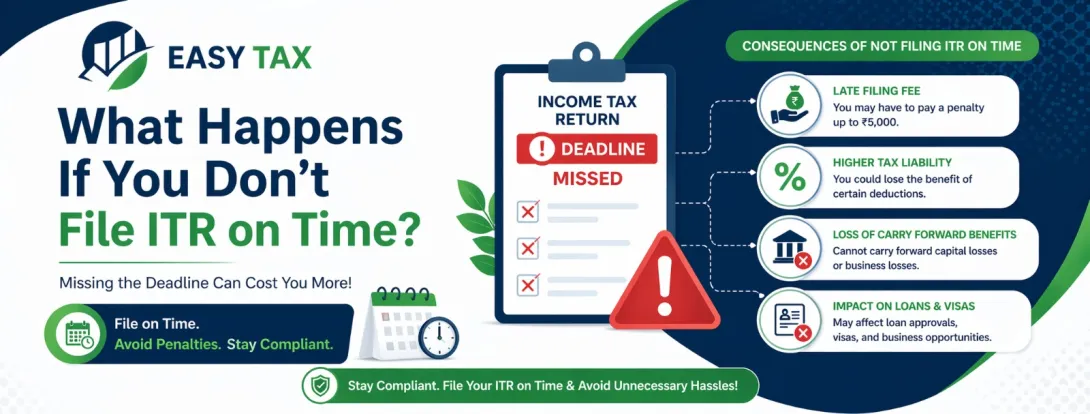
What Happens If You Don’t File ITR on Time? Fees, Interest and Remedies in India
Missing an income tax return deadline can lead to a late-filing fee, interest on unpaid tax and restrictions on carrying forward certain losses. However, the consequences depend on your income, the applicable assessment year, the tax payable and how late you file.
If you have missed the original deadline, do not assume that you can no longer file your return. Indian income tax law provides options such as a belated return, an updated return in eligible cases and, in limited circumstances, a request for condonation of delay.
If you do not file ITR on time, the late-filing fee, interest and next steps depend on your assessment year and tax position.
Important tax-year note: This guide primarily explains the rules for FY 2025–26, which is reported as Assessment Year (AY) 2026–27 under the Income-tax Act, 1961. Income earned from 1 April 2026 onwards falls under Tax Year 2026–27 and the Income-tax Act, 2025. The two filing frameworks should not be confused.
Key takeaways: What happens if you file your ITR late?
- A late-filing fee may apply under Section 234F of the Income-tax Act, 1961 for AY 2026–27.
- Interest may be payable on outstanding tax under Section 234A, depending on the taxpayer’s circumstances.
- Late filing can restrict the carry-forward of certain business and capital losses.
- A belated return may still be filed within the statutory time limit.
- An updated return or condonation request may be available in specific circumstances, but neither is a universal substitute for a belated return.
- Receiving a notice or facing prosecution is not an automatic consequence of every delayed return. The facts and statutory conditions matter.
01 Which income tax law applies to your late ITR?
The applicable law depends on the period in which you earned the income. This distinction is especially important during the transition to the Income-tax Act, 2025.
| Income period | Return period | Applicable law |
|---|---|---|
| FY 2025–26 | AY 2026–27 | Income-tax Act, 1961 |
| 1 April 2026 to 31 March 2027 | Tax Year 2026–27 | Income-tax Act, 2025 |
For income earned during FY 2025–26, you must select AY 2026–27 on the Income Tax Department portal. The fact that you file the return after 1 April 2026 does not move that return to the new Act.
For Tax Year 2026–27 onwards, the new Act applies. Its return-filing provisions are principally contained in Section 263, while the late-filing fee is covered by Section 428.
Always confirm the assessment year or tax year before filing. Choosing the wrong period can result in an incorrect return or payment allocation.
Official reference: Income Tax Department – Income Tax Returns FAQs.
02 What is the last date to file a belated ITR for AY 2026–27?
If you were required to file an income tax return for FY 2025–26 but missed your applicable original due date, Section 139(4) of the Income-tax Act, 1961 allows a belated return to be filed.
For AY 2026–27, the belated return deadline is 31 December 2026, or before completion of the assessment, whichever is earlier.
This is the belated-return deadline, not the original due date. Original due dates differ according to the taxpayer category and applicable audit requirements. CBDT also extended the AY 2026–27 deadline to 21 November 2026 for the specified audit-category taxpayers covered by Circular No. 07/2026.
If you are reading this after the applicable deadline, check whether an updated return or a condonation request is legally available for your circumstances. Do not assume that the belated-return facility remains open.
Official references:
03 Late ITR filing fee under Section 234F
For AY 2026–27, Section 234F of the Income-tax Act, 1961 provides a fee for filing the return after the prescribed due date. The amount depends on the taxpayer’s total income.
| Total income | Late-filing fee |
|---|---|
| Does not exceed ₹5 lakh | ₹1,000 |
| Exceeds ₹5 lakh | ₹5,000 |
The amount is commonly called an ITR late-filing penalty, but the correct statutory term under Section 234F is a fee.
Illustrative examples:
- If your total income is ₹4.5 lakh and Section 234F applies, the late-filing fee is ₹1,000.
- If your total income is ₹8 lakh and Section 234F applies, the late-filing fee is ₹5,000.
These examples illustrate only the late-filing fee. They do not include tax payable, interest or any other amount that may apply to an individual case.
For returns under the Income-tax Act, 2025, Section 428 provides the late-filing fee for Tax Year 2026–27 onwards. The corresponding amounts are ₹1,000 where total income does not exceed ₹5 lakh and ₹5,000 in other cases.
Official reference: Income Tax Department – Late-filing fee FAQs.
04 Interest on unpaid tax under Section 234A
A late-filing fee and interest are different liabilities. The fee under Section 234F relates to delayed filing. Interest under Section 234A may apply when tax remains payable and the return is filed after the applicable due date.
For AY 2026–27, Section 234A of the Income-tax Act, 1961 generally provides interest at 1% for every month or part of a month for the relevant period of delay. The calculation is based on the tax payable after taking account of eligible tax payments and credits, including advance tax and tax deducted or collected at source, as provided by law.
The actual interest depends on the taxpayer’s tax liability, payment dates and applicable statutory adjustments. A taxpayer who has already paid all relevant taxes may have a different interest position from someone who still has outstanding tax.
For Tax Year 2026–27 under the Income-tax Act, 2025, refer to the corresponding interest provisions, including Section 423. Do not apply the new Act’s section numbers to an AY 2026–27 return.
Before filing, reconcile your tax payments and credits with Form 26AS and the Annual Information Statement (AIS). You can use the EasyTax Income Tax Calculator to help estimate your tax liability. The final interest calculation should be based on the applicable law and your actual payment history.
05 Can late filing affect your ability to carry forward losses?
Yes. Missing the due date can affect the ability to carry forward certain losses to future years. However, the restriction does not apply identically to every type of loss.
Under the Income-tax Act, 1961, the timely filing conditions in Sections 80 and 139(3) are relevant to carrying forward specified losses, including eligible business losses and capital losses. If the loss return is filed late and the statutory conditions are not met, the taxpayer may lose the right to carry forward those losses.
House-property losses have a different statutory treatment. Do not assume that every loss is automatically disallowed simply because the return is late. The head of income, the relevant provision and the conditions for carrying forward the loss must be checked.
The Income-tax Act, 2025 also contains transitional rules for eligible losses from earlier years. Section 536 preserves specified brought-forward losses in accordance with the conditions and treatment under the earlier law. It does not automatically restore a loss that was ineligible for carry-forward under the old Act.
Official reference: Income Tax Department – Set-off and Carry-forward of Losses FAQs.
06 Can late filing delay your income tax refund?
Filing late can delay the start of return processing and, consequently, the processing of a refund. A refund is not guaranteed merely because a return has been submitted. The return must be processed and the refund claim must be accepted after applicable adjustments and verification.
Before expecting a refund, check that:
- Your bank account details are correct and the account is validated as required.
- Your return has been successfully submitted and e-verified.
- Your TDS and tax-payment details reconcile with Form 26AS and AIS.
- You have responded to any outstanding portal communication or defective-return notice.
If you are filing after the ordinary deadline, do not assume that you can use an updated return to create a new refund claim or increase an existing refund. Updated-return restrictions must be checked before choosing that route.
07 Can you receive an income tax notice for not filing ITR?
The Income Tax Department may contact a taxpayer who has not filed a return despite having a filing obligation. A communication may also arise from reported financial transactions, information available to the Department or a mismatch between reported income and tax records.
However, a notice is not automatically issued to every person who files late, and receiving a notice does not by itself establish wrongdoing. Read the notice carefully and identify:
- The assessment year or tax year mentioned in the communication.
- The relevant section and the reason for the communication.
- The response deadline and the action requested.
- Whether a return, explanation, payment, rectification or supporting document is required.
Do not ignore a notice. Missing the response deadline can lead to further proceedings or an adverse assessment depending on the applicable law and facts.
If you have received a notice, EasyTax provides Income Tax Notice Assistance to help review the communication and prepare an appropriate response.
08 What should you do if you have not filed your ITR on time?
The correct next step depends on whether the belated-return window is still open and whether you have already filed a return for that year.
01 Identify the correct assessment year
Confirm the financial year in which the income was earned. For FY 2025–26, select AY 2026–27. Do not select Tax Year 2026–27 for income earned before 1 April 2026.
02 Check whether you are required to file a return
Review the applicable filing obligation, income details and statutory conditions. Filing requirements may apply even where tax deducted at source appears to cover the tax liability.
03 Collect and reconcile your documents
Keep your PAN, bank details, salary or business-income records, Form 16 where applicable, interest certificates, investment and deduction information, Form 26AS, AIS and details of advance-tax payments ready.
04 Calculate tax, fee and interest
Calculate the tax payable after eligible credits and payments. Check whether the late-filing fee and interest apply to your case. Pay the correct amount using the appropriate assessment year and payment category.
05 File the belated return if the window is open
For AY 2026–27, a belated return may generally be filed by 31 December 2026, or before completion of assessment, whichever is earlier. Use the correct ITR form and report all applicable income and deductions accurately.
06 Submit and e-verify the return
After submission, complete e-verification using an available method on the e-filing portal. Save the acknowledgement and payment challans for your records. A return that has not been verified as required may not be treated as a validly filed return.
For professional assistance, explore EasyTax Expert-Assisted ITR Filing.
09 What if the belated-return deadline has already passed?
If the belated-return deadline has expired, you should not simply attempt to file an ordinary belated return. Depending on the year and facts, two possible routes may need to be considered: an updated return or a request for condonation of delay.
Option A: Updated return (ITR-U)
An updated return under Section 139(8A) of the Income-tax Act, 1961 may be available for eligible assessment years, subject to the statutory time limit, additional tax and other restrictions.
An updated return is generally intended to disclose additional income or correct an omission that increases the tax payable. It cannot be used to:
- File a return of loss.
- Reduce the tax liability determined on the basis of an earlier return.
- Claim a new refund or increase an existing refund.
Additional income tax may apply, and eligibility depends on the taxpayer’s filing history and the statutory exclusions. Check the current portal requirements and the relevant provision before filing.
Option B: Condonation of delay
In certain cases involving genuine hardship, a taxpayer may request condonation of delay under Section 119(2)(b) of the Income-tax Act, 1961, particularly where the request concerns a refund claim or carry-forward of losses covered by the applicable CBDT guidelines.
Condonation is not automatic. The Department may consider the reason for delay, supporting evidence, monetary limits and applicable instructions. A request may be rejected if the explanation or supporting documents are inadequate.
Official guidance: Income Tax Department – Filing ITR after Condonation of Delay.
10 Does not filing ITR on time always lead to prosecution?
No. It is incorrect to suggest that every taxpayer who misses an ITR deadline will automatically face prosecution.
Failure to file a return can have different consequences depending on whether the person was legally required to file, the tax involved, the period of default, the notices received and the statutory conditions. Serious or wilful non-compliance may attract additional consequences under the applicable law, but those consequences should not be confused with the ordinary late-filing fee.
If you have received a prosecution-related communication or a formal notice, obtain professional advice promptly and respond within the stated time.
11 Common mistakes to avoid when filing a belated ITR
- Selecting the wrong year: Confirm the correct assessment year or tax year before starting the return.
- Ignoring AIS or Form 26AS differences: Reconcile salary, interest, TDS, capital gains and other reported transactions.
- Forgetting additional income: Include all taxable income, not only salary or business receipts.
- Claiming unsupported deductions: Claim only deductions and exemptions available under the chosen tax regime and supported by the relevant conditions.
- Assuming all losses can be carried forward: Check the rules for the specific category of loss.
- Not paying the correct amount: Reconcile tax, fee and interest before submitting the return.
- Skipping e-verification: Complete verification and retain the acknowledgement.
- Ignoring a notice: Check the communication and respond within the deadline.
12 How EasyTax can help with late ITR filing
Late filing can involve more than submitting a form. You may need to reconcile income information, check tax credits, calculate interest, identify the correct filing route and respond to a notice.
EasyTax offers professional support for eligible ITR filing and tax-compliance requirements. Depending on your situation, you can explore:
- Expert-Assisted ITR Filing for return preparation and filing support.
- Income Tax Notice Assistance if you have received a communication from the Department.
- Tax Planning and Advisory for reviewing tax positions and planning future compliance.
- Income Tax Calculator to estimate your tax liability.
- EasyTax Services to explore other tax and compliance support.
Professional assistance can help you understand the available filing route and prepare the required information. The final tax outcome depends on your facts and the applicable law; no service can guarantee a refund, acceptance of a condonation request or absence of notices.
Need help with a missed deadline? Speak with EasyTax about expert-assisted ITR filing.
Frequently asked questions about late ITR filing
01 Can I file my ITR after the due date?
Yes, if the belated-return window is still open and the statutory conditions are met. For AY 2026–27, the general belated-return deadline is 31 December 2026 or before completion of assessment, whichever is earlier.
02 What is the late ITR filing fee for AY 2026–27?
Under Section 234F, the fee is ₹1,000 where total income does not exceed ₹5 lakh and ₹5,000 in other cases, subject to the provision’s applicability.
03 Is late-filing fee the same as interest?
No. The late-filing fee under Section 234F is separate from interest under Section 234A, which may apply where tax remains payable after the due date.
04 Can I file a belated return after 31 December 2026?
Ordinarily, the Section 139(4) belated-return window for AY 2026–27 ends on 31 December 2026 or earlier completion of assessment. After that, check whether an updated return or a condonation request is legally available. These routes have separate conditions and limitations.
05 Will I lose my refund if I file late?
Not necessarily. A refund claim may still be processed if it is legally admissible and the return is validly filed. However, delay can postpone processing, and an updated return cannot be used to create or increase a refund.
06 Can I carry forward business losses if I file my ITR late?
Specified business losses generally require compliance with the applicable timely-filing conditions. A late return may prevent those losses from being carried forward. The exact result depends on the type of loss and statutory provision.
07 Can I file ITR-U if I did not file my original return?
An updated return may be available even where an original return was not filed, but only if the statutory conditions are satisfied. It cannot be used to report a loss, reduce tax liability or claim or increase a refund.
08 Will the Income Tax Department send me a notice if I file late?
A notice is possible in certain circumstances, especially where a person was required to file or where information indicates a potential tax issue. However, a notice is not automatically issued to every late filer.
09 Do I need to e-verify a belated ITR?
Yes. Complete the applicable e-verification process after submitting the return and retain the acknowledgement. Follow the portal instructions and applicable verification time limit.
10 Which Act applies to income earned in FY 2025–26?
Income earned in FY 2025–26 is reported in AY 2026–27 under the Income-tax Act, 1961, even though the return may be filed after 1 April 2026.
Official references and further reading
Disclaimer
This article is for general information about Indian income tax return filing. Tax treatment, filing obligations, deadlines, fees, interest and available remedies depend on the relevant assessment year or tax year and the taxpayer’s circumstances. Laws, notifications, circulars and portal procedures may change. Verify the latest official guidance or consult a qualified Chartered Accountant or tax professional before acting on your specific case.
Last reviewed: 24 November 2026
Was this guide helpful?
Related reading
Tax-Smart Tips for Salaried Employees: New Tax Regime
Tax-smart tips for salaried employees under the new tax regime: understand deductions, employer NPS, tax rebates,…
Tax-Smart Tips for Salaried Employees | EasyTax
Tax-smart tips for salaried employees under India’s new tax regime: compare deductions, employer NPS, rebates and…
Revised Form 161: CBDT Notification 134/2026 Explained
Income Tax · India · Tax update Revised Form 161: CBDT Notification 134/2026 Explained Updated: 19 November 2026 ·…
Latest from the blog
SEO Agent connection test (temporary)
This is a temporary test post. It checks the connection between the EasyTax website and the SEO Agent publishing tool,…

The Complete Guide to the Bank Audit Process
Home / Blog / Tax compliance EasyTax · Tax compliance guide Tax Compliance in India: Income Tax, GST & TDS Tax…

Ca Services for Startups: What We Offer and Why It Matters
Home › Blog › Startup & CA Startup & CA CA Services for Startups in India: What Founders Need and Why It Matters From…
EasyTax • Trusted by 10,000+ Clients
Expert Assisted ITR Filing
Dedicated CA prepares, verifies, and files your ITR. Maximum refund, accurate deductions, zero notices.