

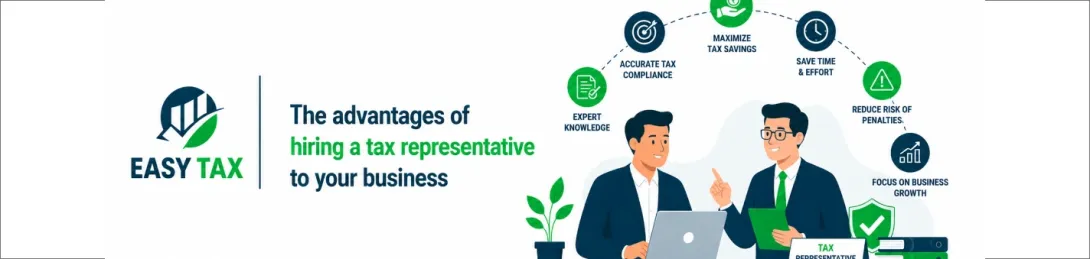
The advantages of hiring a tax representative to your business
Why Should Your Business Hire a Tax Consultant in India?
Managing a business involves more than sales, employees and daily operations. Business owners must also maintain financial records, understand applicable tax obligations, prepare returns and respond to notices when required.
A qualified tax professional can help a business understand these responsibilities, organise financial information and make informed tax decisions. The right professional may also assist with communication and representation before tax authorities, where legally authorised.
This guide explains what a business tax consultant does, the advantages of professional assistance, when representation may be necessary and what to check before hiring someone.
01 What Does a Business Tax Consultant Do?
A business tax consultant helps an organisation understand and manage tax-related responsibilities. The scope of work depends on the business structure, transactions, applicable laws and engagement agreed with the professional.
Depending on their qualifications and engagement, services may include:
- Reviewing income and expense records.
- Assisting with income-tax return preparation and filing.
- Explaining applicable tax provisions and compliance requirements.
- Reviewing GST registration and return-filing obligations.
- Assisting with applicable TDS and related reporting.
- Reviewing supporting documents and financial reconciliations.
- Explaining tax notices and helping prepare responses.
- Advising on tax planning within the applicable law.
- Coordinating with other professionals where specialist advice is required.
Not every consultant provides every service. Before engaging a professional, confirm their qualifications, experience, scope of work and authority to perform the specific task.
02 Benefits of Hiring a Tax Consultant for Your Business
2.1 Better understanding of tax obligations
Tax requirements can differ depending on whether a business is a proprietorship, partnership, LLP or company. They may also depend on turnover, the nature of transactions, employee payments and other business activities.
A tax professional can help identify which obligations apply and explain the records, filings and procedures that the business should review.
2.2 Organised financial records and documentation
Incomplete invoices, unclassified expenses, missing payment records and differences between accounting data and tax statements can make compliance more difficult.
A consultant may help review and organise documents such as:
- Sales invoices and purchase records.
- Bank statements and payment details.
- Expense vouchers and supporting bills.
- Payroll and employee-payment records.
- GST returns and reconciliations, where applicable.
- TDS statements and tax-payment records, where applicable.
Good documentation supports the preparation of returns and makes it easier to explain reported transactions if questions arise later.
2.3 Tax planning based on business circumstances
Tax planning involves reviewing the business's financial position and considering the tax treatment of transactions before decisions are made.
A professional may help assess:
- The tax implications of business expenditure.
- The treatment of eligible capital assets and depreciation.
- The timing and documentation of business transactions.
- Applicable deductions, allowances and exemptions.
- The tax implications of business restructuring.
2.4 Support with income-tax return preparation
Businesses may have to report income from business or profession, capital transactions and other applicable sources. The correct return and reporting requirements depend on the taxpayer's legal structure and circumstances.
A tax professional can help organise financial information, review relevant tax statements, identify missing details and prepare a return for the taxpayer's review and approval.
The business should check the final computation and return details before authorising submission. Professional assistance does not remove the taxpayer's responsibility to provide complete and accurate information.
2.5 Assistance with GST compliance
Businesses covered by GST requirements may need help with registration, invoice review, return preparation, payment reconciliation and input tax credit checks.
GST obligations are not identical for every business. Registration and filing requirements depend on the CGST Act, applicable notifications, the nature of supplies and the taxpayer's circumstances.
A professional can help assess the applicable requirements and identify differences between books, invoices and information available on the GST portal.
For the statutory framework, consult the Central Goods and Services Tax Act, 2017 and applicable notifications and rules.
2.6 Help with applicable TDS obligations
Certain payments made by a business may attract tax deduction at source (TDS), depending on the nature of payment, the payer and recipient, applicable thresholds and other statutory conditions.
A consultant may help identify relevant transactions, review deductions, organise supporting information and assist with applicable statements and reconciliations.
Businesses should not assume that every payment attracts TDS or that the same rate applies to all transactions. The applicable provision and current rules must be checked.
2.7 Assistance in understanding tax notices
A tax notice may ask for clarification, supporting documents, a response to a mismatch or information about a particular transaction.
A tax professional may help the business:
- Identify the issuing authority and the relevant tax period.
- Understand the issue raised in the notice.
- Collect supporting records and documents.
- Prepare a factual response where engaged to do so.
- Track applicable response requirements and proceedings.
The correct response depends on the facts and the applicable law. Hiring a consultant does not guarantee that a notice will be withdrawn or that a penalty will not be imposed.
2.8 More time for business operations
Collecting records, reconciling accounts and preparing tax information can take time. Delegating agreed compliance work to a competent professional may help business owners concentrate on customers, employees and operations.
The business should still maintain its records, review important filings and provide information within agreed timelines.
2.9 Better preparation for financial decisions
Tax consequences can affect the cost and timing of business decisions. Before purchasing assets, changing business structure, entering into major contracts or making certain investments, a business may benefit from reviewing the relevant tax implications.
A consultant can explain the tax aspects of a decision. Commercial, legal, investment and financial advice may require other suitably qualified professionals.
2.10 A clearer compliance process
A documented compliance calendar, a clear list of responsibilities and regular record reviews can help a business manage its tax work more systematically.
Ask the consultant to specify which tasks they will handle, which information the business must provide and who will review and authorise each filing.
03 Tax Advice Versus Legal Representation: Know the Difference
One of the most important points when hiring a tax representative is understanding that providing tax advice and appearing before a tax authority are not necessarily the same activity.
A person may help organise accounts or explain a tax calculation, but the right to appear before an authority depends on the relevant law and the person's eligibility.
Income-tax representation under the 2025 Act
Section 515 of the Income-tax Act, 2025 deals with appearance by an authorised representative. It provides for an assessee to attend through an authorised representative in the specified proceedings, subject to the statutory conditions.
The representative must be authorised in writing and must fall within a category recognised by the section. The law also provides for circumstances in which the assessee must personally attend for examination on oath or affirmation.
Therefore, a business should verify the person's eligibility and the scope of the authorisation before relying on them for formal representation.
Read Section 515 of the Income-tax Act, 2025.
Earlier-year proceedings under the 1961 Act
The Income-tax Act, 1961 was repealed from 1 April 2026. However, the repeal does not invalidate all earlier tax matters. The Income Tax Department explains that proceedings concerning earlier tax years continue under the applicable transitional provisions.
Section 288 of the 1961 Act remains relevant when a proceeding is governed by that Act. The applicable law depends on the tax year and the nature of the proceeding.
Read Section 288 of the Income-tax Act, 1961.
Representation under GST law
Section 116 of the Central Goods and Services Tax Act, 2017 provides a separate framework for appearance by an authorised representative in GST proceedings.
It identifies permitted categories of representatives and contains conditions and restrictions. A business should verify eligibility under the GST law rather than assuming that an income-tax authorisation automatically covers GST proceedings.
Read the CGST Act, including Section 116.
04 Important Income-Tax Law Changes from 1 April 2026
The Income-tax Act, 2025 came into force on 1 April 2026, replacing the Income-tax Act, 1961 for the new framework. This makes it important to identify the tax year and proceedings before applying a statutory reference.
| Situation | What businesses should understand |
|---|---|
| Tax years beginning before 1 April 2026 | The relevant provisions of the Income-tax Act, 1961 continue to apply under the transitional framework. |
| Tax Year 2026–27 onwards | The Income-tax Act, 2025 and the applicable Income-tax Rules, 2026 govern the new framework. |
| Pending earlier-year proceedings | These may continue under the old Act as provided by the transition provisions. |
For example, the Income Tax Department explains that returns for AY 2026–27 relating to the earlier tax period continue to be dealt with under the old framework, while advance-tax payments for Tax Year 2026–27 follow the new Act.
Read the Income Tax Department's official FAQs on the new Act and transition.
05 When Should a Business Hire a Tax Consultant?
Not every business requires the same level of professional support. A business may consider hiring a consultant when its tax work becomes more complex or when it needs specialist help with a particular matter.
- At the time of starting a business: To understand the tax implications of the proposed business structure and applicable registrations.
- When business transactions increase: To review accounting processes, tax records and compliance responsibilities.
- When hiring employees: To understand payroll-related tax and applicable withholding responsibilities.
- When GST becomes relevant: To assess registration, invoicing and return-filing requirements.
- Before major financial decisions: To understand potential tax consequences.
- When receiving a tax notice: To understand the issue and obtain appropriate professional assistance promptly.
- When preparing annual accounts and returns: To organise records and review the applicable tax reporting requirements.
The need for professional support depends on the business's circumstances, internal accounting capability and the complexity of the matter.
06 Documents to Prepare Before Meeting a Tax Consultant
Preparing relevant records before a consultation can make the discussion more useful. The exact documents required depend on the service and the business structure.
Common business documents
- PAN and business registration details.
- Previous income-tax returns and tax computations.
- Financial statements and trial balance, where available.
- Bank statements for the relevant period.
- Sales invoices and purchase invoices.
- Expense records and supporting documents.
- GST registration and return records, if applicable.
- TDS statements and payment details, if applicable.
- Details of outstanding tax demands or notices, if any.
- Relevant agreements and major transaction documents.
For a tax notice or representation matter
- Copy of the complete notice or communication.
- Notice reference number and date of issue.
- Relevant return, computation or earlier response.
- Documents supporting the transaction in question.
- Details of any pending appeal or proceeding.
Do not share passwords, OTPs or confidential account credentials. Use secure document-sharing arrangements and follow the professional's agreed data-protection process.
07 How to Choose the Right Tax Consultant for Your Business
Choosing a professional should involve more than comparing fees. The business should verify the consultant's experience, qualifications, service scope and ability to handle the specific tax matter.
Check relevant qualifications
Verify professional qualifications and current practice status where the service requires them. If formal representation is needed, check the eligibility conditions under the applicable law.
Review relevant experience
Ask whether the professional has handled businesses with a similar legal structure, transaction profile and compliance requirements.
Understand the scope of work
Confirm whether the engagement includes bookkeeping review, return preparation, tax planning, notice responses, GST support or representation. Do not assume that all services are included in one fee.
Ask about communication and deadlines
Agree on how documents will be shared, who will contact the business for missing information and how filing approvals will be obtained.
Get the fees and terms in writing
Request a written quotation that identifies the work covered, additional charges, payment terms and the responsibilities of both parties.
Look for transparent advice
Be cautious of anyone who guarantees a refund, promises that no notice or penalty will ever arise, recommends unsupported deductions or asks the business to hide transactions.
08 Questions to Ask Before Hiring a Tax Consultant
- What qualifications and experience do you have for this work?
- Have you worked with businesses of a similar structure?
- Which specific services are included in your engagement?
- Are you legally eligible to represent the business in the relevant proceeding?
- What documents and information will you require?
- Who will review and approve the final tax return or response?
- How will you communicate filing status and outstanding requirements?
- What are your professional fees and possible additional charges?
- How will confidential financial information be protected?
- What happens if additional work is required after the initial engagement?
09 How EasyTax Can Help with Business Tax Requirements
Businesses looking for tax-related assistance can explore the services available through EasyTax. The appropriate service depends on the business's requirements and the scope of professional support needed.
Explore the following EasyTax service pages:
- Tax Planning and Advisory — for information about tax-planning support.
- Expert-Assisted Income Tax Return Filing — for information about assisted income-tax return filing.
- Contact EasyTax — to discuss the nature of your requirement.
Need help understanding your business tax requirements?
Discuss your requirements and confirm the services, professional qualifications, documents and fees before proceeding with an engagement.
10 Frequently Asked Questions
01 Why should a business hire a tax consultant?
A business may hire a tax consultant to understand its tax obligations, organise financial records, prepare applicable returns, review tax planning options and obtain assistance with tax-related communications.
02 Can a tax consultant help reduce business taxes?
A qualified professional may identify deductions, allowances and other tax treatments available under the applicable law. Any tax benefit depends on eligibility, supporting records and the business's circumstances. Tax savings cannot be guaranteed.
03 Is hiring a tax consultant compulsory for every business?
No. Hiring an external tax consultant is not a universal requirement for every business. However, businesses must meet the tax and reporting obligations applicable to them. Professional assistance may be useful depending on complexity and internal capability.
04 Can a tax consultant represent a business before the Income Tax Department?
A person can represent an assessee only when the applicable law permits that person to act as an authorised representative and the required authorisation and conditions are satisfied. Section 515 of the Income-tax Act, 2025 governs representation under the new Act.
05 Can any tax consultant represent a business in GST proceedings?
No. Section 116 of the CGST Act specifies the categories of persons who may act as authorised representatives, subject to the statutory conditions and restrictions. The business should verify the person's eligibility.
06 What is the difference between a tax consultant and a Chartered Accountant?
A tax consultant is a broad description of a person providing tax-related assistance. A Chartered Accountant is a professional holding the relevant qualification and professional status. The services a person can legally provide depend on the applicable law, qualifications and engagement.
07 Can a consultant help with GST and income-tax compliance?
A professional or firm may offer assistance with both, but the scope and legal authority for each service should be checked separately. GST and income-tax representation have their own statutory frameworks.
08 What should I provide to a tax consultant?
Common documents include business registration details, PAN, financial statements, bank statements, invoices, expense records, previous returns and relevant tax notices. The exact list depends on the service.
09 Can a tax consultant guarantee that my business will not receive a tax notice?
No. A consultant may help improve record quality, review compliance and prepare responses, but cannot guarantee that a tax authority will never issue a notice.
10 Does the Income-tax Act, 2025 apply to every earlier tax proceeding?
No. The Income-tax Act, 2025 came into force on 1 April 2026, but transitional provisions preserve the application of the earlier Act to specified earlier-year matters and proceedings.
11 How should I compare tax consultant fees?
Compare the exact services included, professional qualifications, complexity of the work, additional charges, communication arrangements and responsibility for filing approvals. Request a written engagement scope before making a decision.
11 Official Government Sources and Legal References
The following official sources can help readers verify the legal framework discussed in this article. The applicable provisions should always be checked for the relevant tax year and type of proceeding.
- Income Tax Department — Objective and Scope of the New Act FAQs
- Income-tax Act, 2025 — Section 515: Appearance by Authorised Representative
- Income-tax Act, 1961 — Section 288: Appearance by Authorised Representatives
- CBIC — Central Goods and Services Tax Act, 2017
- Income-tax Act, 2025 — Section 34: General Conditions for Allowable Deductions
12 Conclusion
Hiring a tax consultant can help a business understand its tax responsibilities, organise records, review applicable deductions and manage compliance work. Professional assistance may be particularly useful when the business has multiple tax obligations, complex transactions or a notice requiring attention.
However, choosing the right professional matters. Verify qualifications, experience, service scope, fees and legal eligibility for any formal representation. Keep business records organised and review important filings before authorising submission.
A clear working relationship with a competent tax professional can support better tax administration and more informed business decisions.
Was this guide helpful?
Related reading

Why Your Business Needs a CA: 7 Signs You Shouldn't Ignore
Skip to article Business Accounting & Taxation Why Your Business Needs a CA: 7 Signs You Shouldn't Ignore Business…

Why is My Gst Credit Blocked? Common Reasons and Solutions
Understand why GST credit is blocked, how to check GSTR-2B and Section 16 conditions, and when Rule 37A, Section 17(5)…

Best Gst Consultant in Jaipur
EasyTax Home Blog Our services Contact Home / Blog / GST / Best GST Consultant in Jaipur GST compliance · Jaipur,…
Latest from the blog

SEO Agent connection test (temporary)
This is a temporary test post. It checks the connection between the EasyTax website and the SEO Agent publishing tool,…
Tax-Smart Tips for Salaried Employees: New Tax Regime
Tax-smart tips for salaried employees under the new tax regime: understand deductions, employer NPS, tax rebates,…
Tax-Smart Tips for Salaried Employees | EasyTax
Tax-smart tips for salaried employees under India’s new tax regime: compare deductions, employer NPS, rebates and…
EasyTax • Trusted by 10,000+ Clients
GST Return Filing & Compliance
Timely GSTR-1 & GSTR-3B filing, 100% ITC matching and department notice defense by certified GST experts.