
Time Limit to Reply to Intimation Under Section 143(1)
Essential Aspects of Tax
Receiving an income tax notice can feel stressful, especially if you are filing returns for the first time. One of the most common notices taxpayers receive is the Intimation under Section 143(1). This process directly involves Tax Compliance. This process directly involves Tax Compliance.
In most cases, this is not a serious legal notice. It is simply a communication from the Income Tax Department after processing your Income Tax Return (ITR).
If there is a mismatch in income, deductions, TDS, or tax calculation, you may receive a tax demand notice under Section 143(1). Understanding the time limit to reply can help you avoid penalties and unnecessary stress.
What Is Income Tax Notice 143(1)?
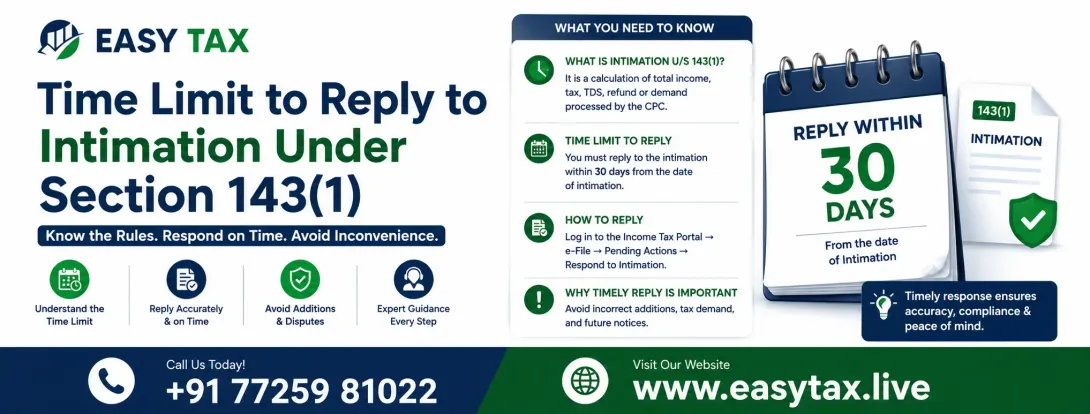
An Intimation under Section 143(1) is a computerized assessment sent after your ITR is processed by the Centralized Processing Centre (CPC).
It compares:
- Income declared in your ITR
- TDS details
- AIS/TIS information
- Tax already paid
- Deductions claimed
Possible Outcomes Under Section 143(1)
| Situation | Meaning |
|---|---|
| No Demand, No Refund | Your return is accepted |
| Refund Determined | Extra tax paid will be refunded |
| Demand Determined | Additional tax is payable |
What Is the Time Limit to Reply to Intimation Under Section 143(1)?
You should respond as soon as possible, preferably within 30 days from the date of receiving the intimation.
If a tax demand is raised and you agree with it, you should pay the amount immediately.
Essential Aspects of Tax Compliance
If you disagree, you should submit an online response with supporting documents according to Income Tax Department guidelines.
Important Time Limits You Should Know
| Particulars | Time Limit |
|---|---|
| Department can issue 143(1) intimation | Within 9 months from end of FY in. This return is filed |
| Recommended taxpayer response time | Within 30 days |
| Rectification request under Section 154 | Within 4 years |
| Revised return filing | Before prescribed deadline under Section 139(5) |
Why Did You Receive an Income Tax Demand Notice Under Section 143(1)?
A demand notice usually means the tax department found a mismatch during processing.
Common Reasons
- TDS mismatch: TDS not reflected properly in Form 26AS.
- Incorrect deduction claim: Wrong deductions under Section 80C, 80D, or HRA.
- AIS mismatch: Income appearing in AIS/TIS not reported in ITR.
- Wrong tax calculation: Incorrect tax liability calculation.
- Duplicate claims: Same deduction claimed twice.
How to Check Intimation 143(1) Online
- Visit the Income Tax e-Filing portal
- Login using PAN and password
- Go to “Pending Actions”
- Click “e-Proceedings” or “View Filed Returns”
- Select the relevant assessment year
- Download the Section 143(1) intimation PDF
The notice usually comes via email as well.
How to Reply to 143(1) Notice Online
Step 1: Login to e-Filing Portal
Access your account using PAN credentials.
Step 2: Open Outstanding Demand
Step 3: Choose Response Type
- Demand is correct
- Demand is partially correct
- Disagree with demand
Step 4: Upload Supporting Documents
Step 5: Submit Response
Verify using OTP or DSC.
Essential Aspects of Tax Compliance
What Happens If You Ignore a 143(1) Intimation?
| Consequence | Impact |
|---|---|
| Interest under Section 220 | Extra interest on unpaid tax |
| Refund adjustment | Future refunds may get adjusted |
| Penalty proceedings | Additional notices may be issued |
| Recovery action | Bank account recovery possible in serious cases |
Difference Between 143(1) and Scrutiny Notice Under 143(2)
| Basis | Section 143(1) | Section 143(2) |
|---|---|---|
| Nature | Automated processing | Detailed scrutiny |
| Issued by | CPC system | Assessing Officer |
| Documents required | Usually minimal | Detailed documents |
| Purpose | Mathematical verification | Full assessment |
| Seriousness | Routine | More serious |
Practical Example of a 143(1) Tax Demand
Suppose you filed your ITR showing ₹5 lakh salary income.
However, AIS showed:
- ₹5 lakh salary
- ₹40,000 FD interest
You forgot to include the FD interest.
The Income Tax Department recalculates your tax and sends an income tax notice 143(1) with additional demand.
Can You Revise Your Return After Receiving 143(1)?
Yes, in some situations.
If you discover a genuine mistake after receiving the intimation, you may file a revised return under Section 139(5).
This is useful if:
- Income was missed
- Wrong deduction claimed
- TDS details were incorrect
Common Mistakes Taxpayers Make
- Ignoring the email notice
- Not checking AIS and Form 26AS
- Paying demand without verification
- Missing supporting documents
- Delayed response
Tax-Saving and Compliance Tips
- Match your ITR with AIS before filing
- Verify Form 26AS properly
- Keep investment proofs organized
- File ITR early
- Use professional CA assistance
FAQs on Time Limit to Reply to Intimation Under Section 143(1)
What is the 143(1) intimation time limit for taxpayers?
Taxpayers should ideally respond within 30 days to avoid complications.
Is Section 143(1) notice serious?
Usually no. It is generally an automated communication after ITR processing.
Can I ignore an income tax notice 143(1)?
No. Ignoring it may result in penalties, refund adjustments, or recovery action.
Can I revise my ITR after receiving 143(1)?
Yes, if the revised return deadline under Section 139(5) is still available.
Conclusion
An Intimation under Section 143(1) is one of the most common communications issued by the Income Tax Department.
In many cases, it is simply a confirmation that your return was processed successfully.
Essential Aspects of Tax Compliance
However, if there is a tax demand or mismatch, you should respond quickly.
Timely action can help you avoid penalties, unnecessary stress. And future tax complications.
For more detailed assistance, explore our professional tax services or check official updates on the Income Tax Department website.
EasyTax • Jaipur
Expert Assisted ITR Filing
Dedicated CA prepares, verifies, and files your ITR. Maximum refund, accurate deductions, zero notices.