

- 100% Online Process
- Expert CA Guidance
- Fast Track Application
- Complete Documentation
- Transparent Pricing
Expert NGO Tax Registration
Unlock crucial tax exemptions and attract more funding with 12AB & 80G Registration
Enable tax-free income for your NGO and provide tax deduction benefits to your donors. Seamlessly register under Section 12AB and 80G to scale your social impact.
- Secure & Private Your data is always safe



Trusted by 10,000+ happy taxpayers across India
No spam. Your information is 100% secure.

Maximize Your Funding
Empower donors with tax deductions under Section 80G
By registering under Section 80G of the Income Tax Act, your NGO allows donors to claim significant tax deductions on their contributions. This powerful incentive encourages higher donation volumes from both individuals and corporations, dramatically expanding your fund-raising capabilities.
Without an 80G certificate, attracting substantial corporate CSR funds or high-net-worth individual donations becomes incredibly difficult.

Protect Your Surplus
Shield your NGO's income from taxation with Section 12AB
Section 12AB (formerly 12AA) grants your NGO an exemption from paying income tax on the surplus income generated from its charitable activities. This ensures that every rupee you receive is utilized purely for the social causes you champion, rather than being eroded by tax liabilities.
Registration under Section 12AB is an absolute prerequisite to legally recognize your entity as a tax-exempt charitable organization under the Income Tax laws.

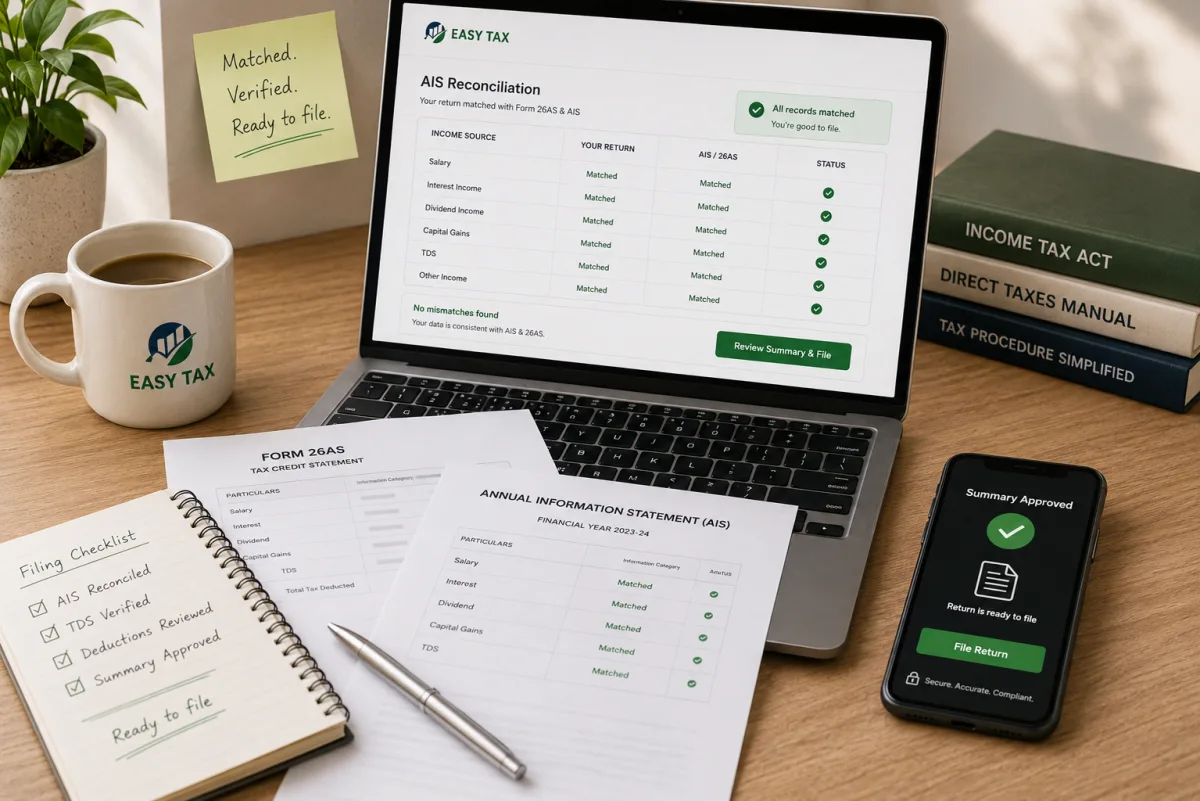
Matched to AIS, before the department checks
Your return is reconciled line-by-line with Form 26AS and AIS so TDS mismatches never come back as a notice. Filing is only done after you approve the summary.
Without Tax Registration vs With 12AB & 80G
- NGO income is treated as normal taxable income
- Donors receive no tax benefits for contributions
- Extremely difficult to attract CSR funding
- Lower credibility among institutional donors
- Higher financial strain on organizational resources
- Complete exemption from income tax on NGO surplus (12AB)
- Donors can claim up to 50% tax deduction on donations (80G)
- Eligible to receive corporate CSR grants
- High credibility and trust among major donors
- Maximum funds retained for charitable activities
How it works
-
Share your documents
Upload Form 16 and answer a 5-minute questionnaire.
-
Talk to your expert
Your assigned CA confirms income, deductions and regime on a short call.
-
Approve the summary
Review the computation and refund estimate; nothing is filed without your OK.
-
We file & you relax
E-filing, e-verification help and the ITR-V acknowledgement in your inbox.
Comprehensive Guide to 12AB and 80G Registration AY 2026-27, explained
For any Non-Governmental Organization (NGO)—whether a Trust, Society, or Section 8 Company—securing registrations under Section 12AB and Section 80G of the Income Tax Act is a vital step toward long-term sustainability and impact. These twin registrations form the bedrock of a recognized, tax-efficient charitable entity in India.
Section 12AB (which replaced the old Section 12A/12AA) provides the NGO itself with an exemption from paying income tax on its surplus income. Without this, the funds meant for charitable activities would be taxed at standard corporate rates. Section 80G, on the other hand, is a powerful fundraising tool; it allows the individuals and companies donating to your NGO to claim tax deductions on their contributions, making them far more willing to donate.
The registration process involves applying via Form 10A on the Income Tax e-filing portal. Newly established NGOs are initially granted Provisional Registration valid for 3 years. At least 6 months prior to the expiry of the provisional registration, or within 6 months of commencing charitable activities, the NGO must apply for Regular Registration, which is valid for 5 years.
Documents you will need
- Trust Deed / Society By-Laws / MOA & AOA
- Certificate of Incorporation or Registration
- PAN Card of the NGO
- List of Governing Body Members with PAN and Aadhar
- NOC from Landlord and Utility Bill for Registered Office
- Audited Financial Statements (for last 3 years, if applicable)

Why choose us for this service
Tax Exemption for NGO
Switched jobs? We merge employers correctly and fix double-counted slabs.
Donor Tax Benefits
Side income reported right, expenses claimed where eligible.
CSR Funding Eligibility
Old vs new compared on your real numbers, not thumb rules.
Government Grants
We monitor your refund until it's credited.
Enhanced Credibility
Missed the deadline or made an error? We fix it.
Notice shield
Filing reconciled with AIS/26AS to prevent the most common notices.
Year-round access
Your expert stays reachable after filing, not just in July.
12AB & 80G Combo Registration honest pricing
End-to-end support for securing both crucial tax exemptions.
- Single Form 16
- HRA & standard deductions
- Regime comparison
- E-verification support
- Everything in Salaried
- Multiple Form 16s / job switch
- House property & interest income
- Capital gains up to 50 trades
- Everything in Multi-income
- Unlimited capital gains & ESOPs
- Foreign income / assets schedule
- Priority CA callback
Comprehensive Guide to 12AB and 80G Registration why it pays to use an expert
For any Non-Governmental Organization (NGO)—whether a Trust, Society, or Section 8 Company—securing registrations under Section 12AB and Section 80G of the Income Tax Act is a vital step toward long-term sustainability and impact. These twin registrations form the bedrock of a recognized, tax-efficient charitable entity in India.
Section 12AB (which replaced the old Section 12A/12AA) provides the NGO itself with an exemption from paying income tax on its surplus income. Without this, the funds meant for charitable activities would be taxed at standard corporate rates. Section 80G, on the other hand, is a powerful fundraising tool; it allows the individuals and companies donating to your NGO to claim tax deductions on their contributions, making them far more willing to donate.
The registration process involves applying via Form 10A on the Income Tax e-filing portal. Newly established NGOs are initially granted Provisional Registration valid for 3 years. At least 6 months prior to the expiry of the provisional registration, or within 6 months of commencing charitable activities, the NGO must apply for Regular Registration, which is valid for 5 years.
Frequently Asked Questions
Everything salaried filers ask before handing their return to an expert.

File with an expert, sleep easy.
Most returns are ready for your approval within 48 hours of document upload.