

- 4.6★ User Rating
- Expert CA/CS Support
- 100% Online Process
- Tax Mitigation
- Preservation of Wealth
Expert Trust Registration
Establish a secure legacy and manage charitable goals with a Trust Registration
A Trust is the ideal arrangement for charitable activities, preserving family wealth, and achieving tax exemptions. Register your Trust online easily with our expert assistance.
- Secure & Private Your data is always safe



Trusted by 10,000+ happy taxpayers across India
No spam. Your information is 100% secure.

Charitable & Private Trust
Fulfill your charitable or private objectives through a Registered Trust
A Trust is an arrangement where the owner (Trustor) transfers property to a Trustee for the benefit of a third party (Beneficiaries). The Indian Trust Act 1882 regulates all trusts in India. Trust registration is highly advisable to obtain key benefits like legal compliance, tax exemptions, and effective management of assets.
Whether you want to involve in charitable activities, provide benefits to underprivileged people, or manage family wealth, registering a trust provides a formal structure and legal recognition.

Types of Trusts
Choose the right structure for your needs with our expert guidance
In India, you can register a Private Trust, which is created for the benefit of specific individuals and governed by the Indian Trusts Act 1882, or a Public Trust, which is constituted wholly for the benefit of the public at large. Public trusts are often used for charitable or religious purposes.
Additionally, to continue claiming tax exemptions under Sections 10, 11, 80G, and 12A, registered charitable trusts must acquire fresh registration under Section 12AB of the Income Tax Act.

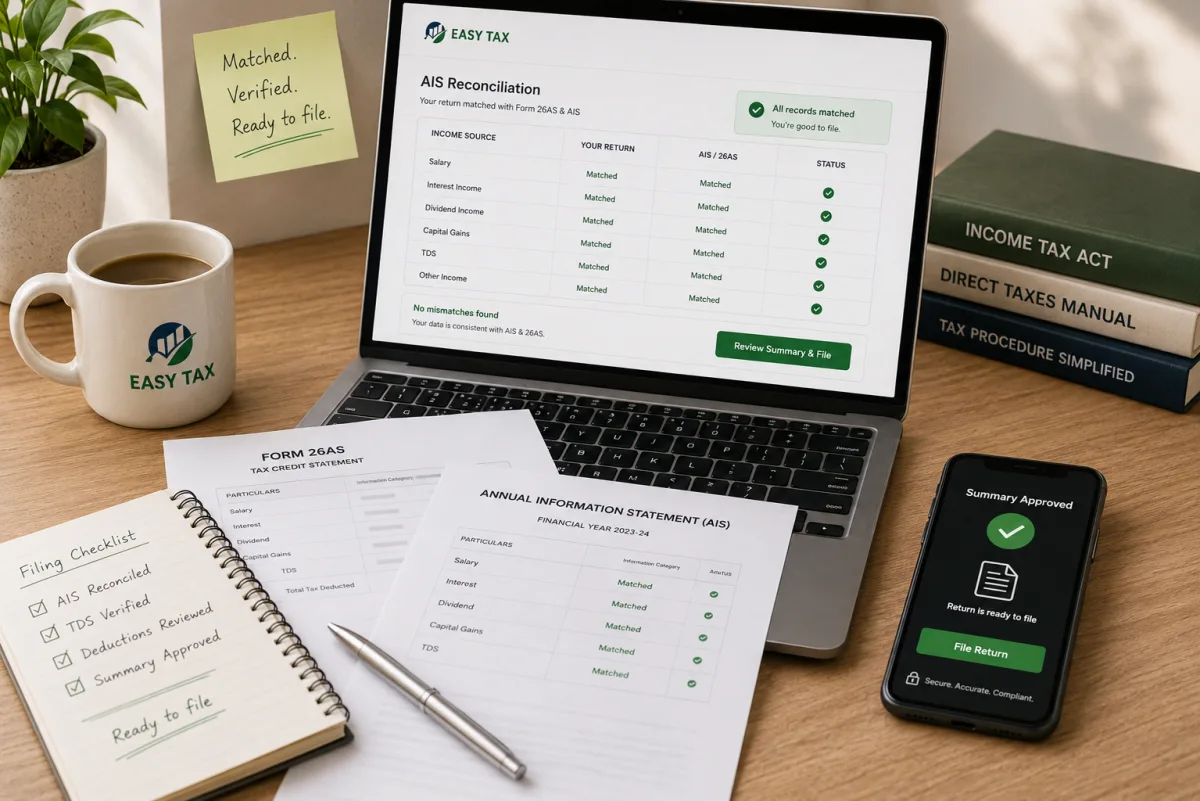
Matched to AIS, before the department checks
Your return is reconciled line-by-line with Form 26AS and AIS so TDS mismatches never come back as a notice. Filing is only done after you approve the summary.
With standard services vs With our expert team
- No legal standing for property ownership in trust name
- Higher tax liabilities without exemptions
- Risk of family wealth disputes
- Lack of formalized charitable structure
- Personal liability for asset management
- Legal recognition and property holding by trustees
- Significant tax exemptions (Section 12AB, 80G)
- Effective preservation of family wealth
- Formalized setup for charitable objectives
- Trustee managed assets with clear beneficiary rights
How it works
-
Share your documents
Upload Form 16 and answer a 5-minute questionnaire.
-
Talk to your expert
Your assigned CA confirms income, deductions and regime on a short call.
-
Approve the summary
Review the computation and refund estimate; nothing is filed without your OK.
-
We file & you relax
E-filing, e-verification help and the ITR-V acknowledgement in your inbox.
Comprehensive Guide to Trust Registration AY 2026-27, explained
A Trust is an arrangement where the owner of the Trust transfers property to a trustee to provide advantages to a third party. A trust is regulated by The Indian Trust Act 1882. Nowadays, registration of a trust is an online process finalized by the execution and registration of a Trust Deed.
Trusts can be broadly classified into Private Trusts, formed for specific individuals, and Public Trusts, formed for the general public or charitable causes. Public-Cum-Private trusts also exist. Establishing a trust offers numerous benefits, such as tax mitigation, preserving family wealth, avoiding probate courts, and facilitating charitable work.
Registering a trust involves selecting a unique name, drafting a comprehensive Trust Deed, executing it on appropriately valued stamp paper, and registering it with the local Sub-Registrar in the presence of the settlor and two witnesses.
Documents you will need
- Proof of Identity (Aadhaar Card, Voter ID, Passport, Driving License)
- Address Proof of Registered Office (Utility Bills)
- NOC from the owner for rented property
- Photographs of Trustee and settlor
- PAN Card of Trustee and settlor
- Trust Deed drafted on correct Stamp Value

Why choose us for this service
Charitable Activities
Switched jobs? We merge employers correctly and fix double-counted slabs.
Tax Exemptions
Side income reported right, expenses claimed where eligible.
Wealth Preservation
Old vs new compared on your real numbers, not thumb rules.
Avoid Court Probate
We monitor your refund until it's credited.
Structured Management
Missed the deadline or made an error? We fix it.
Notice shield
Filing reconciled with AIS/26AS to prevent the most common notices.
Year-round access
Your expert stays reachable after filing, not just in July.
Transparent & Affordable Pricing
Standard Trust Registration
Complete end-to-end registration of your Private or Public Trust.
₹3,000 per return.
Choose plan- Name Approval Assistance
- Drafting of Trust Deed
- Stamp Duty Consultation
- Registration with Sub-Registrar
- PAN & TAN Application
Comprehensive Guide to Trust Registration why it pays to use an expert
A Trust is an arrangement where the owner of the Trust transfers property to a trustee to provide advantages to a third party. A trust is regulated by The Indian Trust Act 1882. Nowadays, registration of a trust is an online process finalized by the execution and registration of a Trust Deed.
Trusts can be broadly classified into Private Trusts, formed for specific individuals, and Public Trusts, formed for the general public or charitable causes. Public-Cum-Private trusts also exist. Establishing a trust offers numerous benefits, such as tax mitigation, preserving family wealth, avoiding probate courts, and facilitating charitable work.
Registering a trust involves selecting a unique name, drafting a comprehensive Trust Deed, executing it on appropriately valued stamp paper, and registering it with the local Sub-Registrar in the presence of the settlor and two witnesses.
Frequently Asked Questions
Everything salaried filers ask before handing their return to an expert.

File with an expert, sleep easy.
Most returns are ready for your approval within 48 hours of document upload.