

- 100% Physical Verification
- Expert CA Team
- Bank Audit Compliant
- Valuation per AS-2
- Discrepancy Resolution
Stock Audit Services
Ensure accurate physical verification and valuation with a Stock Audit
Reconcile your physical stock with book records, identify obsolete inventory, and comply with standard accounting principles and bank requirements.
- Secure & Private Your data is always safe



Trusted by 10,000+ happy taxpayers across India
No spam. Your information is 100% secure.

Precision and Accuracy
Identify mismatches and update your Inventory Records
A stock audit involves the physical verification of inventory and its valuation. It helps identify discrepancies between calculated stocks in books and the physical stock available in reality. By rectifying these mismatches, you can ensure your financial statements present a true and fair view of your assets.
It also helps pinpoint deadstock, slow-moving items, and scrap, allowing for better inventory management and cost reduction.

Compliance and Assurance
Fulfill statutory and banking audit requirements
For businesses with working capital loans, banks often mandate quarterly stock audits to verify the drawing power and ensure the stock is adequately insured and maintained. An auditor verifies the stock valuation according to Accounting Standard (AS) 2 / Ind AS 2, which requires valuation at the lower of cost or net realizable value (NRV).
We provide comprehensive audit reports detailing stock conditions, valuation accuracy, and internal control effectiveness, ensuring you remain compliant and financially sound.

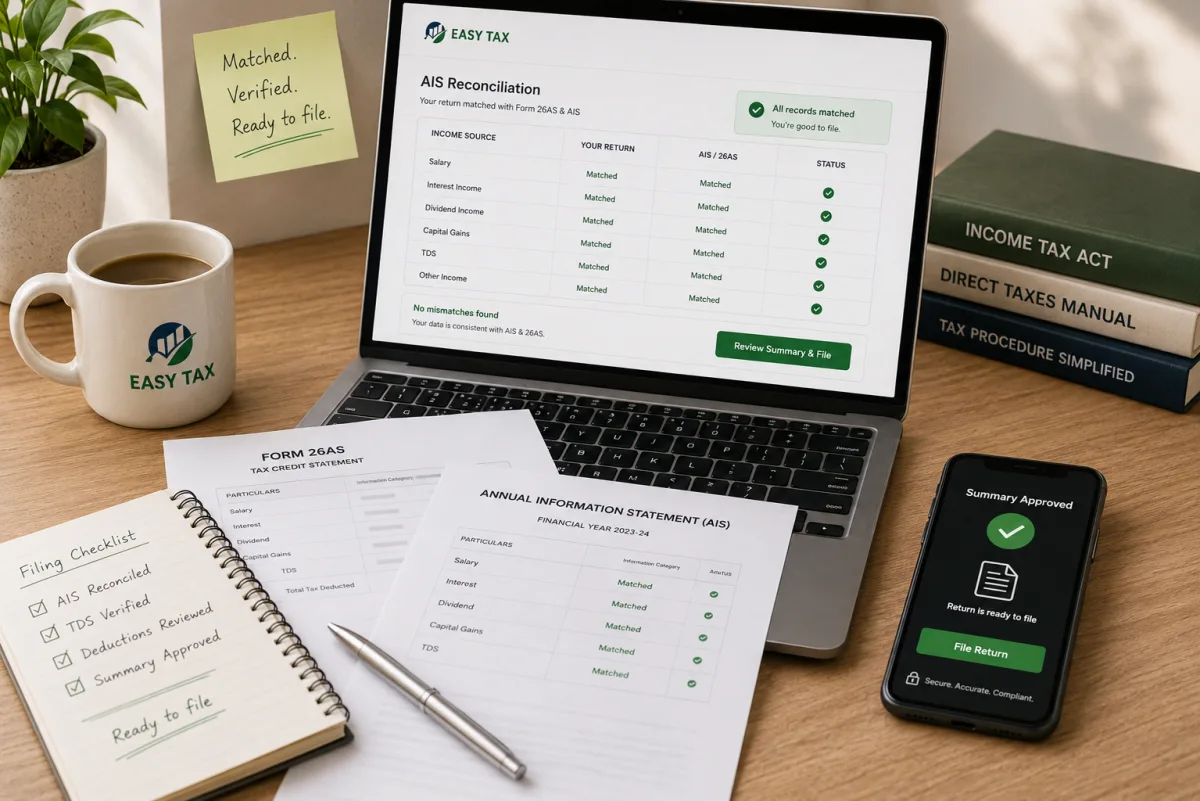
Matched to AIS, before the department checks
Your return is reconciled line-by-line with Form 26AS and AIS so TDS mismatches never come back as a notice. Filing is only done after you approve the summary.
With standard services vs With our expert team
- High risk of stock pilferage and unrecorded wastage
- Overvalued inventory leading to inflated profits
- Non-compliance with bank loan terms (CC/OD limits)
- Poor identification of obsolete or deadstock
- Inefficient inventory management processes
- Accurate physical counting and reconciliation
- Valuation strictly per AS-2/Ind AS-2 (Lower of Cost or NRV)
- Full compliance with bank and statutory requirements
- Clear identification of slow-moving and scrap items
- Enhanced internal controls and cost reduction
How it works
-
Share your documents
Upload Form 16 and answer a 5-minute questionnaire.
-
Talk to your expert
Your assigned CA confirms income, deductions and regime on a short call.
-
Approve the summary
Review the computation and refund estimate; nothing is filed without your OK.
-
We file & you relax
E-filing, e-verification help and the ITR-V acknowledgement in your inbox.
Comprehensive Guide to Stock Audit AY 2026-27, explained
In simple words, the stock audit means physical verification of inventory; it may also involve the valuation of inventory depending upon the terms of reference. An inventory audit is considered a generally accepted auditing procedure. Stock Audit or Inventory check is a physical verification of quantities and conditions of items held in the warehouse. The reason behind this check is to know the position of existing stock and is independently checked.
In legal reference, a Stock audit is a statutory process which every business entity is required to perform at least once in a Financial Year. The stock audit process mainly involves the counting of physical stock present in the specified premises and verifying the same with computed stock as maintained by the company. The intention and purpose behind executing this is to rectify the discrepancies present in the booked stock when compared to physical stock by passing necessary adjustment entries.
Stock Auditor performs its audit on the behalf of the bank from which the auditee takes working capital loan. Our expert team ensures that the valuation of stock is done using the standard accounting principles for valuation, issued by ICAI i.e. Accounting Standard (AS) 2 Valuation of Inventories.
Documents you will need
- Stock Register/Inventory Records
- Purchase and Sales Invoices
- Bank Sanction Letter (for bank audits)
- Previous Stock Audit Report
- List of Godowns/Warehouses
- Insurance Policies for Stock

Why choose us for this service
Fraud Prevention
Switched jobs? We merge employers correctly and fix double-counted slabs.
Cost Reduction
Side income reported right, expenses claimed where eligible.
Bank Compliance
Old vs new compared on your real numbers, not thumb rules.
Accurate Valuation
We monitor your refund until it's credited.
Process Improvement
Missed the deadline or made an error? We fix it.
Notice shield
Filing reconciled with AIS/26AS to prevent the most common notices.
Year-round access
Your expert stays reachable after filing, not just in July.
Stock Audit Service honest pricing
Comprehensive physical verification and valuation audit.
- Single Form 16
- HRA & standard deductions
- Regime comparison
- E-verification support
- Everything in Salaried
- Multiple Form 16s / job switch
- House property & interest income
- Capital gains up to 50 trades
- Everything in Multi-income
- Unlimited capital gains & ESOPs
- Foreign income / assets schedule
- Priority CA callback
Comprehensive Guide to Stock Audit why it pays to use an expert
In simple words, the stock audit means physical verification of inventory; it may also involve the valuation of inventory depending upon the terms of reference. An inventory audit is considered a generally accepted auditing procedure. Stock Audit or Inventory check is a physical verification of quantities and conditions of items held in the warehouse. The reason behind this check is to know the position of existing stock and is independently checked.
In legal reference, a Stock audit is a statutory process which every business entity is required to perform at least once in a Financial Year. The stock audit process mainly involves the counting of physical stock present in the specified premises and verifying the same with computed stock as maintained by the company. The intention and purpose behind executing this is to rectify the discrepancies present in the booked stock when compared to physical stock by passing necessary adjustment entries.
Stock Auditor performs its audit on the behalf of the bank from which the auditee takes working capital loan. Our expert team ensures that the valuation of stock is done using the standard accounting principles for valuation, issued by ICAI i.e. Accounting Standard (AS) 2 Valuation of Inventories.
Frequently Asked Questions
Everything salaried filers ask before handing their return to an expert.

File with an expert, sleep easy.
Most returns are ready for your approval within 48 hours of document upload.