

- Deed + PAN + bank, end to end
- 4.8★ Google rating
- Honest fit-check first
HUF Registration & PAN
A second tax entity your family already owns.
A properly created HUF gets its own PAN, its own basic exemption and its own deductions. We set it up the legally correct way — deed, PAN and bank account.
- Separate Its own exemption & 80C
- Correct Scrutiny-proof deed
- Guided Funding without clubbing



Trusted by 10,000+ happy taxpayers across India
No spam. Your information is 100% secure.

One family, two exemption limits
An HUF is a separate taxpayer: its own slab benefits, its own 80C and 80D, its own capital-gains exemption. Rental income, family investments or ancestral property routed through it are taxed on a fresh slate.

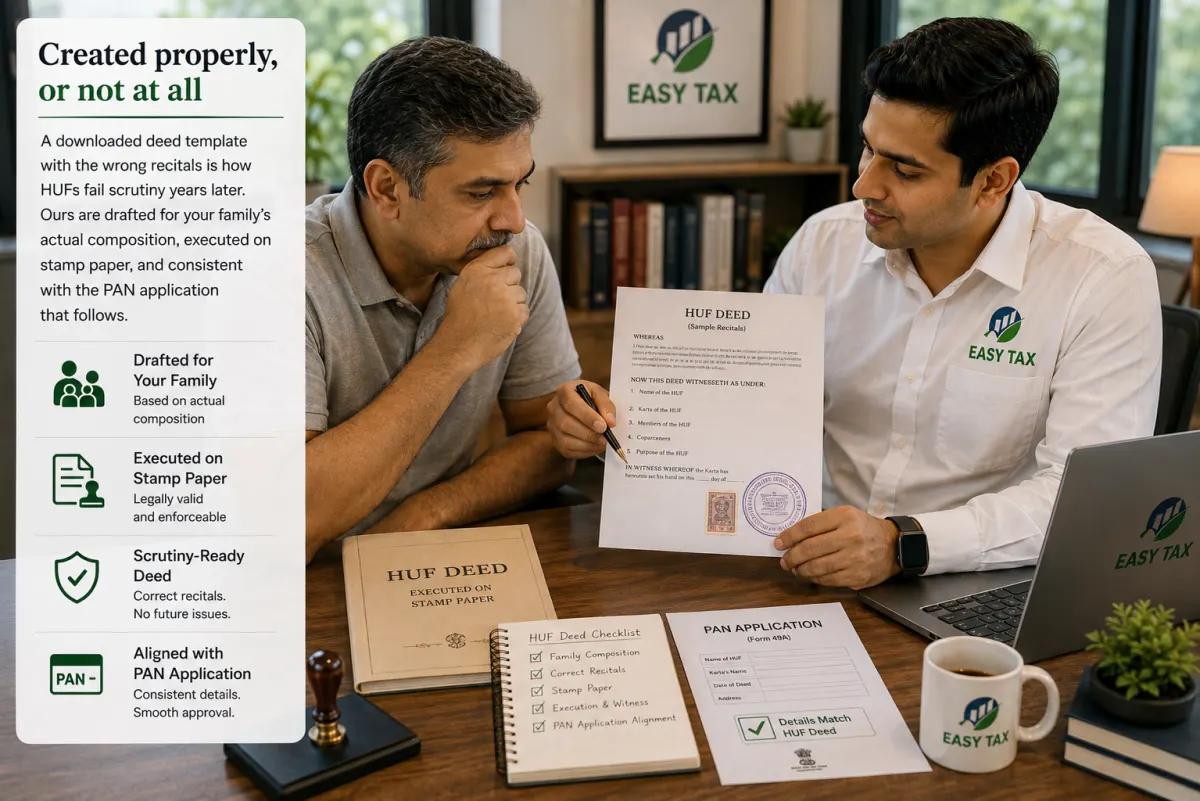
Created properly, or not at all
A downloaded deed template with the wrong recitals is how HUFs fail scrutiny years later. Ours are drafted for your family’s actual composition, executed on stamp paper, and consistent with the PAN application that follows.
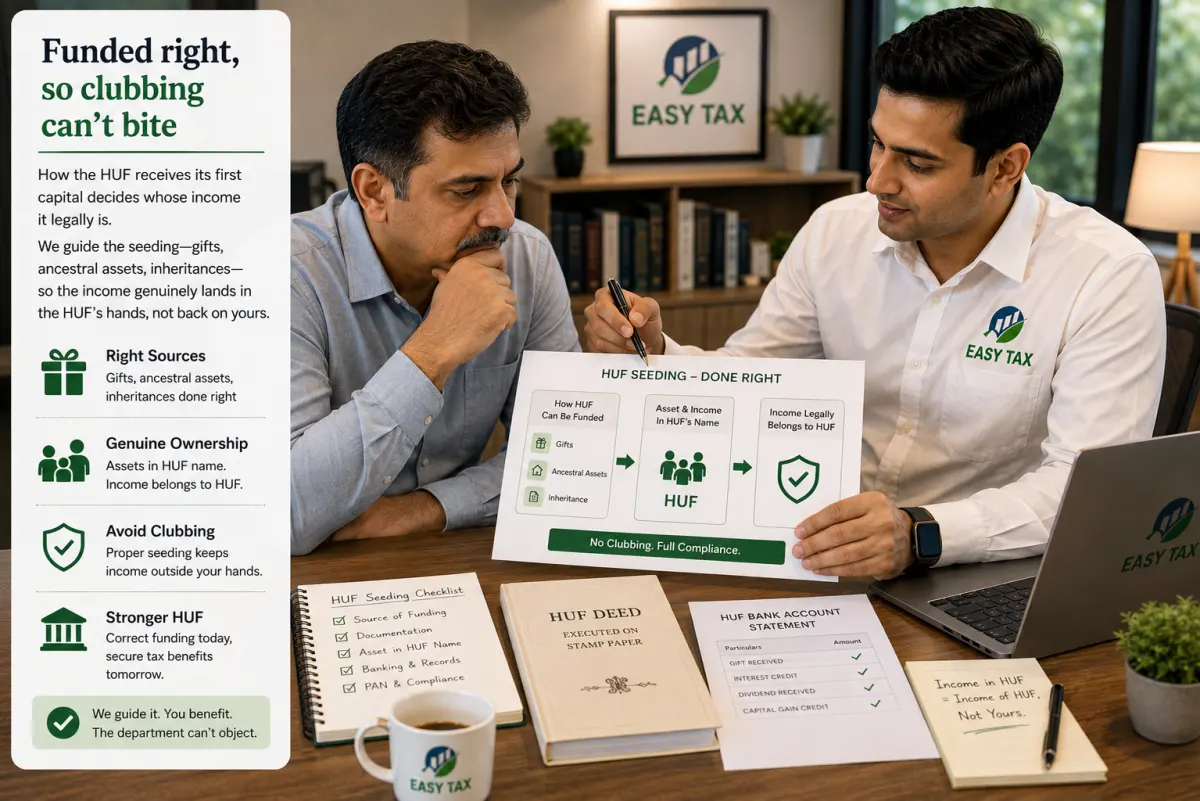
Funded right, so clubbing can’t bite
How the HUF receives its first capital decides whose income it legally is. We guide the seeding — gifts, ancestral assets, inheritances — so the income genuinely lands in the HUF’s hands, not back on yours.
With EasyTax vs a template off the internet
Say NO to
- Template deeds that collapse under scrutiny
- Funding mistakes that club income back to you
- A PAN application that contradicts the deed
- Vague WhatsApp advice on “HUF benefits”
- Banks rejecting your account for missing papers
- Creating an HUF you will never actually use
Say YES to
- An honest assessment of whether an HUF helps you
- A custom deed executed correctly on stamp paper
- PAN (Form 49A) filed and tracked to delivery
- A funding roadmap that survives clubbing provisions
- Bank-account documentation prepared in advance
- First-year filing guidance for the new entity
How it works
-
Fit check
A short call confirms an HUF genuinely benefits your family’s income pattern.
-
Deed drafted & executed
Custom declaration deed prepared; we guide stamp paper and signatures.
-
PAN applied
Form 49A filed with the deed; we track it to card-in-hand.
-
Bank & first steps
Account-opening kit plus a funding and compliance starter guide.
HUF registration for AY 2026-27, explained
What HUF registration means
A Hindu Undivided Family (HUF) is a separate person under the Income Tax Act — a second taxpayer your family can legally own alongside its individual members. Registering one means formally documenting its existence through a declaration deed, obtaining its own PAN, and opening a bank account in its name. Once created, the HUF gets its own basic exemption limit, its own deductions under 80C and 80D, and its own capital-gains exemptions. Income that genuinely belongs to the family — ancestral property rent, family investments — can be routed through it and taxed on a fresh slate rather than piled onto an individual’s higher slab. Done properly, it is one of the cleanest, fully legal ways for a family to reduce its overall tax.
Who should create an HUF
An HUF suits Hindu, Sikh, Jain and Buddhist families — it comes into existence with marriage — who have income that can legitimately be attributed to the family rather than to one member: rent from ancestral or family property, a corpus of investments, or an expected inheritance. It is most valuable when there is real family income to route and a member already in a higher tax bracket. It is worth far less if there is no such income to attribute, which is exactly why we start with an honest fit-check before creating one you would never use.
What our experts do for you
We begin with a fit-check to confirm an HUF genuinely benefits your family’s income pattern. If it does, we draft a declaration deed tailored to your family’s actual composition — not a generic template — and guide its execution on stamp paper. We then file the PAN application (Form 49A) in the HUF’s name, consistent with the deed, and track it to delivery. We prepare the documentation your bank needs to open the HUF account, and give you a funding roadmap designed to survive the clubbing provisions, plus guidance for the entity’s first income tax return.
Tax benefits, funding and the clubbing trap
The core benefit is a fresh set of tax-free and lower-taxed income for the family: the HUF’s own basic exemption and its own 80C/80D limits, on top of each member’s. The catch is funding. How the HUF receives its first capital determines whose income the law treats it as. Safe sources are ancestral property, inheritances directed to the HUF, and gifts within reasonable limits (mind the ₹50,000 aggregate rule for non-relatives). Large transfers from your own pocket invite the clubbing provisions, which tax the resulting income back in your hands — defeating the purpose. Getting the seeding right is the single most important step, and the one we plan most carefully.
Documents you will need
- PAN and Aadhaar of the karta
- Aadhaar of adult members (coparceners) named in the deed
- Marriage certificate or family details for the deed recitals
- Address proof for the HUF (usually the karta’s residence)
- Passport-size photo of the karta
- Details of the intended initial corpus (gift, ancestral asset, inheritance)

What an HUF unlocks
A fresh basic exemption
Income routed to the HUF enjoys its own slab — the core, fully legal saving.
Separate 80C & 80D
The HUF claims its own deductions on top of yours.
Rental income home
Family property income taxed in the HUF’s hands.
Investment vehicle
FDs, mutual funds and shares held under the HUF’s PAN.
Ancestral asset landing zone
The natural, correct owner for inherited family wealth.
Succession clarity
A recognised structure for organising family assets.
Karta & coparceners
Roles and rights documented properly, daughters included.
First-year filing
Guidance so the new entity files its ITR correctly.
Simple, honest pricing
- Fit-check call
- Custom HUF deed
- Execution guidance (stamp paper/notary)
- Everything in Essentials
- PAN application (49A) filed & tracked
- Bank account documentation kit
- Funding roadmap
- Everything in Complete
- The HUF’s first ITR filed
- 80C/80D setup guidance
- One-year email support
Deed, funding & why the paperwork matters
What we need to create your HUF
Creating the entity starts with people and proof. We need the PAN and Aadhaar of the karta (the managing member) and the Aadhaar of the adult coparceners named in the deed, plus family details or a marriage certificate for the deed’s recitals. An address proof — usually the karta’s residence — and a photo of the karta support the PAN application. Most importantly, we need to understand your intended initial corpus — whether it comes from a gift, an ancestral asset or an inheritance — because that decides how the HUF is funded without triggering clubbing.
Funding it correctly is everything
An HUF’s tax benefit stands or falls on how it is funded. Income earned on capital transferred from a member’s own funds is clubbed back to that member, so seeding matters more than any other step. Ancestral property, inheritances directed to the HUF, and reasonable gifts are the safe routes; large personal transfers are not. We map a funding roadmap that keeps the resulting income genuinely in the HUF’s hands, so the entity actually saves tax rather than simply existing on paper.
Why register with EasyTax
We give you an honest fit-check first — we will tell you if an HUF would not help — then a custom deed drafted for your family and executed correctly, a PAN application consistent with that deed and tracked to delivery, and a bank-ready documentation kit. You also get a clubbing-safe funding plan and first-year filing guidance. Everything is handled under India’s DPDP Act. A properly built HUF holds up under scrutiny for decades; a template one often does not.
Frequently asked questions
Everything families ask before creating an HUF.

Hindu, Sikh, Jain and Buddhist families. An HUF comes into existence automatically with marriage; what we formally create is its documented declaration, its PAN and its bank presence. The senior member acts as karta — and a daughter is a coparcener with equal rights, and a woman can be karta. It is a family entity, not something you invent from nothing.
It depends on how much income you can legitimately route to it. The HUF’s own basic exemption and its separate 80C and 80D limits can save a family tens of thousands of rupees a year where there is rental or investment income to attribute — and roughly nothing where there is none. Our fit-check tells you which case you are in before you pay for creation.
The safest sources are ancestral property, inheritances directed to the HUF, and gifts within reasonable limits, minding the ₹50,000 aggregate rule for gifts from non-relatives. Large transfers from your own pocket invite the clubbing provisions, which tax the income back in your hands. This funding step is the one we plan most carefully, because it determines whether the HUF saves tax at all.
Yes, once its income crosses the basic exemption limit — and it is good practice even below that, to build the entity’s record. It files the same ITR process under its own PAN. We provide first-year filing guidance and can file the HUF’s return for you, so the new entity stays compliant from the start.
Yes. Following the recognition of daughters as coparceners with equal rights, a woman can act as karta of an HUF. Coparceners — including daughters — have rights in the family property, and the deed we draft reflects your family’s actual composition and the correct roles, rather than an outdated template that assumes otherwise.
The karta is the member who manages the HUF and represents it in dealings like banking and filing. Coparceners are the members who have a right by birth in the family property — sons and daughters alike. Both roles carry rights and responsibilities, and documenting them correctly in the deed is part of what makes the HUF stand up to scrutiny.
Yes. Once it has a PAN and a bank account, the HUF can hold fixed deposits, mutual funds, shares and property in its own name, and the income is taxed in the HUF’s hands with its own exemptions. This is precisely how families use an HUF as a legitimate second investment and income vehicle, separate from any individual member.
Yes, through a full partition of its assets among the members, which tax law recognises only when the partition is complete. It is paperwork-heavy but entirely doable. This is another reason the founding deed should be drafted properly on day one — a well-documented HUF is far easier to administer, and to partition, than a hastily created one.
Yes. The personal documents, family details and financial information you share are stored securely, used only to draft the deed and file the PAN application, and never shared. You can request deletion afterwards. All handling follows India’s Digital Personal Data Protection (DPDP) Act, so sensitive family data stays confidential.
The family structure the tax law respects.
Deed to PAN in about two weeks, start to finish.
Verified & Supervised by CA Jitendra Shari
Every filing, tax consultation, and compliance checklist is rigorously audited by practicing Chartered Accountants in Jaipur to ensure 100% adherence to Income Tax, GST, and MCA regulations.