

First-Time ITR Filing: Essential Documents Checklist
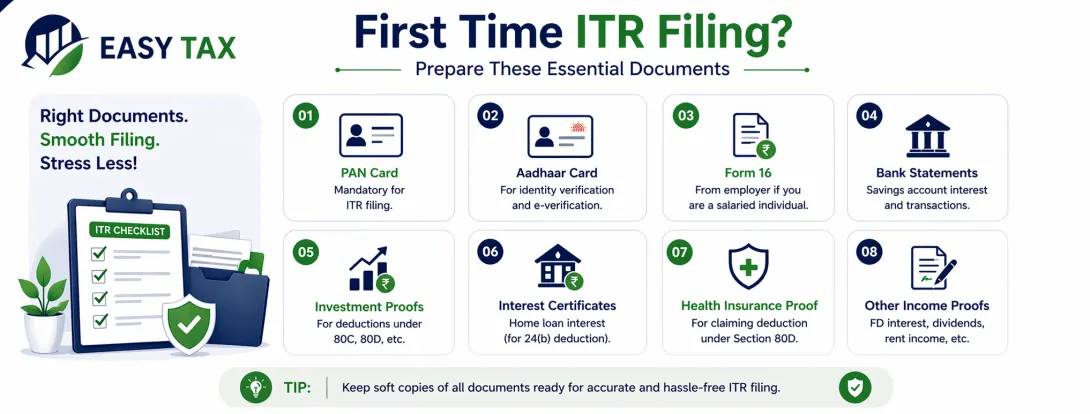
First-Time ITR Filing: Essential Documents You Need in India
Filing an Income Tax Return (ITR) for the first time can feel confusing, especially when you are unsure which documents to collect, what information to report and whether every document needs to be uploaded. The process becomes much easier when you organise your records before starting the return.
The documents you need depend on your income sources and financial activities during the relevant year. A salaried employee may need Form 16 and salary details, while a freelancer may need invoices and expense records. Someone earning rent, interest or capital gains will need additional information.
This guide explains the documents required for first-time ITR filing in India, how to use Form 16, Form 26AS and the Annual Information Statement (AIS), which proofs to retain, and what to check before submitting and verifying your return.
Last reviewed: 24 November 2026
Tax-period note: This guide explains the AY 2026–27 filing context and highlights the transition to the Income-tax Act, 2025 for periods beginning on 1 April 2026.
01 What is ITR filing and why do you need documents?
An Income Tax Return is a prescribed statement through which a taxpayer reports income, eligible deductions, tax payments and other required details to the Income Tax Department.
Before filing, you should collect documents that help establish:
- Your identity and taxpayer details.
- Your salary, business, professional or other income.
- Interest earned from savings accounts, fixed deposits and other investments.
- Tax deducted at source (TDS), tax collected at source (TCS) and advance-tax payments.
- Eligible deductions, exemptions and other tax adjustments.
- Bank account details for any eligible income-tax refund.
Having these records ready reduces the risk of omitting income, claiming an incorrect deduction or entering a tax-credit figure that does not match the available records.
Remember that the documents needed depend on your income and the ITR form applicable to you. You do not necessarily need every document listed in this guide.
02 Basic documents most first-time taxpayers should keep ready
Start with the following basic records. Some may be required for identification or filing, while others help you check the information entered in your return.
PAN card
Your Permanent Account Number (PAN) is an important taxpayer identification detail. Keep your PAN information available and ensure that the name and other details are consistent with the records used for filing.
Check that your PAN is valid and that it is not inoperative because of a PAN-Aadhaar linking requirement applicable to you. Do not assume that every taxpayer is subject to identical linking rules, as the law and notified exemptions apply to specified categories.
Aadhaar card or Aadhaar details
Aadhaar may be relevant for quoting, linking or electronic verification, depending on the taxpayer's circumstances and the applicable rules. Keep your Aadhaar details available where required.
Under the applicable PAN-Aadhaar provisions, certain individuals must link PAN and Aadhaar, while specified categories are exempt. An inoperative PAN can have consequences for tax-related transactions, refunds and tax deduction or collection. Check the official rules rather than assuming that every unlinked PAN automatically makes an ITR invalid.
Official reference: Income Tax Department – PAN-Aadhaar linking FAQs.
Bank account details
Keep the details of your bank accounts used during the relevant financial year. These can help you identify interest income and verify transactions.
You should also check the bank account you intend to nominate for an eligible income-tax refund. Ensure that the account is correctly entered and meets the Income Tax Department's validation requirements.
Mobile number and email address
Keep access to your registered mobile number and email address. They may be used for account access, communications, verification and updates relating to your return.
03 Documents required for salaried individuals
If you receive a salary, collect the following records before preparing your ITR.
Form 16
Form 16 is a TDS certificate issued by an employer when tax has been deducted from salary. It generally contains salary details, deductions considered by the employer and tax deducted during the relevant period.
Use Form 16 to cross-check your salary and TDS information. Do not assume that every figure in Form 16 automatically represents your complete taxable income. You may have other income, deductions or adjustments that must also be considered.
Monthly salary slips
Salary slips help you understand the components of your salary, such as basic pay, allowances, perquisites and deductions. They are particularly useful if you changed jobs, received variable pay or had salary adjustments during the year.
Previous employer's Form 16
If you changed jobs during the financial year, collect Form 16 from each employer who paid you salary during that period. Reconcile the salary and TDS details so that income from different employers is not omitted or reported twice.
Other salary-related records
- Details of bonus, incentives and commissions.
- Details of taxable allowances and perquisites, where applicable.
- Details of pension or family pension, if relevant.
- Details of salary arrears and any relief claimed under the applicable provisions.
- Documents relating to eligible exemptions or deductions, depending on your tax regime.
Official reference: Income Tax Department – ITR-1 FAQs.
04 Form 26AS and Annual Information Statement (AIS)
Form 26AS and AIS are important sources of tax-related information. Review both before filing, but understand that they serve different purposes.
Form 26AS
Form 26AS provides tax-credit information, particularly TDS and TCS details. It helps you check whether tax deducted or collected against your PAN is reflected in the tax records.
Compare the available information with your Form 16, TDS certificates and other supporting records. If a credit is missing or incorrect, investigate the difference before claiming it in your return.
Annual Information Statement (AIS)
AIS provides a broader view of financial information reported to the Income Tax Department. Depending on the information reported, it may include details relating to interest, dividends, securities transactions, property transactions, tax payments and other specified information.
Review AIS for transactions that may have tax implications. If information appears incorrect or incomplete, use the available feedback facility where appropriate and retain supporting evidence.
Important: AIS may not contain every item of income or every transaction. You remain responsible for reporting your complete and accurate income, even if a particular item does not appear in AIS.
How to reconcile Form 26AS and AIS
- Download the relevant Form 26AS and AIS from the Income Tax e-Filing portal.
- Compare salary and TDS details with Form 16 and employer records.
- Compare interest information with bank and deposit statements.
- Check reported securities or property transactions against your own records.
- Investigate missing, duplicated or incorrect information.
- Keep evidence of any correction or feedback submitted.
Official reference: Income Tax Department – AIS FAQs.
05 Documents required for bank interest and other income
Do not limit your ITR preparation to salary. Interest and other income may also need to be reported, depending on the applicable tax provisions.
Savings account interest
Collect bank statements or interest certificates showing interest earned on savings accounts during the relevant period. Check whether the amount is reflected in AIS and report it under the appropriate income category.
Fixed deposit and recurring deposit interest
Collect interest certificates or statements from banks and post offices for fixed deposits, recurring deposits and other interest-bearing accounts.
Dividend income
If you received dividends from shares or mutual funds, collect the dividend statements, broker records or relevant account statements. Reconcile the figures with AIS and report them under the applicable provisions.
Other income records
- Interest from bonds, deposits or other investments.
- Family pension details, where applicable.
- Income from prizes or winnings, where applicable.
- Any other taxable income received during the year.
Keep supporting records even if tax has already been deducted from a payment. TDS does not automatically mean that the income need not be reported.
06 Documents required for house property and rental income
If you own a house property or receive rental income, collect the records relevant to the property and the income earned from it.
- Details of rent received or receivable during the relevant period.
- Property ownership and relevant municipal or property-tax records.
- Home-loan interest certificate issued by the lender, if applicable.
- Details of co-owners and their ownership shares, where relevant.
- Details of the period for which the property was let out or self-occupied.
- Records of rent arrears or unrealised rent, where relevant.
Tax treatment depends on the property's status, ownership, applicable deductions and the tax regime. Do not assume that every home-loan payment or property expense is deductible.
For an eligible taxpayer, interest on a housing loan may receive different treatment depending on the applicable provisions and regime. Check the rules for the relevant assessment year before claiming any deduction.
07 Documents required for capital gains
If you sold shares, mutual funds, land, buildings or other capital assets, collect transaction-level records. The documents help establish the sale consideration, acquisition cost, holding period and other information required to calculate capital gains.
For shares and mutual funds
- Broker contract notes and trade statements.
- Capital gains statement from your broker or investment platform.
- Mutual fund account statements and redemption statements.
- Details of acquisition dates and purchase costs.
- Records of corporate actions, bonus shares, splits or other relevant adjustments.
For property or other assets
- Purchase agreement and sale deed.
- Purchase and sale dates and consideration details.
- Stamp-duty and registration records, where relevant.
- Eligible improvement-cost records and supporting bills.
- Details of co-ownership and ownership shares, where applicable.
- Records of any exemption or reinvestment claim, if applicable.
Capital-gains calculations can be affected by the asset type, acquisition date, holding period, applicable tax provisions and transitional rules. Do not rely on a generic capital-gains calculation without checking the law applicable to the transaction and tax period.
08 Documents required for freelancers and business income
If you work as a freelancer, consultant, independent professional or business owner, you may need additional financial and accounting records.
- Invoices raised and details of payments received.
- Bank statements showing business receipts and payments.
- Expense bills, vouchers and supporting records.
- Details of professional fees, commissions and other receipts.
- TDS certificates and tax-credit information.
- GST returns and reconciliation with books, where applicable.
- Details of assets, depreciation and business loans, where relevant.
- Details of advance tax and self-assessment tax paid.
- Books of account and financial statements, where required.
The applicable ITR form depends on your taxpayer status, income sources and eligibility. Individuals and HUFs with business or professional income may generally need ITR-3, while eligible taxpayers satisfying presumptive-taxation conditions may be able to use ITR-4. Other entity types use different forms.
Do not select ITR-4 simply because you are a freelancer or small business owner. Review its eligibility conditions and exclusions before filing.
Official references:
09 Investment proofs and deduction documents
If you plan to claim deductions or exemptions, collect the supporting records relevant to your eligibility and chosen tax regime.
Depending on the applicable law and your circumstances, records may include:
- Eligible life insurance premium receipts.
- Provident fund or eligible retirement contribution statements.
- Eligible National Pension System contribution statements.
- Eligible health insurance premium receipts.
- Home-loan interest certificate and relevant loan details.
- Eligible donations and receipts from qualifying institutions.
- Other records supporting a deduction or exemption actually available to you.
Understand the tax regime before claiming deductions
For AY 2026–27, the new tax regime is the default regime for eligible individuals. The old tax regime may permit various deductions and exemptions that are generally not available under the new regime, subject to the specific provisions.
Collecting an investment receipt does not automatically make the amount deductible. You must satisfy the relevant statutory conditions and choose or qualify for the regime under which the deduction is available.
Compare your tax liability under the applicable regimes before making a decision. The rules for taxpayers with business or professional income can differ from those for taxpayers without such income.
Useful EasyTax tools:
Official reference: Income Tax Department – New Tax Regime versus Old Tax Regime FAQs.
10 Documents for other special income or circumstances
Some taxpayers have income or financial circumstances that require additional records. Check the following where relevant:
Pension income
- Pension payment statements or pension certificates.
- Form 16 or other tax certificates, where issued.
- Details of family pension, if applicable.
Foreign income and overseas assets
- Foreign bank and investment statements.
- Details of overseas salary, interest, dividends or other income.
- Foreign tax payment certificates and supporting evidence, where relevant.
- Details of foreign assets and ownership interests, where disclosure is required.
Tax relief and foreign tax credit
- Foreign income statements.
- Evidence of foreign tax paid.
- Documents required for the applicable foreign-tax-credit claim and prescribed forms, where relevant.
Other circumstances
- Details of agricultural income, where relevant.
- Documents relating to brought-forward losses.
- Details of gifts or other receipts where tax treatment needs examination.
- Previous return acknowledgements and assessment or notice records, where relevant.
Foreign income, foreign assets and tax-relief claims can involve additional disclosure requirements. If you have overseas income or assets, seek professional advice before selecting a return form.
11 Do you need to upload all supporting documents with your ITR?
No. Income-tax returns are generally annexure-less. This means that taxpayers ordinarily do not attach supporting documents such as Form 16, bank statements, investment receipts or expense bills to the ITR when submitting it.
However, this does not mean that supporting records are unnecessary. You should:
- Keep the documents used to prepare your return.
- Retain calculations and reconciliations supporting the figures reported.
- Preserve evidence for deductions, exemptions and tax credits claimed.
- Produce records if requested by the Income Tax Department during verification, assessment or another proceeding.
Follow the instructions of the applicable ITR form and any specific notice or communication received from the Department. A separate statutory or procedural requirement may ask for information or documents in a particular situation.
Official reference: Income Tax Department – ITR-1 Filing Guidance.
12 Which ITR form should a first-time filer choose?
The correct ITR form depends on your taxpayer category, income sources and eligibility. First-time filing does not mean that you should automatically choose ITR-1.
| ITR form | General category | Important point |
|---|---|---|
| ITR-1 | Eligible resident individuals with specified income sources | Subject to income limits, source-of-income conditions and exclusions. |
| ITR-2 | Individuals and HUFs not having business or professional income and not eligible for ITR-1 | May apply where capital gains or other income circumstances make ITR-1 unavailable. |
| ITR-3 | Individuals and HUFs with business or professional income | Used where the taxpayer is not eligible for a simpler applicable form. |
| ITR-4 | Eligible individuals, HUFs and resident firms other than LLPs using qualifying presumptive provisions | Not available to every small taxpayer; statutory conditions and exclusions apply. |
| ITR-5 | Specified firms, LLPs and other entities | Used by entity categories covered by the form. |
| ITR-6 | Companies other than companies claiming the specified exemption under section 11 | Generally relevant to companies, subject to the applicable rules. |
Check the current notified ITR form and official eligibility guidance before filing. If you have multiple income sources, foreign assets, business income or complex capital gains, professional assistance can help you avoid choosing an incorrect form.
Official reference: Income Tax Department – Income Tax Returns FAQs.
13 Important tax-period update: AY 2026–27 and Tax Year 2026–27
India's income-tax framework changed from 1 April 2026. The Income-tax Act, 2025 introduced the Tax Year framework for periods beginning on or after that date. However, returns for earlier financial years continue to be dealt with under the applicable earlier law.
| Income period | Return period | Applicable law |
|---|---|---|
| 1 April 2025 to 31 March 2026 | Assessment Year 2026–27 | Income-tax Act, 1961 |
| 1 April 2026 to 31 March 2027 | Tax Year 2026–27 | Income-tax Act, 2025 |
If you are filing a return for income earned during FY 2025–26, select AY 2026–27 and follow the applicable provisions under the Income-tax Act, 1961. Do not apply the new Act's section numbers or procedures automatically to that earlier period.
For income earned from 1 April 2026 onwards, use the new Tax Year framework and the forms and rules notified for that period.
Official reference: Income Tax Department – Income Tax Returns and New Act Transition FAQs.
14 Step-by-step checklist before filing your first ITR
Once you have collected your documents, follow this checklist before submitting your return.
- Confirm the tax period: Identify the relevant financial year, assessment year or tax year.
- Check your taxpayer details: Review PAN, name, contact details and other personal information.
- Identify all income sources: Include salary, interest, rent, capital gains, business income and other applicable income.
- Collect supporting records: Keep Form 16, bank statements, interest certificates, invoices and other relevant documents.
- Review Form 26AS and AIS: Reconcile tax credits and reported financial information.
- Choose the applicable tax regime: Compare the tax treatment and deductions available to you.
- Select the correct ITR form: Check eligibility and exclusions using the official instructions.
- Calculate taxable income: Apply the relevant tax provisions and check the tax payable or refund position.
- Review bank details: Check the account nominated for an eligible refund.
- Submit and verify: Complete the filing and the prescribed verification process.
- Save the acknowledgement: Retain the filed return and supporting working papers.
For help preparing and reviewing your return, visit EasyTax Expert-Assisted ITR Filing.
15 What happens after submitting your ITR?
Submitting your return is not the final step. You must complete the prescribed verification process.
Verify your return within the prescribed period
For the applicable e-filing process, the Income Tax Department provides a 30-day period for e-verification or submission of the signed ITR-V, as permitted. If verification is not completed, the return can be treated as invalid. Where verification occurs after the permitted period, the date of verification may be treated as the filing date, with possible consequences for due-date compliance.
Use an available verification method, such as an eligible Aadhaar OTP, electronic verification code or another method supported by the portal. Check the current portal instructions for the options available to you.
Save the acknowledgement
After successful filing, download and retain the ITR acknowledgement. Keep the acknowledgement number, filed return and supporting records in a secure place.
Monitor the return status
Check the portal for processing updates, refund status or communications. If the Department issues a notice or requests additional information, read the communication carefully and respond within the stated time.
Official reference: Income Tax Department – ITR-V and Verification FAQs.
16 Common mistakes first-time ITR filers should avoid
Not reporting all sources of income
Reporting only salary can result in an incomplete return. Review bank interest, dividends, rent, capital gains, freelance receipts and other taxable income.
Relying only on Form 16
Form 16 is useful for salary and TDS information, but it may not contain all your income. Reconcile it with bank statements, AIS and other records.
Claiming deductions without checking eligibility
Investment or insurance receipts do not automatically qualify for a deduction. Check the applicable law, tax regime and statutory conditions.
Choosing the wrong ITR form
Do not select a form simply because it is the easiest option. Check your income sources, taxpayer category and form exclusions.
Ignoring an AIS mismatch
Investigate differences between AIS, Form 26AS, bank statements and your own records. Do not ignore a reported transaction simply because you do not recognise it immediately.
Entering incorrect bank details
Check the account number, IFSC and validation status of the bank account nominated for an eligible refund.
Forgetting to verify the return
Complete verification within the prescribed period and save the confirmation.
Failing to retain supporting documents
Keep your tax calculations, invoices, receipts, certificates and statements even though they are generally not attached to an ordinary annexure-less ITR.
17 What if you miss the ITR filing deadline?
Missing the original filing deadline does not mean that you should ignore your tax obligations. Depending on your circumstances and the applicable law, a belated return or another permitted filing route may be available.
For AY 2026–27, the general belated-return deadline is 31 December 2026 or completion of assessment, whichever is earlier, subject to the applicable provisions. Original due dates and extensions vary by taxpayer category. Check the current official guidance before relying on a date.
Late filing may result in a late-filing fee, interest on unpaid tax or restrictions on carrying forward certain losses. The actual consequences depend on the taxpayer's facts and applicable provisions.
If you have already received an income-tax notice or are unsure how to correct a filing issue, seek appropriate assistance rather than submitting another return without reviewing the available legal options.
For help with tax communications, visit EasyTax Income Tax Notice Assistance.
18 Frequently asked questions about first-time ITR filing
What documents are required for first-time ITR filing?
Common records include PAN details, bank account information, Form 16 where applicable, salary slips, Form 26AS, AIS, bank statements, interest certificates and supporting records for deductions or other income. Additional documents may be required for capital gains, house property, business income or foreign income.
Is Form 16 compulsory for filing an ITR?
Form 16 is useful for salaried taxpayers whose employers have deducted tax from salary. It is not a universal requirement for every taxpayer. A person without salary income may need other records to report income and tax payments.
Do I need to upload Form 16 and investment proofs with my ITR?
ITR forms are generally annexure-less, so supporting documents are ordinarily retained rather than attached to the return. You must still preserve them and provide them if lawfully requested.
Can I file an ITR without Form 16?
Yes, where Form 16 is not available, you can prepare your salary and tax details from other reliable records, such as salary slips, employer statements, bank records and tax-credit information. Reconcile the figures carefully before filing.
What is the difference between Form 26AS and AIS?
Form 26AS primarily provides tax-credit information such as TDS and TCS, while AIS provides a broader view of specified financial information reported to the Department. Both should be reviewed, but neither should replace your own records.
Is Aadhaar mandatory for ITR filing?
PAN-Aadhaar linking requirements apply to specified taxpayers, subject to statutory and notified exemptions. Aadhaar may also be used for certain e-verification methods. Check the current rules applicable to your circumstances.
Can I claim deductions under the new tax regime?
The new tax regime restricts many deductions and exemptions available under the old regime, although certain specified deductions may remain available. Check the rules for the relevant tax period before claiming any amount.
How do I know which ITR form to select?
ITR form selection depends on your taxpayer category, income sources and eligibility. Review the official instructions for ITR-1, ITR-2, ITR-3, ITR-4 and other applicable forms before filing.
Do I need to verify my ITR after filing?
Yes. Complete e-verification or the permitted verification process within the prescribed period. For the applicable process, the Income Tax Department specifies a 30-day period. Save the verification confirmation.
What should I do if AIS shows incorrect information?
Compare the entry with your own records and available supporting documents. Where appropriate, submit feedback through the AIS facility and retain evidence. You remain responsible for reporting the correct income in your return.
19 Get help with your first ITR filing
Your first income-tax return does not have to be difficult. Collecting the right documents, reconciling income and tax credits, selecting the correct form and completing verification can make the process more straightforward.
If your income sources are complex, you have capital gains or foreign income, or you are unsure which tax regime or ITR form applies, consider getting professional assistance.
EasyTax provides support for income-tax return preparation, tax planning and tax-related compliance.
- Get Expert-Assisted ITR Filing
- Calculate Your Income Tax
- Compare the Old and New Tax Regimes
- Explore Tax Planning Services
Explore all EasyTax services to find the support relevant to your tax requirements.
Disclaimer
This article is for general educational information and does not constitute legal, accounting or tax advice. The documents required, applicable ITR form, deductions, deadlines and verification requirements depend on the taxpayer's circumstances and the law applicable to the relevant period.
Tax provisions, return forms and administrative deadlines may change through legislation, rules, notifications and CBDT circulars. Verify the latest official guidance and consult a qualified tax professional before acting on your specific circumstances.
Reviewed by: Retain or add the named CA reviewer only after that professional has reviewed and approved this revised article.
Last reviewed: 24 November 2026
Official references
- Income Tax Department – ITR-1 FAQs
- Income Tax Department – ITR-1 Filing Guidance
- Income Tax Department – AIS FAQs
- Income Tax Department – PAN-Aadhaar Linking FAQs
- Income Tax Department – New versus Old Tax Regime FAQs
- Income Tax Department – Income Tax Returns FAQs
- Income Tax Department – ITR-V and Verification FAQs
Was this guide helpful?
Related reading

Tax-Smart Tips for Salaried Employees: New Tax Regime
Tax-smart tips for salaried employees under the new tax regime: understand deductions, employer NPS, tax rebates,…
Tax-Smart Tips for Salaried Employees | EasyTax
Tax-smart tips for salaried employees under India’s new tax regime: compare deductions, employer NPS, rebates and…
Revised Form 161: CBDT Notification 134/2026 Explained
Income Tax · India · Tax update Revised Form 161: CBDT Notification 134/2026 Explained Updated: 19 November 2026 ·…
Latest from the blog
SEO Agent connection test (temporary)
This is a temporary test post. It checks the connection between the EasyTax website and the SEO Agent publishing tool,…

The Complete Guide to the Bank Audit Process
Home / Blog / Tax compliance EasyTax · Tax compliance guide Tax Compliance in India: Income Tax, GST & TDS Tax…

Ca Services for Startups: What We Offer and Why It Matters
Home › Blog › Startup & CA Startup & CA CA Services for Startups in India: What Founders Need and Why It Matters From…
EasyTax • Trusted by 10,000+ Clients
Expert Assisted ITR Filing
Dedicated CA prepares, verifies, and files your ITR. Maximum refund, accurate deductions, zero notices.