GST Registration Limit 2026: State-wise Thresholds
GST Registration Guide | India | 2026
GST Registration Limit 2026: Goods, Services and State-Wise Thresholds
Not every business in India has to register under GST from its first sale. Registration liability generally depends on aggregate turnover, the type of supplies made, the State or Union territory from which supplies are made and certain compulsory-registration provisions.
Applicable period: Financial year 2026–27. Threshold information in this guide is based on the legal material identified in the official references below. State-specific notifications and later amendments should be checked before acting.
What is the GST registration limit in India in 2026?
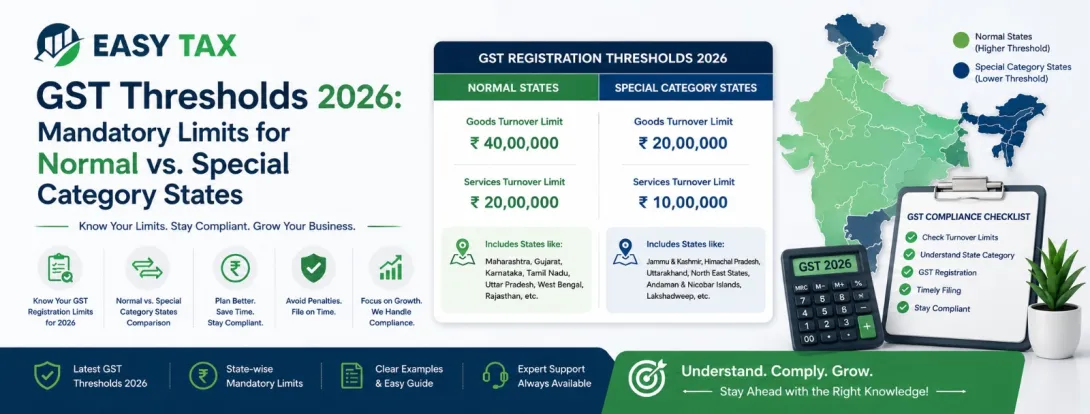
The general GST registration threshold is ₹20 lakh of aggregate turnover in a financial year. Eligible suppliers engaged exclusively in supplying goods may receive a higher exemption limit of ₹40 lakh in States where the relevant notification applies.
A lower threshold generally applies in the four special category States recognised for Section 22 registration purposes: Manipur, Mizoram, Nagaland and Tripura.
Quick comparison:
- Eligible exclusive goods suppliers in most States: up to ₹40 lakh.
- Goods suppliers in States excluded from the ₹40 lakh exemption: generally ₹20 lakh.
- Services-only and mixed suppliers in most States: ₹20 lakh.
- Special category States: a lower ₹10 lakh statutory baseline applies, subject to the applicable State-specific legal position.
These are threshold rules, not a guarantee that every business below the relevant amount is exempt. Sections 23 and 24 of the Central Goods and Services Tax Act, 2017, and applicable notifications must also be considered.
GST registration threshold comparison table for 2026
The applicable threshold depends on whether the supplier deals exclusively in goods, provides services or makes a combination of goods and services. The following table separates the general rules from the special-State position.
| Supplier category | Most States | Relevant lower-threshold States | Important condition |
|---|---|---|---|
| Exclusively supplying eligible goods | ₹40 lakh | Generally ₹20 lakh in States excluded from the ₹40 lakh exemption; special category States require separate verification. | The higher exemption is subject to Notification No. 10/2019-Central Tax and its exclusions. |
| Supplying services only | ₹20 lakh | ₹10 lakh in the four special category States, subject to applicable State-specific notifications. | Special exemptions may apply to specified categories of service suppliers. |
| Supplying both goods and services | ₹20 lakh | ₹10 lakh in the four special category States, subject to applicable State-specific notifications. | The ₹40 lakh goods exemption is not a general threshold for mixed suppliers. |
Which States are special category States for GST registration?
The expression "special category States" has a specific meaning for Section 22 of the CGST Act. It should not be confused with every State that may be described as a special category State in another policy or administrative context.
For the Section 22 registration definition, the four relevant States are:
- Manipur
- Mizoram
- Nagaland
- Tripura
The explanation to Section 22 refers to Article 279A(4)(g) of the Constitution but excludes Jammu and Kashmir, Arunachal Pradesh, Assam, Himachal Pradesh, Meghalaya, Sikkim and Uttarakhand from this definition. This is why the GST registration list is narrower than some older general-purpose lists of special category States.
The legal definition should be checked in Section 22 of the CGST Act .
Which States do not receive the ₹40 lakh goods exemption?
Notification No. 10/2019-Central Tax provides an exemption for eligible persons engaged exclusively in supplying goods up to ₹40 lakh, but it contains exceptions.
The notification excludes intra-State suppliers in the following States and Union territory from that higher exemption:
- Arunachal Pradesh
- Manipur
- Meghalaya
- Mizoram
- Nagaland
- Puducherry
- Sikkim
- Telangana
- Tripura
- Uttarakhand
For the six States in this list that are not special category States under Section 22—Arunachal Pradesh, Meghalaya, Puducherry, Sikkim, Telangana and Uttarakhand—the general goods threshold is ₹20 lakh.
Manipur, Mizoram, Nagaland and Tripura also fall within the special category definition for Section 22. Their lower-threshold position must be checked separately, including any notification that enhances the statutory baseline.
What is aggregate turnover under GST?
Aggregate turnover is not the same as profit, net income or the sales recorded under just one GST registration number.
Under Section 2(6) of the CGST Act, aggregate turnover broadly includes the combined value of the following supplies made by persons having the same PAN, computed on an all-India basis:
- Taxable supplies.
- Exempt supplies.
- Export of goods or services or both.
- Inter-State supplies.
The definition excludes central tax, State tax, Union territory tax, integrated tax and compensation cess. It also excludes the value of inward supplies on which tax is payable by the recipient under reverse charge.
For the statutory definition, refer to Section 2(6) of the CGST Act .
GST registration threshold examples
These examples illustrate how the threshold comparison works. They assume ordinary taxable supplies, no special compulsory-registration trigger, no specific exemption and no other fact that changes the result.
Example 1: A goods trader in Rajasthan
A trader in Jaipur supplies eligible goods exclusively and has aggregate turnover of ₹32 lakh during the financial year.
- Applicable general goods exemption limit: ₹40 lakh.
- Turnover: ₹32 lakh.
- Initial threshold result: below the ₹40 lakh limit.
The trader may fall within the higher exemption, provided all conditions of Notification No. 10/2019 are met and no compulsory registration provision applies.
Example 2: A service provider in Rajasthan
A Jaipur-based consultant provides taxable services and has aggregate turnover of ₹18 lakh during the financial year.
- General services threshold: ₹20 lakh.
- Turnover: ₹18 lakh.
- Initial threshold result: below ₹20 lakh.
The consultant would generally remain below the threshold, subject to compulsory-registration provisions and applicable exemptions.
Example 3: A business supplying goods and services
A business in a State other than a special category State supplies both goods and services and has aggregate turnover of ₹23 lakh.
- General mixed-supplier threshold: ₹20 lakh.
- Turnover: ₹23 lakh.
- Initial threshold result: above ₹20 lakh.
The business should examine its registration liability. It cannot automatically claim the ₹40 lakh exclusive-goods exemption merely because part of its turnover comes from goods.
Example 4: Two branches under the same PAN
A business has one location with ₹13 lakh turnover and another location with ₹9 lakh turnover. Both locations belong to the same legal person and PAN.
- First location: ₹13 lakh.
- Second location: ₹9 lakh.
- Combined aggregate turnover: ₹22 lakh.
The aggregate-turnover test is based on the combined PAN-level amount, not only the turnover of one branch. The applicable registration obligation and State-wise registrations must then be examined under the Act.
When can GST registration be compulsory below the turnover threshold?
A turnover threshold is not the only test for GST registration. Section 24 of the CGST Act identifies categories that may require compulsory registration notwithstanding Section 22.
These provisions cover specified categories such as certain persons making inter-State taxable supplies, casual taxable persons, non-resident taxable persons, persons liable under reverse charge, specified agents, input service distributors, specified e-commerce suppliers and e-commerce operators.
However, notifications provide exemptions or relaxations for certain categories. For example, specified small inter-State service suppliers and certain suppliers using e-commerce platforms may qualify for notified relief if the prescribed conditions are satisfied.
Situations where a person may not be liable to register
Section 23 contains categories that are not liable for registration. These include an agriculturist to the extent of supply of produce out of cultivation of land and persons exclusively engaged in supplying goods or services that are wholly exempt or not liable to tax under GST, subject to the statutory wording.
A person below the ordinary threshold may also choose voluntary registration. Voluntary registration is not the same as being legally required to register.
How to check and apply for GST registration
If your business appears to have crossed its applicable threshold, review the following points before submitting a registration application:
- Calculate aggregate turnover. Combine the relevant supplies under the same PAN across India.
- Identify your supply category. Determine whether you supply only goods, only services or both.
- Check the State-specific threshold. Review the applicable State and Union territory notifications.
- Check compulsory-registration provisions. Review Sections 23 and 24 and the relevant exemptions.
- Use the official GST Portal. Follow the current registration procedure and application requirements published by the Government.
The official portal is GST Portal — Government of India .
Section 25 of the CGST Act contains the general application provision for persons liable to registration. The time limit, documentation and process should be checked against the current Act, rules and portal instructions.
Frequently asked questions about GST registration limits
01 What is the GST registration limit for businesses in India in 2026?
The general threshold is ₹20 lakh of aggregate turnover in a financial year. Eligible persons exclusively supplying goods may qualify for the ₹40 lakh exemption in States where the relevant notification applies. Lower thresholds and exceptions must be checked for the relevant State and supplier category.
02 Is the GST limit ₹40 lakh for every business?
No. The ₹40 lakh exemption is for eligible persons engaged exclusively in supplying goods and is subject to specified exceptions. It is not a general threshold for service providers or mixed suppliers.
03 Which States are special category States for GST registration?
For the Section 22 registration definition, the four relevant States are Manipur, Mizoram, Nagaland and Tripura.
04 Are all special category States subject to the same GST limit?
Section 22 contains a ₹10 lakh baseline and permits the Government to enhance it up to ₹20 lakh through the prescribed notification process. Check the notification applicable to the specific State and type of supply. Official publications have described the goods position differently, so professional verification is advisable.
05 Does GST aggregate turnover include exempt supplies?
Yes. Aggregate turnover broadly includes taxable supplies, exempt supplies, exports and inter-State supplies under the same PAN, computed on an all-India basis, subject to statutory exclusions.
06 Is GST registration required if turnover is below ₹20 lakh?
Not necessarily. The answer depends on the applicable threshold, the State, the type of supply, compulsory-registration provisions and available exemptions. A business should not decide solely from the ₹20 lakh figure.
07 Does the ₹40 lakh exemption apply to businesses supplying both goods and services?
Generally, no. The higher exemption is intended for eligible persons engaged exclusively in supplying goods. A mixed supplier should examine the ordinary threshold and the applicable notifications.
08 Does each branch get a separate GST turnover limit?
Aggregate turnover is generally calculated across all relevant locations under the same PAN on an all-India basis. Separate GST registrations and State-level liability must be considered under the Act.
09 Did GST registration thresholds increase in 2026?
The Ministry of Finance stated in its Lok Sabha answer dated 9 February 2026 that no further GST Council recommendation had been made to revise the thresholds described in that answer. Check subsequent notifications before relying on any later claimed change.
10 Can a business register voluntarily below the GST threshold?
Yes. The CGST Act permits voluntary registration, subject to the applicable conditions. A voluntarily registered person must comply with the obligations applicable to a registered taxpayer.
Need help checking your GST registration liability?
The correct threshold can depend on your State, the type of supplies, PAN-level aggregate turnover and applicable exemptions. If you are unsure whether registration is required, have your business facts and relevant notifications reviewed before making a decision.
Contact EasyTax for GST assistance
EasyTax assistance is subject to review of the taxpayer's facts and applicable law. No registration outcome or tax result is guaranteed.
Official GST sources and legal references
The following sources support the legal framework discussed in this article. Always check the latest amended text and notifications applicable to the relevant State and transaction.
- Central Goods and Services Tax Act, 2017 — Section 22: Persons liable for registration, threshold framework and the definition of special category States.
CBIC Tax Information Portal — Section 22 - Central Goods and Services Tax Act, 2017 — Sections 23, 24 and 25: Persons not liable for registration, compulsory registration and registration procedure.
CBIC — Central Goods and Services Tax Act - Notification No. 10/2019-Central Tax dated 7 March 2019: Higher exemption threshold for eligible suppliers exclusively supplying goods and the specified exceptions.
Ministry of Finance / PIB — GST threshold decisions and notifications - Ministry of Finance — Lok Sabha Unstarred Question No. 1484, answered 9 February 2026: Government statement on the GST registration threshold and whether a further revision had been recommended.
Lok Sabha — GST Registration Threshold Limit - ICAI Handbook on Registration under GST, November 2025: Detailed discussion of Section 22, special category States, aggregate turnover and Notification No. 10/2019.
ICAI — Handbook on Registration under GST - CBIC GST Sectoral FAQs: Government explanations on registration thresholds and registration-related questions. Use these as guidance alongside the Act and applicable notifications.
CBIC — GST Sectoral FAQs - GST Portal: Official portal for registration and GST taxpayer services.
Government GST Portal
This article is general educational information, not an individual legal or tax opinion. The applicable registration position depends on the taxpayer's facts, current legislation, State notifications and exemptions. Obtain professional advice where the position is uncertain.
Was this guide helpful?
Related reading

Why Your Business Needs a CA: 7 Signs You Shouldn't Ignore
Skip to article Business Accounting & Taxation Why Your Business Needs a CA: 7 Signs You Shouldn't Ignore Business…
Why is My Gst Credit Blocked? Common Reasons and Solutions
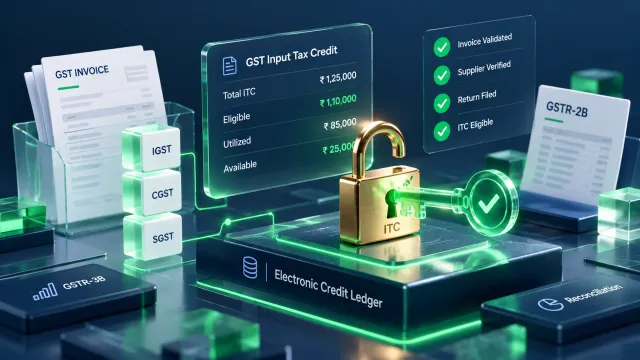
Understand why GST credit is blocked, how to check GSTR-2B and Section 16 conditions, and when Rule 37A, Section 17(5)…

Best Gst Consultant in Jaipur
EasyTax Home Blog Our services Contact Home / Blog / GST / Best GST Consultant in Jaipur GST compliance · Jaipur,…
Latest from the blog

SEO Agent connection test (temporary)
This is a temporary test post. It checks the connection between the EasyTax website and the SEO Agent publishing tool,…
Tax-Smart Tips for Salaried Employees: New Tax Regime
Tax-smart tips for salaried employees under the new tax regime: understand deductions, employer NPS, tax rebates,…
Tax-Smart Tips for Salaried Employees | EasyTax
Tax-smart tips for salaried employees under India’s new tax regime: compare deductions, employer NPS, rebates and…
EasyTax • Trusted by 10,000+ Clients
GST Return Filing & Compliance
Timely GSTR-1 & GSTR-3B filing, 100% ITC matching and department notice defense by certified GST experts.