

GSTR-1 and GSTR-3B Filing 2026: GST Return Guide
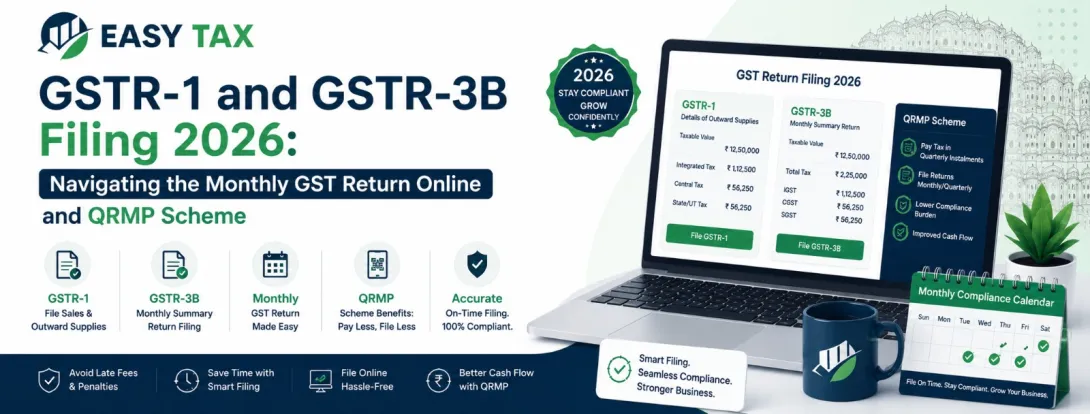
GSTR-1 and GSTR-3B Filing 2026: Monthly GST Returns, Due Dates and QRMP Scheme
GST return filing is an important responsibility for businesses registered under India’s Goods and Services Tax system.Two important compliance forms for regular taxpayers are GSTR-1 and GSTR-3B.
GSTR-1 reports outward supplies, while GSTR-3B is the summary return through which taxpayers report tax liabilities, eligible input tax credit (ITC), reversals and payment of tax.
This guide explains the difference between these returns, the monthly and quarterly filing options, the QRMP scheme, reconciliation checks, payment procedures and important GST Portal updates relevant in 2026.
01 What is the difference between GSTR-1 and GSTR-3B?
GSTR-1 and GSTR-3B serve different purposes. A taxpayer should prepare both returns using consistent sales, purchase and accounting records.
| Particular | GSTR-1 | GSTR-3B |
|---|---|---|
| Purpose | Reports details of outward supplies. | Reports summary tax liabilities, ITC and tax payment. |
| Information | Applicable invoice, debit note, credit note and other outward-supply details. | Taxable supplies, reverse-charge liabilities, eligible ITC, reversals and payment details. |
| Nature | Statement of outward supplies. | Summary return and tax-discharge mechanism. |
| Correction | Applicable amendments and corrections can be reported through permitted subsequent-period mechanisms, including GSTR-1A where available. | Once filed, GSTR-3B cannot simply be revised. Errors must be dealt with through legally permitted subsequent returns or other procedures. |
| Portal | GST Portal | GST Portal |
What is GSTR-1?
GSTR-1 is the statement in which a registered taxpayer reports applicable details of outward supplies of goods or services during the relevant tax period.
Depending on the taxpayer and transaction, the statement may include:
- Business-to-business (B2B) invoices.
- Applicable business-to-consumer (B2C) supply details.
- Export and other specified supply details.
- Debit notes and credit notes.
- Amendments to previously reported documents.
- Applicable exempt, nil-rated and non-GST supply information.
What is GSTR-3B?
GSTR-3B is a summary return used by applicable registered taxpayers to declare their tax liabilities, eligible input tax credit, required reversals, interest and late fee, and payment of tax.
The GST Portal provides auto-populated information to assist with return preparation. However, auto-populated figures should not be treated as a substitute for reviewing books, invoices, eligibility conditions and applicable GST provisions.
The official GST Portal guide explains the process for preparing, previewing, paying and filing GSTR-3B: Create and Submit GSTR-3B – GST Portal User Guide .
02 Monthly and quarterly GST return filing
The applicable filing frequency depends on the taxpayer's category, eligibility and selected filing option under the GST framework. Regular taxpayers may generally follow monthly filing or, if eligible and opted in, the Quarterly Return Monthly Payment (QRMP) scheme.
| Filing option | GSTR-1 | GSTR-3B | Tax payment |
|---|---|---|---|
| Monthly filing | Monthly | Monthly | With the applicable monthly return process. |
| QRMP | Quarterly | Quarterly | Monthly payment for the first two months, followed by adjustment through the quarterly return. |
03 What is the QRMP scheme?
QRMP stands for Quarterly Returns with Monthly Payment. It is an option for eligible taxpayers to file GSTR-1 and GSTR-3B quarterly while paying tax dues monthly for the first two months of the quarter, subject to the scheme's rules.
Who can opt for QRMP?
Under the GST Portal's published QRMP guidance, taxpayers with aggregate annual turnover of up to ₹5 crore in the current and preceding financial year, where applicable, may be eligible if they meet the other conditions, including filing the last due GSTR-3B.
QRMP is not automatic for every small business. The taxpayer should verify eligibility and select the applicable option on the GST Portal.
How does monthly payment work under QRMP?
For the first two months of a quarter, an eligible taxpayer generally deposits the applicable amount through a challan in Form PMT-06. The taxpayer may use the applicable self-assessment method or the prescribed fixed-sum method, where available.
- Month 1: Calculate and deposit the applicable monthly amount, subject to the scheme's conditions.
- Month 2: Repeat the applicable monthly payment process.
- Month 3: Prepare and file the quarterly GSTR-1 and GSTR-3B and account for payments already deposited.
The QRMP advisory generally specifies the 25th of the following month for the first-two-month challan process. Check the latest portal instructions and any applicable extension before making payment.
Invoice Furnishing Facility (IFF)
Eligible QRMP taxpayers may use the optional Invoice Furnishing Facility to furnish specified B2B invoice details for the first two months of a quarter. It helps recipients receive relevant invoice information earlier.
IFF is optional. It is not a separate quarterly return, and documents already furnished through IFF should not be reported again as new documents in the quarterly GSTR-1.
Read the official GST Portal QRMP advisory for eligibility, monthly payments, IFF and quarterly filing details.
04 GSTR-1 and GSTR-3B due dates in 2026
The following are the generally applicable due-date patterns for regular taxpayers. Specific notifications may extend or otherwise prescribe dates for particular tax periods or classes of taxpayers.
| Return or payment | General due-date pattern |
|---|---|
| Monthly GSTR-1 | 11th day of the following month, subject to applicable notifications. |
| Quarterly GSTR-1 under QRMP | 13th day of the month following the quarter, subject to applicable notifications. |
| Monthly GSTR-3B | Generally the 20th day of the following month. |
| Quarterly GSTR-3B under QRMP | Generally the 22nd or 24th day of the month following the quarter, depending on the State or Union Territory category. |
| QRMP monthly challan | Generally by the 25th of the month following the first or second month of the quarter, subject to the scheme and applicable instructions. |
Do not rely only on a calendar or a third-party article. Check the return dashboard after selecting the correct financial year, quarter and tax period.
Official portal: GST Portal – Returns Dashboard .
05 How to file GSTR-1 online
Prepare the outward-supply records before starting the online filing process. Keep sales invoices, debit notes, credit notes and relevant transaction details available for the selected tax period.
- Open the GST Portal. Visit www.gst.gov.in and sign in using the authorised credentials.
- Open the Returns Dashboard. Navigate to Services > Returns > Returns Dashboard.
- Select the correct tax period. Choose the financial year, quarter and month as applicable to the taxpayer's filing frequency.
- Open the GSTR-1 tile. Choose the available preparation option, such as online preparation or the supported offline upload process.
- Enter outward-supply information. Report applicable invoices, credit notes, debit notes, exports, amendments and other required supply details.
- Review the records. Check GSTINs, invoice numbers, dates, taxable values, tax rates, place-of-supply details and tax amounts.
- Generate and inspect the summary. Review the consolidated and recipient-wise summary. Correct discrepancies before proceeding.
- File the statement. Complete the filing using the permitted DSC or EVC method and verify the filing status and acknowledgement.
Refer to the official GST Portal guide for creating and submitting GSTR-1 .
06 How to file GSTR-3B online
GSTR-3B should be prepared after reviewing the relevant sales, purchase, ITC and tax-payment records. The portal may auto-populate some figures, but the taxpayer remains responsible for filing correct information.
- Sign in to the GST Portal. Open the Returns Dashboard and select the relevant tax period.
- Open GSTR-3B. Select the option to prepare the return for the applicable period.
- Review outward and reverse-charge liabilities. Check taxable outward supplies, applicable reverse-charge transactions and other relevant liability tables.
- Review eligible ITC. Compare the portal's auto-populated details with GSTR-2B, purchase records and the applicable ITC conditions.
- Report reversals and ineligible ITC. Account for reversals and blocked or otherwise ineligible credits as required by the CGST Act and Rules.
- Check interest and late fee. Review any amounts payable for delayed payment or delayed filing. Check system-generated calculations and make any required additional assessment.
- Preview the return. Inspect the draft return carefully before proceeding.
- Discharge the liability. Use the available electronic credit ledger and electronic cash ledger in accordance with the applicable utilisation rules. Generate a challan if additional cash payment is required.
- File and save the acknowledgement. Complete filing through the permitted DSC or EVC method. Confirm the filed status and retain the acknowledgement.
The official GST Portal provides a step-by-step GSTR-3B creation, payment and filing guide .
07 GSTR-2B and ITC reconciliation before filing
Input Tax Credit can reduce the eligible GST liability of a registered taxpayer, but it must be claimed in accordance with the CGST Act and Rules. A figure appearing in an auto-drafted statement does not by itself establish that every legal condition for claiming credit has been satisfied.
What is GSTR-2B?
GSTR-2B is an auto-drafted, read-only ITC statement based on relevant information furnished by suppliers and other specified sources. It helps taxpayers review inward-supply documents and prepare the eligible ITC portion of GSTR-3B.
What should businesses reconcile?
- Purchase register against GSTR-2B.
- Supplier GSTIN and invoice number.
- Invoice date and taxable value.
- IGST, CGST and SGST amounts.
- Credit notes and debit notes.
- Duplicate or incorrectly recorded invoices.
- Ineligible or blocked ITC and required reversals.
- Reverse-charge transactions and corresponding tax payment.
- Import-related ITC and relevant supporting records.
The GST Portal's GSTR-2B FAQ explains the statement and its use in preparing GSTR-3B. CBIC Circular No. 170/02/2022-GST also explains reporting of inter-State supplies and ineligible or reversed ITC.
08 Important GST Portal updates relevant in 2026
GSTR-3B interest calculation enhancement
A GSTN advisory explains an enhancement applicable from the January 2026 tax period for the portal's interest calculation in Table 5.1 of GSTR-3B. The calculation takes into account the minimum balance available in the electronic cash ledger during the relevant period, in line with the applicable Rule 88B provision.
The system-generated interest is a minimum amount. Taxpayers must still self-assess the correct interest liability and increase the amount where necessary.
Read the official GSTN advisory on interest collection and GSTR-3B enhancements .
Tax Liability Breakup confirmation
The GST Council Secretariat's March 2026 newsletter describes a GSTR-3B portal update for the “Tax Liability Breakup, As Applicable” tab. From the February 2026 tax period, the tab is auto-populated for specified previous-period supplies reported in a later period where the related liability is being discharged in the current GSTR-3B.
Taxpayers covered by this workflow should review the breakup and confirm or edit it as appropriate before completing filing.
Source: GST Council Newsletter, March 2026 .
Auto-population does not remove taxpayer responsibility
GST Portal auto-population is intended to assist return preparation. Taxpayers should compare system-generated figures with their accounting records and supporting documents and correct discrepancies through the permitted mechanism before filing.
09 Late fees and interest for delayed GST returns
Delay in furnishing required GST statements or returns can result in late fees under the applicable provisions. Delayed payment of tax can also attract interest.
Late fee
Section 47 of the CGST Act provides for a late fee where the required details or returns are not furnished by the due date. The statutory provision states a base amount of ₹100 per day, subject to the specified maximum under the provision. Applicable notifications, waivers, reduced amounts and State or Union Territory provisions must also be checked for the relevant period.
Interest
Section 50 of the CGST Act provides for interest on delayed payment of tax, subject to the applicable notified rate and statutory calculation provisions. The actual liability depends on the facts, period of delay and relevant rules.
Official references:
10 Common mistakes while filing GSTR-1 and GSTR-3B
- Incorrect GSTIN: Verify the recipient's GSTIN before reporting B2B invoices.
- Wrong invoice details: Check invoice number, date, taxable value and tax rate against the original document.
- Incorrect place of supply: Review the applicable place-of-supply rules and the nature of the transaction.
- Mismatch between sales records and GSTR-1: Reconcile the outward-supply statement with the sales register and accounting records.
- Claiming ITC without checking eligibility: Review GSTR-2B, invoices, statutory conditions and applicable reversals before claiming credit.
- Ignoring reverse charge: Identify transactions on which tax is payable under reverse charge and report them correctly.
- Relying entirely on auto-populated values: Review the system-generated return against actual books and supporting documents.
- Missing the filing frequency: Confirm whether the taxpayer follows monthly filing or QRMP.
- Not saving filing evidence: Retain filed return acknowledgements, challans and relevant reconciliation records.
11 Practical GST return pre-filing checklist
Use this checklist before submitting the applicable return for a tax period:
- Confirm the correct GSTIN and tax period.
- Confirm whether monthly or QRMP filing applies.
- Reconcile sales invoices with the books.
- Check credit notes, debit notes and amendments.
- Review exports and inter-State supply details where applicable.
- Reconcile purchase records with GSTR-2B.
- Check ITC eligibility and required reversals.
- Review reverse-charge liabilities.
- Verify tax liability and available ledger balances.
- Check applicable interest and late fees.
- Preview the return before filing.
- Save the filed return acknowledgement and payment records.
12 Frequently asked questions
01 What is the main difference between GSTR-1 and GSTR-3B?
GSTR-1 reports details of outward supplies. GSTR-3B is the summary return used to report tax liabilities, eligible ITC, reversals and payment of tax.
02 Is GSTR-1 filed monthly or quarterly?
It depends on the taxpayer's applicable filing option. Regular taxpayers generally file monthly, while eligible taxpayers who opt for QRMP can file GSTR-1 quarterly.
03 Who is eligible for the QRMP scheme?
The GST Portal's QRMP guidance provides eligibility for qualifying taxpayers with aggregate annual turnover up to ₹5 crore in the current and preceding financial year, where applicable, subject to the other conditions and portal requirements.
04 Does QRMP mean that GST is paid only once every quarter?
No. Under QRMP, GSTR-1 and GSTR-3B are filed quarterly, but the applicable tax payment is generally made monthly for the first two months through the prescribed challan process.
05 What is the general due date for monthly GSTR-1?
The general due date is the 11th day of the following month, subject to applicable notifications or extensions.
06 What is the general due date for monthly GSTR-3B?
For regular monthly filers, the general due date is the 20th day of the following month, subject to applicable notifications and extensions.
07 Is GSTR-2B enough to claim input tax credit?
GSTR-2B is an important reconciliation statement, but it does not replace the legal eligibility checks under the CGST Act and Rules. Taxpayers should review invoices, statutory conditions, restrictions and reversals before claiming ITC.
08 Can GSTR-3B be revised after filing?
GSTR-3B cannot simply be revised after filing. An error should be examined and corrected through the legally permitted subsequent-period return or other applicable procedure.
09 Is a Nil GSTR-3B return required when there is no business activity?
The GST Portal's GSTR-3B filing guidance states that a Nil return is required for an applicable tax period even where there is no business activity. Confirm the taxpayer's return obligation and available Nil filing method on the portal.
10 Where can I check the latest GST return due dates?
Check the official GST Portal, the relevant return dashboard and applicable CBIC notifications. Due dates may be extended for specified taxpayers or tax periods.
13 Official GST sources and references
The following primary government and GST Portal resources are useful for checking return requirements and filing procedures. Always check the relevant version, tax period and subsequent notifications.
- CGST Act, 2017: CBIC – Central Goods and Services Tax Act (including Sections 37, 39, 47 and 50).
- GSTR-1 filing procedure: GST Portal – GSTR-1 User Guide .
- GSTR-3B filing procedure: GST Portal – Create and Submit GSTR-3B .
- QRMP scheme: GST Portal – QRMP Advisory .
- GSTR-2B: GST Portal – GSTR-2B FAQs .
- ITC reporting: CBIC Circular No. 170/02/2022-GST .
- 2026 interest calculation update: GSTN Advisory on Interest Collection and GSTR-3B Enhancements .
- 2026 liability breakup update: GST Council Newsletter – March 2026 .
- Notifications: CBIC Central Tax Notifications .
- Return filing: Official GST Portal .
Need assistance with GST return filing?
Preparing GSTR-1 and GSTR-3B involves reviewing sales records, purchase documents, input tax credit, tax liabilities and filing requirements. If you need professional assistance, explore EasyTax's GST return filing and compliance services.
Confirm the exact service scope, applicable professional fees, required documents and engagement terms with EasyTax before proceeding.
Conclusion
GSTR-1 and GSTR-3B are important parts of regular GST compliance. GSTR-1 communicates outward-supply information, while GSTR-3B reports the taxpayer's summary liabilities, eligible ITC and payment details.
Businesses should confirm their filing frequency, follow the applicable due dates, reconcile outward and inward supplies, review ITC eligibility and verify system-generated figures before submitting returns.
For 2026 compliance, taxpayers should also review the applicable GST Portal advisories and notifications rather than relying on unverified claims about automated validations or return restrictions.
Was this guide helpful?
Related reading

Why Your Business Needs a CA: 7 Signs You Shouldn't Ignore
Skip to article Business Accounting & Taxation Why Your Business Needs a CA: 7 Signs You Shouldn't Ignore Business…

Why is My Gst Credit Blocked? Common Reasons and Solutions
Understand why GST credit is blocked, how to check GSTR-2B and Section 16 conditions, and when Rule 37A, Section 17(5)…

Best Gst Consultant in Jaipur
EasyTax Home Blog Our services Contact Home / Blog / GST / Best GST Consultant in Jaipur GST compliance · Jaipur,…
Latest from the blog

SEO Agent connection test (temporary)
This is a temporary test post. It checks the connection between the EasyTax website and the SEO Agent publishing tool,…
Tax-Smart Tips for Salaried Employees: New Tax Regime
Tax-smart tips for salaried employees under the new tax regime: understand deductions, employer NPS, tax rebates,…
Tax-Smart Tips for Salaried Employees | EasyTax
Tax-smart tips for salaried employees under India’s new tax regime: compare deductions, employer NPS, rebates and…
EasyTax • Trusted by 10,000+ Clients
GST Return Filing & Compliance
Timely GSTR-1 & GSTR-3B filing, 100% ITC matching and department notice defense by certified GST experts.