
Tax Benefit Calculator India: Compare Tax Regimes
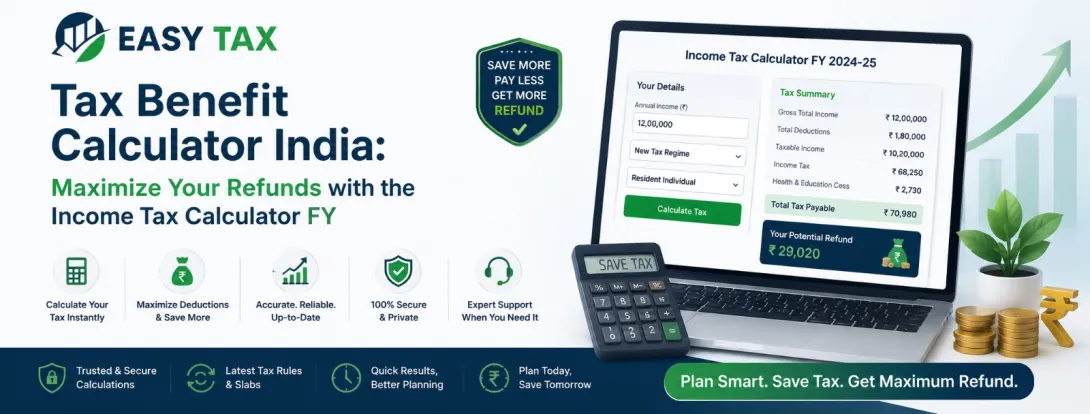
Tax Benefit Calculator India: How to Compare Tax Regimes and Estimate Your Tax
Choosing the right income-tax regime can affect how much tax you pay and how much of your income you retain. A tax benefit calculator helps you estimate your tax liability, compare the old and new tax regimes, and understand how eligible deductions and rebates affect your final tax.
For Assessment Year (AY) 2026–27, taxpayers are filing returns for income earned during Financial Year (FY) 2025–26. The applicable law for this return is the Income-tax Act, 1961, even though the Income-tax Act, 2025 came into force from 1 April 2026. This distinction matters when selecting a calculator, checking a deduction or preparing your return.
In this guide, you will learn how to use a tax benefit calculator, understand the AY 2026–27 tax slabs, compare eligible deductions under both regimes and estimate whether you may receive a refund or need to pay additional tax.
What Is a Tax Benefit Calculator?
A tax benefit calculator is an online tool that estimates income tax using details such as your income, eligible deductions, exemptions and tax regime. Depending on the calculator's supported features, it can help you compare the estimated liability under the old and new regimes.
The result is an estimate based on the information entered. It does not independently verify your salary certificates, investment documents, tax-credit statements or eligibility for deductions. You should reconcile the result with your records before filing your Income Tax Return (ITR).
You can use the EasyTax Income Tax Calculator to review the available FY 2025–26 calculation options. Check the financial year displayed by the tool before entering your details.
AY 2026–27: Which Income-tax Law Applies?
The Income-tax Act, 2025 commenced on 1 April 2026. However, the introduction of the new Act does not mean that the FY 2025–26 return is governed by the new law.
| Income period | Return period | Applicable law |
|---|---|---|
| 1 April 2025 to 31 March 2026 | AY 2026–27 | Income-tax Act, 1961 |
| 1 April 2026 to 31 March 2027 | Tax Year 2026–27 | Income-tax Act, 2025 |
Accordingly, taxpayers filing a return for FY 2025–26 should select AY 2026–27 and follow the applicable provisions of the 1961 Act. Tax Year 2026–27 is a separate compliance period, and its return is filed after that tax year ends.
For further details, refer to the Income Tax Department's official FAQs on the new Act.
New Tax Regime Slabs for AY 2026–27
For FY 2025–26 / AY 2026–27, the new tax regime under section 115BAC of the Income-tax Act, 1961 has the following slab rates for eligible individual taxpayers:
| Taxable income | Tax rate |
|---|---|
| Up to ₹4,00,000 | Nil |
| ₹4,00,001 to ₹8,00,000 | 5% |
| ₹8,00,001 to ₹12,00,000 | 10% |
| ₹12,00,001 to ₹16,00,000 | 15% |
| ₹16,00,001 to ₹20,00,000 | 20% |
| ₹20,00,001 to ₹24,00,000 | 25% |
| Above ₹24,00,000 | 30% |
These are progressive slab rates. Each rate applies only to the portion of taxable income falling within that slab, not to the entire income.
The new regime is the default regime for eligible taxpayers. Eligible taxpayers may opt for the old regime subject to the applicable rules and conditions. The correct choice depends on the taxpayer's income, deductions, exemptions and other tax circumstances.
For the official AY 2026–27 slab information, refer to the Income Tax Department's guidance for salaried individuals.
Section 87A Rebate: When Can Tax Be Reduced to Zero?
For AY 2026–27, an eligible resident individual opting for the new tax regime may claim a rebate under section 87A if the individual's total taxable income does not exceed ₹12 lakh. The maximum rebate under this regime is ₹60,000, subject to the statutory conditions.
The rebate reduces eligible income tax. It is not a deduction from gross income and is not automatically available to every taxpayer. Special-rate income, non-resident status and other statutory conditions can affect the final calculation.
How the ₹12.75 lakh salary figure works
An eligible salaried individual under the new regime may claim a standard deduction of up to ₹75,000. If the individual's gross salary is ₹12.75 lakh and the full standard deduction is available, the resulting taxable salary income may be ₹12 lakh before considering any other income or adjustments.
At taxable income of ₹12 lakh, the slab tax under the new regime is ₹60,000:
| Income portion | Rate | Tax |
|---|---|---|
| First ₹4,00,000 | Nil | ₹0 |
| Next ₹4,00,000 | 5% | ₹20,000 |
| Next ₹4,00,000 | 10% | ₹40,000 |
| Total slab tax | ₹60,000 | |
| Eligible section 87A rebate | −₹60,000 | |
| Income tax after rebate | ₹0 |
This illustration assumes an eligible resident individual with salary income, the full standard deduction and no additional income taxed at special rates or other adjustments. It is not a universal tax-free threshold for every taxpayer.
Where taxable income exceeds ₹12 lakh, marginal relief may apply in eligible cases. The calculation should be made using the applicable statutory formula rather than assuming that every rupee above the threshold is taxed in the same way.
Old Tax Regime: When Can Deductions Help?
The old tax regime may be useful for taxpayers who qualify for substantial deductions and exemptions. It generally allows a wider range of deductions than the new regime, but it also has different slab rates.
Depending on eligibility and the facts of the case, deductions and exemptions under the old regime may include:
- Section 80C: Eligible investments and payments such as life insurance premiums, qualifying provident fund contributions, PPF and eligible ELSS investments, subject to the aggregate statutory limit.
- Section 80D: Eligible health insurance premiums and specified medical expenditure, subject to the applicable conditions and limits.
- Section 80CCD(1B): Eligible additional contributions to the National Pension System, subject to the statutory limit and conditions.
- Section 24(b): Eligible interest on borrowed capital for a house property, subject to the applicable property-use and deduction rules.
- HRA exemption: Eligible salaried employees may claim house rent allowance exemption under the applicable provisions, subject to the prescribed calculation and supporting conditions.
These deductions are not automatically available to everyone. The nature of the payment, the taxpayer's records, statutory limits and other conditions must be checked.
For a comparison of the available regimes, use the EasyTax Old vs New Regime Comparator. You can also review the EasyTax tax planning service for assistance in evaluating eligible tax-planning options.
Which Regime Is Better: Old or New?
There is no single deduction amount or salary level at which the old regime is always better. The result depends on the taxpayer's age where relevant, income composition, salary structure, eligible deductions, exemptions, house-property income, capital gains and other tax circumstances.
A taxpayer with limited deductions may find the new regime more beneficial because of its slab structure. Another taxpayer with substantial eligible deductions and exemptions may obtain a lower liability under the old regime.
Instead of relying on a general break-even figure, calculate both regimes using the same income details and only those deductions for which you are eligible.
Information to compare
| Information | Why it matters |
|---|---|
| Annual salary and other income | Establishes the income to be considered under each regime. |
| Standard deduction | Reduces eligible salary income according to the applicable regime. |
| Eligible investments and payments | Helps determine deductions available under the old regime. |
| Rent and HRA details | Helps determine whether an HRA exemption is available under the old regime. |
| Home-loan interest | May affect the calculation depending on the property and applicable provisions. |
| Employer NPS contribution | May qualify for a deduction under the applicable provisions, including under the new regime where conditions are met. |
| Capital gains and special-rate income | May be subject to separate tax rates and rebate limitations. |
How to Use a Tax Benefit Calculator
Follow these steps to estimate your tax liability and compare the regimes:
- Select the correct tax period: For income earned during FY 2025–26, select FY 2025–26 or AY 2026–27, depending on how the calculator labels the period.
- Enter your income: Add salary, pension and other applicable income. Include other taxable income rather than relying only on your Form 16.
- Enter eligible deductions: Add only deductions supported by the applicable tax rules and your records.
- Review both regimes: Compare the estimated liability under the old and new regimes using the same income information.
- Check tax credits: Reconcile TDS, advance tax and self-assessment tax with your records and the available tax statements.
- Review the result: Check taxable income, slab tax, rebate, cess, surcharge where applicable and final estimated liability.
Open the EasyTax Income Tax Calculator to review its available inputs and calculation period. The live calculator currently identifies its supported period as FY 2025–26. Do not rely on it for Tax Year 2026–27 unless the tool is updated and its new-Act calculations are clearly identified and tested.
How Is an Income-tax Refund Estimated?
A refund is not the same as tax savings. It generally arises when the eligible taxes already paid or credited to your account exceed the final tax liability determined after considering your income, deductions, rebates and other applicable provisions.
A simplified way to understand the calculation is:
Estimated refund = Eligible tax payments and credits − Final tax liability
For example, if your final tax liability is lower than the eligible TDS and advance tax already paid, you may have a refund due. If the tax already paid is lower than your final liability, you may need to pay the balance tax.
The final refund, if any, is subject to the return being processed and the tax credits being accepted and matched by the Income Tax Department. A calculator can provide an estimate, but it cannot guarantee that a refund will be issued or processed for a particular amount.
Documents and Details to Keep Ready
Accurate information improves the usefulness of a tax estimate. Depending on your income sources and claims, keep the following records available:
- PAN and applicable personal details.
- Form 16 and salary statements, where applicable.
- Bank interest certificates and details of other income.
- Form 26AS and Annual Information Statement (AIS) for tax-credit and transaction reconciliation.
- Proof of eligible investments, insurance premiums and other deductions.
- Home-loan interest certificate and relevant property details, where applicable.
- Details of employer NPS contributions and other eligible retirement contributions.
- Details of TDS, advance tax and self-assessment tax payments.
Do not assume that every transaction will automatically appear in AIS or that every item shown in AIS is necessarily taxable in the manner displayed. Review the information, provide feedback where appropriate and report all taxable income correctly.
If you need to estimate tax deducted at source, you can also use the EasyTax TDS Calculator. For eligible NPS-related planning, refer to the EasyTax NPS Calculator.
Common Mistakes to Avoid When Comparing Tax Benefits
A regime comparison is useful only when the information entered is complete and accurate. Avoid these common mistakes:
- Using the wrong tax period: Do not mix FY 2025–26 / AY 2026–27 rules with Tax Year 2026–27 provisions under the new Act.
- Claiming deductions without checking eligibility: An investment or payment qualifies only if it meets the applicable statutory conditions.
- Ignoring income apart from salary: Bank interest, rent, capital gains and other taxable income may change the final result.
- Confusing a rebate with a deduction: A deduction reduces eligible income, while a rebate reduces eligible income tax.
- Ignoring special-rate income: Some capital gains and other specified income may not follow ordinary slab treatment.
- Assuming the estimated refund is guaranteed: Refunds depend on the final return, tax-credit reconciliation and Department processing.
- Relying on an outdated calculator: Always check the year, legal framework and features supported by the calculator.
Important Note on Tax Year 2026–27
The Income-tax Act, 2025 applies to Tax Year 2026–27, which begins on 1 April 2026. The new Act uses the term “Tax Year” instead of the earlier Assessment Year framework and contains its own provisions for tax rates, deductions and rebates.
The new Act retains a default new tax regime under section 202. However, statutory references and the availability of deductions must be checked under the new Act rather than assumed from the old Act. For example, provisions previously referred to by sections 80C and 87A should not simply be copied into a Tax Year 2026–27 explanation without checking their corresponding new-Act provisions.
The Income Tax Department confirms that AY 2026–27 returns for FY 2025–26 continue under the 1961 Act, while Tax Year 2026–27 compliance follows the 2025 Act. The two periods must be treated separately.
Read the Department's official new-Act transition FAQs before relying on a calculation for the new tax year.
Frequently Asked Questions
01 What is a tax benefit calculator?
A tax benefit calculator estimates income tax using information such as income, eligible deductions, rebates and the selected tax regime. It helps taxpayers compare possible tax outcomes, but the result depends on the accuracy of the information entered and the features supported by the tool.
02 Which tax regime is the default for AY 2026–27?
The new tax regime under section 115BAC of the Income-tax Act, 1961 is the default regime for eligible taxpayers for AY 2026–27. Eligible taxpayers may opt for the old regime subject to the applicable conditions and filing requirements.
03 Can an eligible salaried individual have zero tax on salary of ₹12.75 lakh?
An eligible resident salaried individual under the new regime may have taxable salary income of ₹12 lakh after a standard deduction of up to ₹75,000 on gross salary of ₹12.75 lakh. The section 87A rebate may reduce the eligible tax to zero, subject to the statutory conditions and the nature of the individual's other income.
04 Is the old tax regime always better if I have deductions?
No. The value of deductions must be compared with the tax rates and benefits under the new regime. The result depends on your total income, eligible deductions, exemptions and other tax circumstances.
05 Is there a fixed break-even deduction amount for choosing the old regime?
No universal break-even amount applies to every taxpayer. The result varies with income, age where relevant, salary structure, deductions, exemptions, capital gains and other circumstances. Compare both regimes using your own eligible figures.
06 Does a tax benefit calculator guarantee an income-tax refund?
No. A calculator estimates tax liability and may help you estimate whether a refund could arise. The actual refund depends on the final return, eligible tax credits, processing and verification by the Income Tax Department.
07 Can I use the EasyTax income-tax calculator for Tax Year 2026–27?
The linked EasyTax calculator currently identifies its coverage as FY 2025–26. Check the live tool for its current supported period. Do not use it as a Tax Year 2026–27 calculator unless the tool has been updated to support the Income-tax Act, 2025 and its calculations have been tested.
08 What should I check before filing my ITR?
Check your income details, eligible deductions, tax regime, Form 16 where applicable, Form 26AS, AIS, TDS credits, bank details and tax payments. Make sure the selected assessment year and return form are appropriate for your circumstances.
Get Help With Tax Planning and ITR Filing
A tax calculator is a useful starting point, but complex income sources, deductions, capital gains, house-property income and business income may require a closer review. A qualified tax professional can help examine the records, identify applicable provisions and review the return before submission.
Need assistance with your income-tax return?
Explore EasyTax Expert-Assisted ITR Filing for support with return preparation, document review and filing-related questions. The service does not guarantee a particular refund or that a return will never receive a notice.
You can also explore the EasyTax services directory to find tax and compliance assistance.
Official References
For current and authoritative information, refer to the following government resources:
- Income Tax Department: Salaried Individuals for AY 2026–27 — tax slabs, regime guidance and return-related information.
- Income Tax Department: Objective and Scope of the New Act FAQs — transition from the 1961 Act to the 2025 Act.
- Income Tax Department: Income Tax Returns FAQs — return filing under the two Acts and the distinction between AY 2026–27 and Tax Year 2026–27.
- Finance Bill 2025 — amendments to the new-regime slab structure applicable from AY 2026–27.
Disclaimer
This article is for general educational information and should not be treated as personalised tax advice. Tax liability depends on the taxpayer's residential status, income sources, age where relevant, eligible deductions, exemptions, special-rate income and the law applicable to the relevant tax period. Verify the applicable provisions and current official guidance before making tax or filing decisions.
Reviewed by: The article should be reviewed and approved by the designated EasyTax Chartered Accountant before publication. Update the reviewer name, review date and source-check date only after that review has actually taken place.
Was this guide helpful?
Related reading
Tax-Smart Tips for Salaried Employees: New Tax Regime
Tax-smart tips for salaried employees under the new tax regime: understand deductions, employer NPS, tax rebates,…
Tax-Smart Tips for Salaried Employees | EasyTax
Tax-smart tips for salaried employees under India’s new tax regime: compare deductions, employer NPS, rebates and…
Revised Form 161: CBDT Notification 134/2026 Explained
Income Tax · India · Tax update Revised Form 161: CBDT Notification 134/2026 Explained Updated: 19 November 2026 ·…
Latest from the blog
SEO Agent connection test (temporary)
This is a temporary test post. It checks the connection between the EasyTax website and the SEO Agent publishing tool,…

The Complete Guide to the Bank Audit Process
Home / Blog / Tax compliance EasyTax · Tax compliance guide Tax Compliance in India: Income Tax, GST & TDS Tax…

Ca Services for Startups: What We Offer and Why It Matters
Home › Blog › Startup & CA Startup & CA CA Services for Startups in India: What Founders Need and Why It Matters From…
EasyTax • Trusted by 10,000+ Clients
Expert Assisted ITR Filing
Dedicated CA prepares, verifies, and files your ITR. Maximum refund, accurate deductions, zero notices.