

New GST Registration Process 2026 : A Step-by-Step Guide to Goods and Services Tax Enrollment
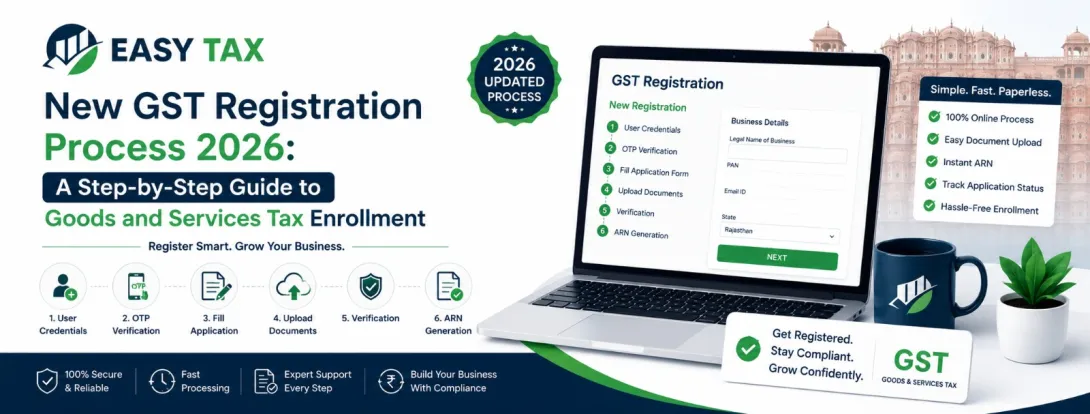
GST Registration Process in India 2026: Eligibility, Documents and Step-by-Step Guide
Starting a business, expanding into another State or selling products through an online marketplace can raise an important question: When do you need GST registration, and how do you apply for it?
GST registration is the process through which a person liable to register under the Goods and Services Tax law obtains a GST Identification Number (GSTIN). The requirement depends on factors such as aggregate turnover, the nature and location of supplies, business activities and applicable exemptions.
This guide explains the GST registration process in India for 2026, including eligibility, documents, online application, Aadhaar authentication, application tracking and important responsibilities after registration.
01 What Is GST Registration?
GST registration is the legal process of registering a business or other eligible person under the GST system. After registration is granted, the applicant receives a GSTIN, which is used for GST-related compliance, invoicing, returns and other applicable activities.
A GSTIN is a 15-character identification number associated with a registered person in a particular State or Union Territory. Registration is generally State-specific. A person operating in multiple States may need separate registrations depending on the applicable provisions.
The principal legal provisions concerning registration are contained in Sections 22 to 30 of the Central Goods and Services Tax Act, 2017, along with the corresponding State or Union Territory GST law and relevant rules and notifications.
Official reference: CBIC – CGST Act, Section 22 .
02 Who Needs GST Registration?
A person may become liable to register because their aggregate turnover crosses the applicable threshold or because a specific provision of the GST law requires registration.
Depending on the circumstances, this can include:
- Businesses supplying taxable goods or services.
- Manufacturers and wholesalers.
- Retailers and traders.
- Service providers and consultants.
- Businesses operating in more than one State.
- Specified e-commerce operators and sellers.
- Casual taxable persons and non-resident taxable persons.
- Persons required to register under a specific provision or notification.
03 GST Registration Thresholds in India
Section 22 of the CGST Act provides the general turnover-based registration framework. The applicable threshold depends on the State or Union Territory and the nature of the supplies.
| Situation | General legal framework | Important qualification |
|---|---|---|
| Supplier in a State other than a specified special-category State | Generally ₹20 lakh aggregate turnover in a financial year. | Check applicable notifications and the nature of the supply. |
| Supplier making taxable supplies from specified special-category States | Section 22 contains a general ₹10 lakh threshold framework. | Some States have notified different thresholds, subject to conditions. |
| Person exclusively supplying goods | An exemption up to ₹40 lakh may be available in eligible cases. | This is notification-based and subject to State exclusions and conditions. |
The ₹40 lakh exemption is not a universal threshold for every goods supplier. It is available only where the conditions of the relevant notification are met. A person supplying services, mixed supplies or supplies falling within an excluded category should not automatically apply this exemption.
The term aggregate turnover generally refers to the all-India value of supplies made by persons having the same PAN, including taxable supplies, exempt supplies, exports and inter-State supplies, computed in the manner prescribed by the GST law. It excludes GST and certain other amounts as provided by law.
Before applying a threshold, check the current legal position for the State, business activity and relevant financial year.
Official references: CGST Act – Section 22 and Notification No. 10/2019-Central Tax .
04 Compulsory Registration and Important Exceptions
Section 24 of the CGST Act lists certain categories of persons who may be required to register irrespective of the general threshold under Section 22. However, the section must be read along with applicable exemptions and notifications.
Categories covered by Section 24 include, subject to the law and applicable exceptions:
- Persons making inter-State taxable supplies.
- Casual taxable persons making taxable supplies.
- Non-resident taxable persons making taxable supplies.
- Persons liable to pay tax under reverse charge.
- Specified agents making taxable supplies on behalf of others.
- Input Service Distributors.
- Specified suppliers using e-commerce operators required to collect tax at source.
- Specified e-commerce operators.
- Other persons or classes notified by the Government.
Inter-State supplies
Section 24 includes persons making inter-State taxable supplies within its compulsory-registration framework. However, notified exceptions exist for specified categories and circumstances. Therefore, it is inaccurate to say that every inter-State seller must register regardless of turnover and without exception.
E-commerce sellers
The registration position for sellers using an e-commerce operator depends on the type of supply, the operator's role, the relevant provisions and applicable notifications. Certain eligible suppliers have been given exemptions or special registration routes.
A seller should not assume that selling through an online marketplace automatically creates the same registration obligation in every case.
Official reference: CBIC – CGST Act, Section 24 .
05 Documents Required for GST Registration
The documents required depend on the constitution of the business, the identity of the applicant and the nature of the premises. The GST Portal may display different document requirements for different situations.
Common information and documents
- PAN of the business or proprietor, as applicable.
- Valid mobile number and email address of the primary authorised signatory.
- Photograph of the proprietor, partners, directors or relevant authorised persons, as applicable.
- Proof of constitution of business, where applicable.
- Identity and address details of promoters, partners or directors, as applicable.
- Details of the authorised signatory.
- Principal place of business address and supporting premises documents.
- Additional place of business details, if applicable.
- Bank account information when required under the applicable post-registration process.
Business constitution documents
| Business type | Examples of relevant supporting information |
|---|---|
| Proprietorship | Proprietor's PAN and identity details, photograph and applicable business/premises documents. |
| Partnership firm | Partnership deed and details of partners and authorised signatory. |
| LLP | LLP incorporation details, designated partner information and authorised signatory details. |
| Company | Certificate of incorporation, company PAN and relevant director/authorised signatory details. |
| Trust, society or other entity | Constitution or registration documents relevant to the entity and its authorised representatives. |
Proof of principal place of business
The appropriate premises document depends on whether the property is owned, rented, leased or used with permission.
- Owned premises: relevant ownership or property documents accepted by the portal.
- Rented premises: applicable rent or lease agreement and supporting ownership or possession documents as required.
- Consent-based premises: consent documentation and supporting proof as applicable.
- Shared premises: relevant consent and premises evidence based on the actual arrangement.
Refer to the official GST Portal registration manual for the current application fields and instructions.
06 Step-by-Step GST Registration Process Online
A normal taxpayer can apply through the official GST Portal. The application is submitted electronically and is divided into Part A and Part B.
Step 1. Open the official GST Portal
Visit www.gst.gov.in . Select Services → Registration → New Registration.
Step 2. Complete Part A
Select the appropriate taxpayer category and enter the required information, including:
- State or Union Territory.
- District.
- Legal name of the business as per PAN.
- PAN of the business or proprietor, as applicable.
- Email address of the primary authorised signatory.
- Mobile number of the primary authorised signatory.
Complete the OTP verification process using the details entered. The portal will generate a Temporary Reference Number (TRN).
Step 3. Log in using the TRN
Return to the New Registration page and select the TRN option. Enter the TRN and complete the required OTP verification to access the saved application.
The GST Portal manual states that the saved application associated with a TRN is subject to a 15-day validity period. Complete and submit the application within the displayed validity period.
Step 4. Complete Part B
Fill in the application tabs applicable to your business. These may include:
- Business details.
- Promoters or partners.
- Authorised signatory.
- Authorised representative, where applicable.
- Principal place of business.
- Additional places of business.
- Goods and services.
- State-specific information.
- Aadhaar authentication and verification, as applicable.
Step 5. Upload supporting documents
Upload the documents requested for the selected business type and premises category. Check that the documents are genuine, readable and consistent with the information in the form.
Step 6. Complete the applicable verification
Follow the Aadhaar authentication, biometric authentication or document-verification instructions shown by the GST Portal for the application. The process may vary depending on the applicant and risk-based system checks.
Step 7. Submit the application
Complete the declaration and submit the application using the applicable electronic verification method. DSC is mandatory for certain categories, including companies and LLPs, as specified by the portal instructions.
Step 8. Save the ARN
After successful submission and completion of the required authentication steps, the portal generates an Application Reference Number (ARN). Save the acknowledgement and use the ARN to track the application's status.
07 Aadhaar Authentication and Biometric Verification
Aadhaar authentication is an important part of the GST registration process for applicants covered by the applicable provisions. The authentication requirements depend on the constitution of the business and the persons identified for verification.
Depending on the application and system checks, the process may involve OTP-based Aadhaar authentication, biometric authentication at a designated GST Suvidha Kendra (GSK), document verification or other prescribed checks.
What happens if Aadhaar authentication is not completed?
Where an applicant does not opt for Aadhaar authentication or does not complete the applicable authentication, the application may be subject to the alternative verification process prescribed under the GST Rules. This can include photo capture and document verification at a designated centre.
Risk-based physical verification may also apply in specified circumstances, including cases identified by the common portal.
Follow the exact instructions and appointment details generated for your application. Do not rely on a general online claim that every applicant will receive approval within seven working days.
Official reference: GST Portal – Registration and Aadhaar Authentication Manual .
08 How Long Does GST Registration Take?
The processing timeline depends on the application, completeness of documents, authentication requirements and whether the proper officer needs clarification or verification.
Under Rule 9 of the CGST Rules, an application that is found to be in order is generally to be approved within seven working days from submission. However, additional time and procedures can apply in specified cases, including cases involving incomplete Aadhaar authentication, risk-based physical verification or a request for clarification.
If the officer requests clarification
If the proper officer identifies a discrepancy, a notice may be issued in FORM GST REG-03. The applicant is generally required to submit a reply in FORM GST REG-04 within seven working days from the date of receipt of the notice, as prescribed.
Read the notice carefully, answer each point and upload relevant supporting evidence. A vague or incomplete reply may not resolve the discrepancy.
Official reference: CBIC – CGST Rules, Rule 9 .
09 What Should You Do After Receiving GSTIN?
Receiving a GSTIN is not the end of the registration process. A registered person must also complete the applicable post-registration requirements and maintain accurate business records.
Download and verify the registration certificate
Once registration is granted, download the registration certificate in FORM GST REG-06 from the GST Portal. Check the legal name, GSTIN, address, registration type and other particulars.
Furnish bank account details
Bank account details are not a mandatory field in the initial registration application under the GST Portal's normal taxpayer registration guide. However, Rule 10A requires most registered persons to furnish bank account details on the common portal within 30 days from the date of grant of registration or before furnishing outward supply details in FORM GSTR-1 or using the Invoice Furnishing Facility, whichever is earlier.
The rule contains exceptions for specified categories of registration. Check the rule as applicable to your registration.
Display GST registration details where required
Follow the applicable requirements for displaying the registration certificate and GSTIN at the principal place of business and additional places of business.
Understand return filing obligations
Your return obligations depend on the registration category, scheme and applicable provisions. A regular taxpayer, composition taxpayer, Input Service Distributor and other categories may have different filing requirements.
Maintain proper records
Maintain accurate records of outward supplies, inward supplies, invoices, credit notes, debit notes, stock and input tax credit wherever applicable. Do not claim input tax credit merely because an expense appears in your accounting records; statutory eligibility and documentation conditions must be satisfied.
Official reference: CBIC – CGST Rules, Rule 10A .
10 Special Registration Routes: Rules 14A and 14B
In addition to the normal registration process, the GST Rules provide specific registration routes for eligible applicants. These routes have their own conditions and should not be treated as alternatives available to every business.
Rule 14A: Simplified registration route
Rule 14A provides a simplified registration option for eligible persons subject to the prescribed conditions, including the applicable monthly output tax liability limit and other requirements.
The applicant should check the current rule and portal eligibility before selecting this option. The option is not automatically suitable for every small business.
Rule 14B: Specified e-commerce goods suppliers
Rule 14B was inserted through the Central Goods and Services Tax (Amendment) Rules, 2026, with effect from 1 November 2026. It provides a specific route for certain suppliers of goods using eligible e-commerce operators required to collect tax at source under Section 52.
Broadly, the route allows an eligible person already registered in a home State to obtain registration in another State or Union Territory where the person has no physical presence, subject to conditions. These include:
- The person intends to supply goods through an eligible e-commerce operator.
- The prescribed output tax liability limit is satisfied.
- The e-commerce operator consents to the use of its warehouse as the declared principal place of business.
- The prescribed Aadhaar, document and physical verification steps are completed.
- The applicant satisfies the other conditions in Rule 14B.
The rule contains detailed requirements concerning application, warehouse details, operator consent, verification and records. It should be read in full before applying.
Official reference: Notification No. 05/2026-Central Tax – CGST Amendment Rules, 2026 .
For additional procedural explanations, see the GST Council FAQs on GST registration .
11 Consequences of Not Registering When Liable
A person who is legally required to register but fails to obtain registration may face consequences under the GST law. These can include tax liability, applicable interest and penalties, depending on the facts and the relevant provisions.
Section 122(1)(xi) of the CGST Act specifically includes failure to obtain registration when liable as a listed contravention. The penalty under Section 122(1) is generally ₹10,000 or an amount equivalent to the tax evaded or other specified amount, whichever is higher, for the contraventions covered by that subsection.
This should not be confused with Section 122(2), which deals with specified cases of tax not paid, short-paid, erroneously refunded or input tax credit wrongly availed or utilised and contains a separate penalty framework.
Official reference: CBIC – CGST Act, Section 122 .
12 Common GST Registration Mistakes to Avoid
- Using the wrong turnover threshold: Check the applicable State, supply category and notification before deciding whether registration is required.
- Ignoring compulsory-registration provisions: Review Section 24 and the relevant exceptions rather than relying only on turnover.
- Entering a legal name that does not match PAN: Verify the legal name and PAN before submitting Part A.
- Uploading unclear documents: Make sure all supporting documents are readable and relevant.
- Using an incorrect business address: Ensure that the premises evidence supports the address entered.
- Missing the TRN validity period: Complete the saved application within the validity period shown on the portal.
- Ignoring an officer's clarification notice: Check the portal and registered email regularly and reply within the prescribed time.
- Assuming GSTIN approval completes every obligation: Review bank details, return filing, invoicing and record-keeping requirements after registration.
13 Frequently Asked Questions About GST Registration
01 Can I apply for GST registration online?
Yes. Eligible applicants can apply through the official GST Portal at www.gst.gov.in using Services → Registration → New Registration.
02 Is GST registration free?
The GST Portal does not charge a government application fee for a normal GST registration application. A taxpayer may, however, choose to pay a professional for assistance with eligibility review, document preparation or filing.
03 What is the general GST registration threshold?
Section 22 generally provides a ₹20 lakh threshold in States other than specified special-category States and a ₹10 lakh framework for specified special-category States. Eligible exclusive goods suppliers may qualify for a separate notification-based exemption up to ₹40 lakh, subject to conditions and exclusions.
04 Is GST registration compulsory for every business?
No. Registration depends on aggregate turnover, the nature and location of supplies, compulsory-registration provisions and applicable exemptions. Some businesses may be required to register below the general threshold, while others may qualify for an exemption.
05 Is Aadhaar authentication compulsory?
Aadhaar authentication requirements depend on the applicable provisions and the applicant's circumstances. If authentication is not opted for or is not completed, an alternative verification process may apply.
06 How long does GST registration take?
Rule 9 generally provides for approval within seven working days where the application is in order. Additional verification, physical checks or clarification proceedings can affect the timeline. Approval within seven days should not be treated as guaranteed for every application.
07 Are bank details required in the initial GST registration application?
The GST Portal's normal taxpayer registration guide states that bank account details are optional in the initial application. Rule 10A separately requires most registered persons to furnish bank details within the prescribed post-registration period.
08 What is an ARN in GST registration?
ARN means Application Reference Number. It is generated after successful submission and the applicable authentication steps. It can be used to track the status of the application.
09 What happens if the GST officer raises a query?
The officer may issue a clarification notice in FORM GST REG-03. The applicant should respond in FORM GST REG-04 within the prescribed period, generally seven working days from receipt of the notice.
10 Can I obtain GST registration in more than one State?
A person may require separate State or Union Territory registrations depending on the location and nature of business activities. Section 25 and the applicable rules govern the registration framework.
11 What is Rule 14B of the CGST Rules?
Rule 14B, effective from 1 November 2026, provides a specific registration route for certain eligible goods suppliers using qualifying e-commerce operators in another State or Union Territory. It has detailed conditions and is not a general route for every seller.
12 What should I do after receiving GSTIN?
Download and verify the registration certificate, furnish bank details within the applicable Rule 10A timeline, understand your return obligations and maintain the records required under GST law.
14 Official GST Registration Sources
GST registration requirements can change through amendments, rules, notifications and clarifications. Use official government resources to verify the requirements applicable to your case.
- GST Portal – Official registration and taxpayer services
- GST Portal – Apply for Registration: Normal Taxpayer
- CBIC – CGST Act, Section 22
- CBIC – CGST Act, Section 24
- CBIC – CGST Act, Section 25
- CBIC – CGST Rules, Rule 9
- CBIC – CGST Rules, Rule 10A
- CBIC – CGST Act, Section 122
- GST Council – Notification No. 10/2019-Central Tax
- Notification No. 05/2026-Central Tax – CGST Amendment Rules, 2026
Need Help Understanding GST Registration?
GST registration requirements depend on your business structure, turnover, location and type of supply. Reviewing these details before applying can help reduce avoidable errors and clarification requests.
If you need assistance, visit EasyTax to explore the available tax and compliance services.
Important Disclaimer
This article is for general educational information and is not a substitute for professional legal, tax or accounting advice. GST registration requirements depend on the facts of each case, the applicable State or Union Territory, the nature of supplies and current legal provisions, rules and notifications.
Verify the latest requirements through the official GST Portal and applicable government sources before taking action. Consult a qualified GST professional for advice on a specific registration matter.
Was this guide helpful?
Related reading

Why Your Business Needs a CA: 7 Signs You Shouldn't Ignore
Skip to article Business Accounting & Taxation Why Your Business Needs a CA: 7 Signs You Shouldn't Ignore Business…

Why is My Gst Credit Blocked? Common Reasons and Solutions
Understand why GST credit is blocked, how to check GSTR-2B and Section 16 conditions, and when Rule 37A, Section 17(5)…

Best Gst Consultant in Jaipur
EasyTax Home Blog Our services Contact Home / Blog / GST / Best GST Consultant in Jaipur GST compliance · Jaipur,…
Latest from the blog

SEO Agent connection test (temporary)
This is a temporary test post. It checks the connection between the EasyTax website and the SEO Agent publishing tool,…
Tax-Smart Tips for Salaried Employees: New Tax Regime
Tax-smart tips for salaried employees under the new tax regime: understand deductions, employer NPS, tax rebates,…
Tax-Smart Tips for Salaried Employees | EasyTax
Tax-smart tips for salaried employees under India’s new tax regime: compare deductions, employer NPS, rebates and…
EasyTax • Trusted by 10,000+ Clients
GST Return Filing & Compliance
Timely GSTR-1 & GSTR-3B filing, 100% ITC matching and department notice defense by certified GST experts.