
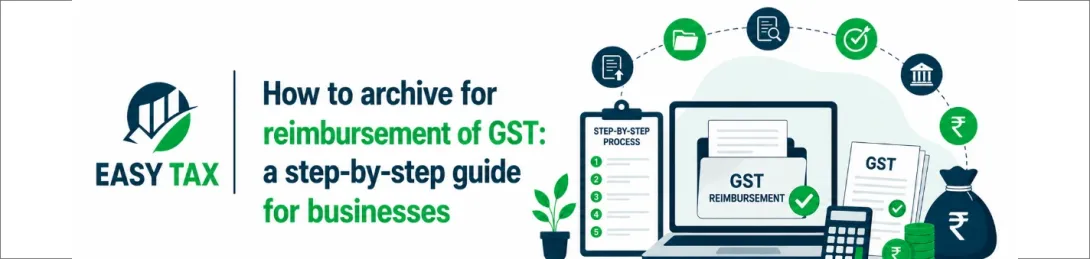
How to archive for reimbursement of GST: a step-by-step guide for businesses
Essential Aspects of Tax
Complete Guide to GST Refund in India: Step-by-Step Process, Eligibility & Rules (2026)
Goods and Services Tax (GST) refund is an important mechanism under the Indian tax system that allows businesses and exporters to reclaim excess tax paid. This ensures that tax is not an additional cost for genuine business activities such as exports, input tax credit accumulation, or excess tax payment. This process directly involves Tax Compliance. This process directly involves Tax Compliance. This process directly involves Tax Compliance.
However, the GST refund process requires proper documentation, accurate filing. And strict compliance with GST rules. Even a small mistake can lead to delays or rejection.
In this detailed guide, you will learn everything about GST refunds in India, including eligibility, step-by-step process, documents required, common mistakes, timelines. And expert tips to ensure smooth approval.
What is GST Refund?
A GST refund refers to the amount of tax paid by a taxpayer that is returned by the government under specific conditions.
GST refunds are mainly applicable when:
- Excess GST is paid
- Input Tax Credit (ITC) accumulates
- Goods or services are exported
- Tax is paid on exempt supplies by mistake
- Refund under inverted duty structure applies
In simple terms, a GST refund ensures that businesses do not suffer double taxation or unnecessary tax burden.
Who Can Claim GST Refund?
GST refund can be claimed by:
Essential Aspects of Tax Compliance
- Exporters of goods and services
- Manufacturers with inverted duty structure
- Businesses with excess ITC accumulation
- Taxpayers who paid excess GST by mistake
- SEZ units and SEZ developers
- Deemed export suppliers
- Individuals eligible under specific refund provisions
Types of GST Refunds in India
1. Export of Goods or Services
Exporters can claim a refund of:
- GST paid on exports
OR - Input tax credit on inputs used in exports (zero-rated supplies)
2. Inverted Duty Structure Refund
This applies when:
- GST on inputs is higher than GST on output
Example: Raw material taxed at 18% but finished goods at 5%
3. Excess Payment of Tax
Refund arises due to:
- Clerical error
- Wrong tax calculation
- Double payment
4. ITC Accumulation Refund
When input tax credit cannot be fully utilized.
5. SEZ Refunds
Supplies made to SEZ units or developers are eligible for refund.
6. Deemed Export Refund
Certain supplies treated as exports under GST law.
GST Refund Eligibility Criteria
To claim a GST refund, the taxpayer must:
- Be registered under GST
- File all GST returns (GSTR-1 and GSTR-3B)
- Ensure invoices are correctly reported
- Maintain proper documentation
- Apply within the prescribed time limit (usually 2 years from relevant date)
Step-by-Step GST Refund Process
Step 1: Determine Refund Eligibility
Before applying, identify the reason for refund:
- Export
- ITC accumulation
- Excess tax payment
- SEZ supply
Correct classification is important to avoid rejection.
Step 2: Collect Required Documents
Proper documentation is critical for approval.
Required documents include:
- GST invoices
- Shipping bills (for exports)
- Bank realization certificates (BRC/FIRC)
- GST returns (GSTR-1, GSTR-3B)
- Input tax credit records
- Payment challans
- Undertakings and declarations (where applicable)
Step 3: File Form RFD-01 on GST Portal
Go to the GST portal:
Steps:
- Navigate to Services → Refunds → Application for Refund
- Select refund category
- Fill Form RFD-01
- Upload documents
- Submit application
Step 4: ARN Generation
After submission:
Essential Aspects of Tax Compliance
- Application Reference Number (ARN) is generated
- Used to track refund status
- Confirmation sent via SMS/email
Step 5: Verification by GST Officer
The GST officer will:
- Verify documents
- Match GST returns
- Check ITC claims
- Raise queries if needed
If clarification is required, a notice may be issued under GST rules.
Step 6: Refund Approval
Once verified:
- Refund is approved
- Amount is credited to bank account
- Processing time is generally 15–60 days
If delayed beyond timeline, interest may be payable as per GST law.
Time Limit for GST Refund
GST refund must be filed within:
- 2 years from the relevant date
Relevant date may vary based on refund type:
- Export date
- Payment date
- Invoice date
Common GST Refund Mistakes
1. Incorrect Invoice Details
Mismatch in invoices leads to rejection.
2. Wrong Refund Category Selection
Selecting wrong type delays processing.
3. Non-filing of GST Returns
Refund not processed if returns are pending.
4. Missing Export Documents
Lack of shipping bills or BRC causes issues.
5. ITC Mismatch
Differences between GSTR-2A and claims can trigger notices.
GST Refund Timeline
| Stage | Time |
|---|---|
| Application Filing | Day 0 |
| Acknowledgment (ARN) | Instant |
| Verification | 7–15 days |
| Final Approval | 15–60 days |
| Refund Credit | After approval |
Interest on Delayed GST Refund
If GST refund is delayed beyond 60 days:
- Interest is payable by the government
- Rate is generally 6%–9% depending on case
Benefits of GST Refund
1. Improves Cash Flow
Refunded tax improves working capital.
2. Supports Export Businesses
Exporters benefit from zero-rated taxation.
3. Reduces Tax Burden
Prevents unnecessary tax accumulation.
4. Encourages Business Growth
More liquidity helps expansion.
Example of GST Refund Case
A manufacturing company pays:
- Input GST: 18%
- Output GST: 5%
This creates an inverted duty structure.
Result:
Essential Aspects of Tax Compliance
- Excess ITC accumulates
- Company can claim refund
- Improves cash flow significantly
Why Professional Help is Important
GST refund process can become complex due to:
- Frequent rule changes
- Document requirements
- System errors on portal
- Strict verification process
Professional assistance ensures:
- Error-free filing
- Faster approval
- Proper documentation
- Reduced rejection chances
Why Choose Easy Tax Consultancy
Easy Tax Consultancy provides expert GST refund services including:
- GST refund filing (RFD-01)
- Export refund support
- ITC reconciliation
- Documentation assistance
- GST compliance advisory
- Refund tracking and follow-up
With professional guidance, businesses can avoid delays and maximize refund benefits smoothly.
FAQs on GST Refund
1. How long does GST refund take?
Usually 15–60 days after verification.
2. Can I claim GST refund for exports?
Yes, exports are zero-rated and fully eligible.
3. What happens if documents are incorrect?
Refund may be rejected or delayed.
4. Is GST refund taxable?
No, GST refund is not taxable income.
5. Can I apply online?
Yes, all refunds are filed through GST portal.
Conclusion
GST refund is a powerful financial mechanism that helps businesses recover excess tax and improve liquidity. However, it requires proper documentation, correct classification. And timely filing to ensure smooth approval.
By understanding the step-by-step process, eligibility criteria, and common mistakes, businesses can successfully claim refunds without delays.
For expert assistance, professional tax consultancy like Easy Tax Consultancy can help you manage GST refunds efficiently, ensuring compliance and faster processing.
For more detailed assistance, explore our professional tax services or check official updates on the Income Tax Department website.
EasyTax • Jaipur
GST Return Filing & Compliance
Timely GSTR-1 & GSTR-3B filing, 100% ITC matching and department notice defense by certified GST experts.