
Common ITR Filing Mistakes: 12 Errors to Avoid in India
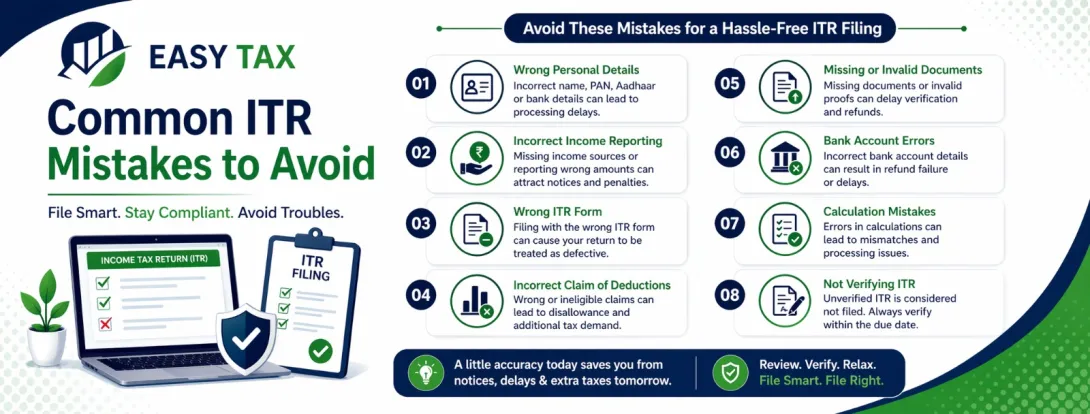
12 Common Income Tax Return Mistakes to Avoid in India
Filing an Income Tax Return (ITR) requires more than entering your salary and submitting an online form. You must report all relevant income, select the correct ITR form, reconcile tax information, claim only eligible deductions and verify your return after submission.
Even a small mistake can result in an incorrect tax calculation, a delayed refund, a defective-return notice or the need to revise your return. Understanding common ITR filing mistakes can help salaried employees, freelancers, professionals, investors and other taxpayers prepare more accurate returns.
Important tax-year update: This article covers Assessment Year (AY) 2026–27, relating to income earned during Financial Year (FY) 2025–26. These returns are governed by the Income-tax Act, 1961. The Income-tax Act, 2025 applies from 1 April 2026 to Tax Year 2026–27 onwards. The applicable law depends on the period in which the income was earned, not merely the date on which the return is filed.
For official transition guidance, refer to the Income Tax Department's Income Tax Returns FAQs.
12 Common ITR Filing Mistakes You Should Avoid
01 Selecting the Wrong ITR Form
Choosing an incorrect ITR form is one of the most common income tax return mistakes. Different forms apply to different categories of taxpayers and income sources. Selecting a form without checking its eligibility conditions may result in an incomplete or defective return.
For AY 2026–27, ITR-1 (Sahaj) is generally available to eligible resident individuals, other than Not Ordinarily Resident individuals, with total income up to ₹50 lakh and specified eligible income sources. These include salary or pension, income from up to two house properties, certain other-source income and eligible capital gains under section 112A within the prescribed limit.
However, ITR-1 cannot be used in several circumstances. These include having business or professional income, short-term capital gains, specified special-rate income, eligible long-term capital gains under section 112A exceeding ₹1.25 lakh, foreign assets or foreign income, being a company director, holding unlisted equity shares or having brought-forward losses or losses to be carried forward. Other exclusions also apply.
ITR-2 is generally applicable to individuals and HUFs who are not eligible to file ITR-1 and do not have income from business or profession. ITR-3 is generally relevant to individuals and HUFs with business or professional income. Eligible taxpayers using presumptive taxation may be able to use ITR-4, subject to its conditions.
Do not automatically select the same form you used last year. Your income sources, residential status and eligibility may have changed.
How to avoid this mistake: Review the current form instructions and check your income sources before selecting the form. Use the official Income Tax Department guidance for individual taxpayers for AY 2026–27 and the ITR-1 eligibility FAQs.
02 Forgetting to Report All Sources of Income
Reporting only salary income can result in an incomplete return if you have other taxable income. Depending on your circumstances, you may also need to report savings-account interest, fixed-deposit interest, rental income, dividends, capital gains, freelance receipts, pension income and other taxable receipts.
For example, a salaried employee who earns interest from a fixed deposit should review that interest while preparing the return. Similarly, an investor who sells shares or mutual fund units should check the applicable capital-gains information and report the transaction correctly.
Do not assume that income can be omitted because tax has already been deducted at source. TDS is generally a tax credit against your tax liability; it does not automatically remove the requirement to report the underlying income.
Also remember that the Annual Information Statement (AIS) and Form 26AS are reconciliation tools. They do not replace your responsibility to report complete and accurate income.
How to avoid this mistake: Prepare a list of all income sources before filing. Review salary records, bank statements, interest certificates, rent records, broker statements and other relevant documents. Compare them with AIS and Form 26AS and investigate differences.
Refer to the official AIS FAQs for information about AIS and taxpayer feedback.
03 Not Reconciling Form 16, AIS and Form 26AS
Form 16 is an important document for salaried taxpayers, but it may not contain every item of income or transaction relevant to your return. AIS and Form 26AS provide additional tax-related information that should be checked before filing.
A mismatch may arise because of multiple employers, a job change, incorrect TDS reporting, bank interest, securities transactions or information reported by another institution. Copying figures from Form 16 without reviewing the other records can result in an incorrect return.
However, an AIS entry should not automatically be treated as correct in every case. Compare the information with your own records. If an item is inaccurate or does not relate to you, use the appropriate feedback facility and retain supporting evidence.
How to avoid this mistake:
- Download Form 16 from each employer, where applicable.
- Review Form 26AS for TDS, TCS and tax-payment information.
- Download and review AIS and the Taxpayer Information Summary.
- Compare salary, interest and other income with your own documents.
- Contact the employer, bank or deductor if a TDS mismatch needs correction.
- Keep evidence supporting any difference or feedback submitted.
The Income Tax Department also recommends reviewing AIS, Form 26AS and supporting documents before filing. Read its ITR filing precautions.
04 Entering Incorrect Personal or Bank Details
Incorrect personal details can create avoidable filing and communication problems. Common errors include an incorrect PAN, inaccurate address, outdated email address, incorrect mobile number or mismatch in personal information.
Bank-account details also deserve attention, particularly if you expect a refund. An inactive, incorrectly entered or unvalidated bank account may prevent the refund from being credited successfully.
How to avoid this mistake:
- Check your name and PAN against official records.
- Review your address and contact information.
- Confirm that your selected bank account is active.
- Complete bank-account pre-validation where required.
- Check the account number and IFSC before submitting the return.
Never share your e-filing password, OTP or confidential login credentials with another person.
05 Claiming Deductions or Exemptions Without Checking Eligibility
Claiming deductions without satisfying the applicable legal conditions can lead to an incorrect tax computation. Common areas requiring attention include eligible investments, health insurance premiums, donations, education-loan interest, home-loan interest and other deductions or exemptions.
The availability of a deduction depends on the applicable assessment year, the taxpayer's circumstances, the type of income and the selected tax regime. A payment or investment does not automatically qualify for a deduction simply because it is commonly used for tax planning.
For example, deductions under sections 80C and 80D of the Income-tax Act, 1961 are subject to statutory conditions and limits. Donations may qualify for different deduction percentages and qualifying limits depending on the recipient organisation and applicable provisions.
The new tax regime permits fewer deductions and exemptions than the old regime. Therefore, taxpayers should not copy deduction claims from a previous year's return without checking the applicable rules.
How to avoid this mistake:
- Check whether the deduction is available under your selected regime.
- Verify the applicable statutory limit and qualifying conditions.
- Retain investment proofs, receipts and payment certificates.
- Do not claim a deduction merely because it appears in pre-filled data.
- Review the relevant assessment-year instructions before submitting the return.
06 Choosing the Wrong Tax Regime
Selecting a tax regime without comparing your actual tax liability can result in an avoidable tax cost. The new tax regime is the default regime for eligible taxpayers, but eligible taxpayers may opt for the old regime subject to the applicable conditions.
The old regime allows specified deductions and exemptions, subject to statutory conditions. The new regime offers a different rate structure but permits fewer deductions and exemptions. For example, the HRA exemption is not available under the new regime.
For taxpayers without business or professional income, the regime choice can generally be exercised annually in the return, subject to the prescribed due-date requirements. Taxpayers with business or professional income who wish to opt out of the new regime must consider the Form 10-IEA requirements and applicable restrictions.
The right regime depends on your income, eligible deductions, exemptions and financial circumstances. There is no single regime that is automatically better for every taxpayer.
How to avoid this mistake: Compare the tax payable under both regimes using your actual figures before filing.
Use the EasyTax Income Tax Calculator and the Old vs New Regime Comparator to help evaluate the alternatives. You can also explore EasyTax Tax Planning Services for assistance with tax choices.
For official information, see the Income Tax Department's New Tax vs Old Tax Regime FAQs and its Form 10-IEA FAQs.
07 Submitting the Return Without Reviewing the Tax Computation
Submitting a return without checking the completed schedules and tax computation can allow avoidable errors to go unnoticed. A return may contain an incorrect income figure, missing schedule, inaccurate deduction, tax-credit mismatch or incorrect bank details.
Before submission, review the following:
- Total income under each applicable income head.
- Exempt income and deductions claimed.
- Selected tax regime.
- Taxable income and tax liability.
- TDS, TCS, advance tax and self-assessment tax credits.
- Interest and fee calculations, where applicable.
- Refund or tax payable amount.
- Bank-account details and all relevant schedules.
How to avoid this mistake: Preview or download the completed return before submitting it. Compare the figures with your documents and retain a copy of the final acknowledgement and computation.
08 Missing the Applicable ITR Filing Deadline
Missing the applicable filing deadline can lead to a late-filing fee and other consequences under the law. The deadline depends on the assessment year and taxpayer category. Different due dates may apply to taxpayers who are required to undergo a tax audit or are subject to other specified requirements.
For AY 2026–27, which relates to income earned during FY 2025–26, the Income-tax Act, 1961 continues to apply. The Income Tax Department states that a belated return may generally be furnished on or before 31 December 2026, or before completion of assessment, whichever is earlier.
Under section 234F of the Income-tax Act, 1961, the late-filing fee is:
- ₹1,000 where total income does not exceed ₹5 lakh.
- ₹5,000 in other cases.
This is a statutory late-filing fee. It should not be confused with interest that may separately apply where tax remains payable. Late filing can also affect the ability to carry forward certain losses and claim certain benefits, subject to the applicable provisions.
How to avoid this mistake: Check the due date applicable to your taxpayer category and assessment year. Do not rely on a date published for a different category or an earlier year.
For professional support, visit EasyTax Expert-Assisted ITR Filing.
Official reference: Income Tax Returns FAQs – belated-return deadline and section 234F fee.
09 Not Verifying the Return After Submission
Uploading an ITR is not the final step. The return must also be verified using an available prescribed method. Taxpayers can use eligible electronic verification methods or submit a signed ITR-V where permitted.
The Income Tax Department provides a period of 30 days from the date of uploading the return for e-verification or submission of ITR-V. If verification is completed after this period, the date of verification may be treated as the date of furnishing the return, and the consequences of late filing may apply.
A return that remains unverified is treated as invalid, although a condonation request may be available for genuine delays, subject to the applicable procedure.
How to avoid this mistake:
- Complete e-verification immediately after filing wherever possible.
- Use an available prescribed verification method.
- If submitting ITR-V physically, follow the current instructions and address.
- Save the verification acknowledgement.
- Check that the portal displays the return as successfully verified.
Read the Department's official 30-day ITR verification FAQs.
10 Not Correcting an Error Through the Appropriate Return Procedure
Discovering an error after filing does not mean that you should ignore it or submit another return without checking the applicable procedure. The correct route depends on the assessment year, the nature of the error, whether an assessment has been completed and the statutory time limit.
Revised return: A revised return is generally used to correct an omission or wrong statement in an original or belated return, subject to the applicable legal conditions and time limit.
For AY 2026–27, the Income Tax Department's current guidance states that a revised return under section 139(5) of the Income-tax Act, 1961 may be filed before the end of the relevant assessment year, that is, before 31 March 2027, or before completion of assessment, whichever is earlier. The Department's FAQ marks the extended date as proposed in the Finance Bill, 2026. Check the operative provision and portal instructions before relying on the date.
The Department also states that for AY 2026–27 onwards, an additional fee under section 234I may apply when a revised return is filed after 31 December and up to 31 March of the relevant assessment year. Check the applicable notified fee and portal computation before filing.
Updated return: An updated return (ITR-U) is a separate statutory procedure. It is subject to eligibility restrictions and additional tax. It cannot be used to claim an increased refund, reduce tax liability or report an enhanced loss.
How to avoid this mistake: Identify the assessment year, original filing date and nature of the error. Check the current rules before deciding whether to file a revised return, updated return or take another permitted action.
Official reference: Income Tax Returns FAQs – revised and updated return provisions.
11 Ignoring a Defective Return Notice or Tax Communication
A defective-return notice generally indicates that the return contains incomplete or inconsistent information or another defect that requires correction. Ignoring such a notice can create further complications.
For a notice under section 139(9) of the Income-tax Act, 1961, the Income Tax Department generally provides 15 days from receipt of the notice, or the time specified in the notice, to rectify the defect.
If the defect is not corrected within the permitted time, the return may be treated as invalid, subject to the applicable law. The consequences can include issues relating to interest, loss carry-forward and other tax benefits, depending on the facts.
Other communications, such as a proposed adjustment under section 143(1)(a), are different from a defective-return notice. Read the specific communication carefully and follow its response procedure.
How to avoid this mistake:
- Check your registered email and e-filing account regularly.
- Read the notice section, issue and response deadline.
- Compare the issue with your filed return and supporting documents.
- Submit the correction or response through the prescribed portal procedure.
- Save the acknowledgement and supporting evidence.
For assistance, explore EasyTax Income Tax Notice Assistance.
Official reference: How to Respond to a Defective Return Notice under section 139(9).
12 Not Checking Refund Status and Bank Account Validation
After filing and verifying your return, check the processing status and refund details on the Income Tax e-Filing portal. A refund may take time to process. A bank-account validation issue, incorrect account details or another processing requirement may also delay the credit.
Do not assume that a refund will be credited immediately after uploading the return. First confirm that the return has been successfully verified and processed.
How to avoid this mistake:
- Ensure that your bank account is active and pre-validated where required.
- Check the return verification and processing status.
- Review any communication or action required on the portal.
- Retain the acknowledgement and bank details used in the return.
AY 2026–27 vs Tax Year 2026–27: Understand the Difference
The introduction of the Income-tax Act, 2025 makes it important to select the correct tax period while filing. AY 2026–27 and Tax Year 2026–27 are not interchangeable.
Assessment Year 2026–27
The return is filed under the Income-tax Act, 1961, even if the actual filing takes place after 1 April 2026.
Tax Year 2026–27
The Income-tax Act, 2025 applies to this tax year. The corresponding return obligation arises after the tax year ends.
Do not select a tax period only on the basis of the date you are filing. Select the year corresponding to the income being reported and use the applicable form and provisions.
For further details, read the Income Tax Department's transition and return-filing FAQs.
ITR Filing Checklist: What to Review Before Submission
Use this checklist to review your return before submitting it:
- Confirm the correct Assessment Year or Tax Year.
- Check your residential status and eligibility for the selected ITR form.
- Collect Form 16 from every employer, where applicable.
- Review AIS and Form 26AS and reconcile TDS and TCS information.
- Include all relevant salary, interest, rental, capital-gains and other income.
- Review deductions and exemptions under the selected tax regime.
- Compare the old and new tax regimes using your actual figures.
- Check PAN, address, contact information and bank-account details.
- Review all schedules and the final tax computation.
- Pay any tax due and correctly report the payment details.
- Submit the return using the correct form and tax period.
- Complete verification within the prescribed 30-day period.
- Save the acknowledgement and verification confirmation.
- Monitor processing status and any refund-related communication.
How EasyTax Can Help You Avoid ITR Filing Errors
Accurate ITR filing involves more than entering figures into an online form. Taxpayers may need to reconcile multiple income sources, review tax credits, compare regimes and check whether the selected ITR form matches their circumstances.
EasyTax provides Expert-Assisted ITR Filing for taxpayers who want professional support with return preparation and review.
You can also use the EasyTax Income Tax Calculator to estimate tax under the available regimes and the Old vs New Regime Comparator to evaluate your tax choices.
If you need help reviewing your financial choices, explore EasyTax Tax Planning Services. If you have received a communication from the Income Tax Department, you can review the scope of EasyTax Income Tax Notice Assistance.
You can also explore the full range of EasyTax tax and compliance services.
Review the service scope, fees and engagement terms before proceeding. Professional filing assistance cannot guarantee a particular refund amount or that the Income Tax Department will never issue a notice or request further information.
Frequently Asked Questions About ITR Filing Mistakes
01 What are the most common mistakes made while filing an ITR?
Common mistakes include selecting an incorrect ITR form, omitting taxable income, failing to reconcile AIS and Form 26AS, claiming ineligible deductions, choosing a tax regime without comparison, entering incorrect bank details and not verifying the return.
02 What happens if I select the wrong ITR form?
A return filed using an inapplicable form may be treated as defective or may require correction, depending on the circumstances and applicable law. Check the form eligibility rules and respond to any notice within the time allowed.
03 Can I correct a mistake after filing my ITR?
In eligible cases, you may be able to file a revised return within the applicable statutory time limit. An updated return is a separate procedure with different conditions and additional tax implications. The appropriate route depends on the assessment year and nature of the error.
04 Is Form 16 sufficient to file an income tax return?
Not necessarily. Form 16 mainly provides salary and TDS information. You may also need AIS, Form 26AS, bank interest details, capital-gains statements, rental records and information about other taxable income.
05 Is ITR verification compulsory after filing?
Yes. A return must be verified using an available prescribed method. The Income Tax Department provides 30 days from the date of uploading the return for e-verification or submission of ITR-V. An unverified return is treated as invalid, subject to any permitted condonation.
06 What is the late-filing fee for AY 2026–27?
Under section 234F of the Income-tax Act, 1961, the fee is ₹1,000 where total income does not exceed ₹5 lakh and ₹5,000 in other cases, subject to the applicable law. Interest and other consequences may also apply depending on the taxpayer's circumstances.
07 What should I do if I receive a defective-return notice?
Read the notice carefully, identify the defect and respond within the time allowed. For a notice under section 139(9), the Department generally provides 15 days from receipt or the period specified in the notice. Keep the supporting documents and response acknowledgement.
08 Can ITR-1 be used if I have income from two house properties?
For AY 2026–27, the Income Tax Department's ITR-1 FAQ states that income from up to two house properties may be reported in ITR-1, subject to all other eligibility conditions. Having two properties does not automatically make every taxpayer eligible for ITR-1.
09 Is the new tax regime compulsory?
The new tax regime is the default regime for eligible taxpayers, but an eligible taxpayer may opt for the old regime subject to the applicable rules. Business and professional taxpayers have additional Form 10-IEA requirements when opting out.
10 How can I reduce errors while filing an ITR?
Use the correct ITR form, report all relevant income, reconcile AIS and Form 26AS, claim only eligible deductions, compare tax regimes, review the final computation and verify the return promptly.
Conclusion
Avoiding common ITR filing mistakes starts with accurate information and a careful review of your documents. Select the correct ITR form, report all relevant income, reconcile tax information, compare the available tax regimes and verify your return after submission.
Pay particular attention to the distinction between AY 2026–27 and Tax Year 2026–27. Returns for FY 2025–26 continue to be governed by the Income-tax Act, 1961, while the Income-tax Act, 2025 applies to tax years beginning on or after 1 April 2026.
Taking time to review your return before submission can help reduce avoidable errors and make the filing process more straightforward. If your income sources or tax position are complex, consider obtaining professional assistance before filing.
Was this guide helpful?
Related reading
Tax-Smart Tips for Salaried Employees: New Tax Regime
Tax-smart tips for salaried employees under the new tax regime: understand deductions, employer NPS, tax rebates,…
Tax-Smart Tips for Salaried Employees | EasyTax
Tax-smart tips for salaried employees under India’s new tax regime: compare deductions, employer NPS, rebates and…
Revised Form 161: CBDT Notification 134/2026 Explained
Income Tax · India · Tax update Revised Form 161: CBDT Notification 134/2026 Explained Updated: 19 November 2026 ·…
Latest from the blog
SEO Agent connection test (temporary)
This is a temporary test post. It checks the connection between the EasyTax website and the SEO Agent publishing tool,…

The Complete Guide to the Bank Audit Process
Home / Blog / Tax compliance EasyTax · Tax compliance guide Tax Compliance in India: Income Tax, GST & TDS Tax…

Ca Services for Startups: What We Offer and Why It Matters
Home › Blog › Startup & CA Startup & CA CA Services for Startups in India: What Founders Need and Why It Matters From…
EasyTax • Trusted by 10,000+ Clients
Expert Assisted ITR Filing
Dedicated CA prepares, verifies, and files your ITR. Maximum refund, accurate deductions, zero notices.