

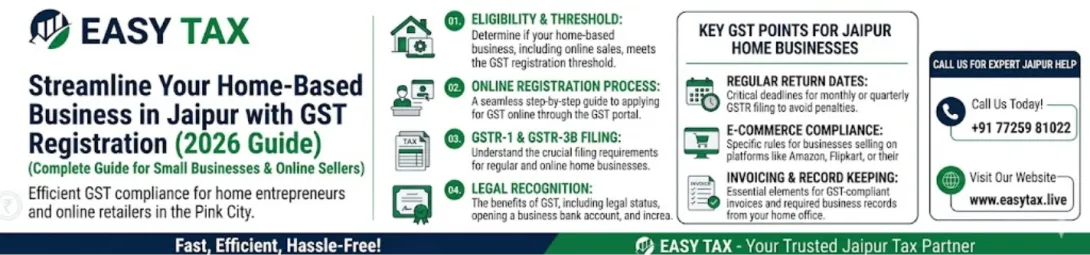
GST Registration for Home-Based Business in Jaipur: Complete Guide for Small Businesses & Online Sellers
GST Registration for Home-Based Business in Jaipur: A Complete Guide
Running a business from home in Jaipur does not automatically mean that you must register under the Goods and Services Tax (GST) system. Your registration requirement depends on factors such as the nature of your supplies, aggregate turnover, the way you sell your products or services, and whether a specific compulsory-registration rule applies to your business.
1. What counts as a home-based business?
A home-based business is an activity operated wholly or partly from a residential property instead of a separate commercial office or shop. The business may sell products, provide services or do both.
Examples include:
- Home bakers and people selling packaged food products.
- Clothing, tailoring, embroidery and boutique businesses.
- Handmade jewellery, crafts, gifts and home décor sellers.
- Freelancers, designers, consultants and digital service providers.
- Small businesses taking orders through social media or websites.
- Businesses selling through online marketplaces.
The address from which you operate does not, by itself, decide whether GST registration is compulsory. The GST rules apply according to the nature of the supply, turnover and relevant registration provisions.
2. When is GST registration required for a Jaipur home business?
The starting point is section 22 of the Central Goods and Services Tax Act, 2017. It deals with registration based on aggregate turnover. Section 23 identifies certain persons who are not liable to registration, while section 24 specifies categories that may require registration irrespective of the ordinary turnover threshold.
These provisions must be read together with applicable notifications and amendments. Do not decide registration liability by looking at turnover alone.
Check these questions before deciding
- What do you supply? Identify whether you sell taxable goods, provide taxable services, make exempt supplies or have a combination of activities.
- What is your aggregate turnover? Work out aggregate turnover using the GST definition. It is not necessarily the same as profit, cash received or sales made only from your Jaipur address.
- Do you make interstate supplies? Interstate taxable supplies can raise compulsory-registration questions. Check the relevant provisions and exceptions for the particular type of supply.
- Do you sell through an e-commerce operator? The answer depends on the type of supply, the operator's role and the applicable statutory provisions and notifications.
- Does a compulsory-registration category apply? Review section 24 and any relevant notification before relying on the turnover exemption.
3. GST turnover thresholds in Rajasthan
Rajasthan is not one of the states for which the ordinary lower special-category threshold applies. However, the applicable threshold still depends on the kind of supply and the conditions in the relevant notification.
Under section 22 of the CGST Act, the general threshold framework includes a ₹20 lakh threshold. Notification 10/2019-Central Tax provides a conditional exemption up to ₹40 lakh for persons engaged exclusively in supplying goods, subject to the notification's conditions and exclusions.
| Business activity | General reference point | Important qualification |
|---|---|---|
| Exclusive supply of eligible goods | Up to ₹40 lakh exemption may be available | Subject to Notification 10/2019-Central Tax, its exclusions and compulsory-registration provisions. |
| Services | Generally ₹20 lakh | Specific compulsory-registration provisions and exemptions must still be checked. |
| Goods and services together | Do not assume the exclusive-goods exemption applies | Mixed activities require a review of aggregate turnover and the applicable statutory provisions. |
The ₹40 lakh exemption is not a universal GST threshold for every small business. It is conditional and is intended for qualifying persons engaged exclusively in supplying goods. Certain goods and compulsory-registration categories are excluded.
What does aggregate turnover mean?
Aggregate turnover is calculated on a PAN-India basis under the GST law. It includes relevant taxable supplies, exempt supplies, exports and interstate supplies of persons having the same PAN, subject to the statutory definition. It is not calculated only on the sales made from one Jaipur premises.
If you operate more than one business activity under the same PAN, or supply goods and services together, have a GST professional calculate the aggregate turnover before relying on an exemption.
4. GST rules for online selling and marketplaces
Home businesses often sell through Instagram, WhatsApp, their own websites or third-party marketplaces. These channels should not automatically be treated as identical for GST purposes.
Selling through your own website or social media
Record the nature of each supply, the location of the customer, the place-of-supply position and your aggregate turnover. The applicable registration requirement depends on the actual supply and the relevant GST provisions, not merely on the fact that an order was received online.
Selling goods through an e-commerce operator
Section 24 of the CGST Act contains provisions relating to supplies through certain electronic commerce operators. However, Notification 34/2023-Central Tax provides a conditional exemption from mandatory registration for specified persons supplying goods through an e-commerce operator required to collect tax at source under section 52.
Broadly, that notification applies only where the supplier's aggregate turnover in the preceding and current financial years does not exceed the applicable section 22 threshold and the notification's conditions are satisfied.
The conditions include:
- The supplier must not make interstate supplies of goods.
- The supplier must not supply goods through e-commerce operators in more than one State or Union Territory.
- The supplier must have a valid PAN.
- The supplier must declare the required PAN, business address and State details on the common portal.
- The supplier must obtain the required enrolment number before making supplies through the e-commerce operator.
Freelancers and online service providers
Freelancers, consultants and digital service providers should separately examine the service-provider threshold, the place-of-supply rules and any applicable exemption. Do not automatically apply the goods-supplier exemption to a service business.
5. Can you use your Jaipur home address for GST registration?
A residential address can be used as the principal place of business where it is genuinely the relevant business location and the applicant can provide appropriate evidence of possession or permission.
The GST Portal registration manual explains the principal place of business and identifies different documents depending on whether the premises are owned, rented or used with the consent of another person.
If you own the home
The portal manual identifies documents such as a property tax receipt, municipal khata copy or electricity bill as examples of evidence supporting ownership of the premises.
If you rent the home
The manual describes a valid rent or lease agreement along with supporting evidence of the lessor's ownership, such as a property tax receipt, municipal khata copy or electricity bill.
If you use a family member's or another person's property
A consent letter and supporting ownership evidence of the person giving consent may be required. The precise documents should be checked against the current GST Portal instructions and the applicant's circumstances.
Selecting a residential address does not remove other legal requirements that may apply to the business, property or activity. Check any applicable local permissions separately.
6. Documents to prepare for GST registration
The documents depend on the legal constitution of the applicant, authorised signatory details and the way the business uses its premises. The following is a preparation list, not a statement that every item is mandatory for every applicant.
Basic applicant and business information
- PAN of the proprietor or relevant business entity.
- Legal name and trade name, where applicable.
- Valid mobile number and email address for verification.
- Photograph and identity details where required by the application.
- Business constitution details.
Documents based on business structure
- Proprietorship: proprietor's PAN and identity details, along with relevant business and premises information.
- Partnership: partnership deed and partner/authorised-signatory details, as applicable.
- LLP or company: incorporation and entity documents, along with authorised signatory information, as applicable.
Principal place of business evidence
- Owned property: suitable ownership evidence.
- Rented property: valid rent/lease agreement and supporting evidence.
- Consented or shared property: consent letter and supporting ownership evidence, where applicable.
Use the official GST Portal document checklist to confirm the documents applicable to your particular business structure and premises arrangement.
7. How to apply for GST registration online
GST registration applications are submitted through the official GST Portal. The portal's registration manual describes the following broad workflow for a normal taxpayer.
- Open the official GST Portal.
- Select Services > Registration > New Registration.
- Select the taxpayer type, State and district. For a Jaipur principal place of business, select Rajasthan and the relevant district details.
- Enter the legal name as reflected in the PAN database, PAN, email address and mobile number.
- Complete the required OTP verification and obtain the Temporary Reference Number (TRN).
- Use the TRN to access Part B of the application.
- Complete the applicable business, promoter/partner, authorised signatory, principal place of business, goods and services, Aadhaar authentication and verification sections.
- Upload the documents applicable to your business and premises.
- Review the application carefully and submit it using the prescribed verification method.
- Save the acknowledgement and track the application status on the portal.
The portal may require additional authentication or clarification depending on the applicant and application. If a clarification notice is issued, read the notice carefully and respond through the prescribed portal process.
8. What should you do after receiving GST registration?
Registration is the beginning of GST compliance, not the end of it. A registered business should understand the obligations attached to its taxpayer category and business activity.
- Check the GST registration certificate and the details recorded on the portal.
- Understand the applicable tax rates and classification of the goods or services supplied.
- Issue tax invoices or other documents in the form required by the GST rules.
- Maintain sales, purchase and other relevant business records.
- File the applicable GST returns and pay tax, where due.
- Review input tax credit eligibility before claiming credit.
- Update registration details when a reportable change occurs.
Input tax credit is not automatic for every purchase. Section 16 of the CGST Act and the relevant rules prescribe conditions for claiming credit. The purchase must satisfy the applicable legal requirements and restrictions.
9. Examples: how different Jaipur home businesses should assess GST
These examples are illustrations of the questions to examine. They are not individual tax opinions or automatic registration conclusions.
| Business example | What to check |
|---|---|
| Home-based clothing or handicraft seller | Whether the business supplies only eligible goods, its aggregate turnover, the applicable goods threshold and whether interstate or marketplace conditions affect registration. |
| Home baker | Product classification, taxable or exempt status, aggregate turnover and whether any additional food-business permissions apply separately. |
| Freelance designer or consultant | Service turnover, place-of-supply rules, customer locations and any applicable registration exception. |
| Marketplace seller | Whether the platform is an e-commerce operator covered by the relevant provision, the type of supply, and whether Notification 34/2023-Central Tax conditions are met. |
| Business selling goods and providing services | Aggregate turnover and whether the exclusive-goods exemption is unavailable because the business has mixed activities. |
10. Frequently asked questions
Is GST registration compulsory for every home-based business in Jaipur?
No. Operating from home does not automatically make GST registration compulsory. The requirement depends on the business's supplies, aggregate turnover, applicable exemptions and compulsory-registration provisions.
Can I use my residential address for GST registration?
A residential property can be used as the principal place of business where it is the relevant business location and appropriate premises evidence is available. The required evidence depends on whether the property is owned, rented or used with another person's consent.
Is the ₹40 lakh threshold applicable to every small business?
No. Notification 10/2019-Central Tax provides a conditional exemption for qualifying persons engaged exclusively in supplying goods. It should not be treated as a universal threshold for service providers or mixed businesses.
Do all sellers using an online marketplace need GST registration?
Not necessarily. The law contains specific provisions for supplies through e-commerce operators, and Notification 34/2023-Central Tax provides a conditional exemption for certain small goods suppliers. Its conditions must be checked before relying on it.
Can an unregistered home business sell goods outside Rajasthan?
Do not assume that it can or cannot based only on the location of the buyer. Interstate taxable supplies can trigger compulsory registration, but the applicable exceptions and the precise type of supply must be reviewed.
Are bank details compulsory in the initial GST application?
The GST Portal manual states that bank details are optional and non-mandatory in the initial application workflow described there. It explains that bank details can be added after registration through an amendment application. Always check the current portal workflow before filing.
How long does GST registration take?
There is no guaranteed completion time for every application. Authentication, document review and clarification requests can affect processing. Track the application status through the GST Portal.
Can I claim input tax credit after registration?
A registered person may claim input tax credit only when the statutory conditions and restrictions are satisfied. Registration alone does not make every business expense eligible for credit.
11. Official government sources
Use the following primary sources to verify registration liability, exemptions, premises documents and the application procedure. The applicable provisions and notifications should be checked again before acting on a specific business's facts.
- CBIC Tax Information Portal — CGST Act, section 22 — Persons liable for registration and turnover-based framework.
- CBIC Tax Information Portal — CGST Act, section 24 — Compulsory registration categories.
- CBIC Tax Information Portal — CGST Act, section 25 — Procedure for registration.
- GST Council — Notification 10/2019-Central Tax — Conditional exemption for persons exclusively supplying goods up to the specified turnover.
- GST Council — Notification 34/2023-Central Tax — Conditional exemption for specified goods suppliers using e-commerce operators.
- Notification 34/2023-Central Tax — Official PDF — Full text and conditions of the notification.
- GST Portal — Apply for Registration: Normal Taxpayer — Application steps, verification, premises details and bank account instructions.
- GST Portal — Registration Document Checklist — Documents for business constitution, authorised signatory and principal place of business.
- GST Common Portal — Official registration and taxpayer services.
Need help assessing GST registration for your Jaipur business?
Before applying, organise your turnover details, supply types, sales channels and home-address documents. A review of these facts can help identify the relevant registration provisions and documentation requirements.
Contact EasyTax about GST registration







EasyTax • Jaipur
GST Return Filing & Compliance
Timely GSTR-1 & GSTR-3B filing, 100% ITC matching and department notice defense by certified GST experts.