

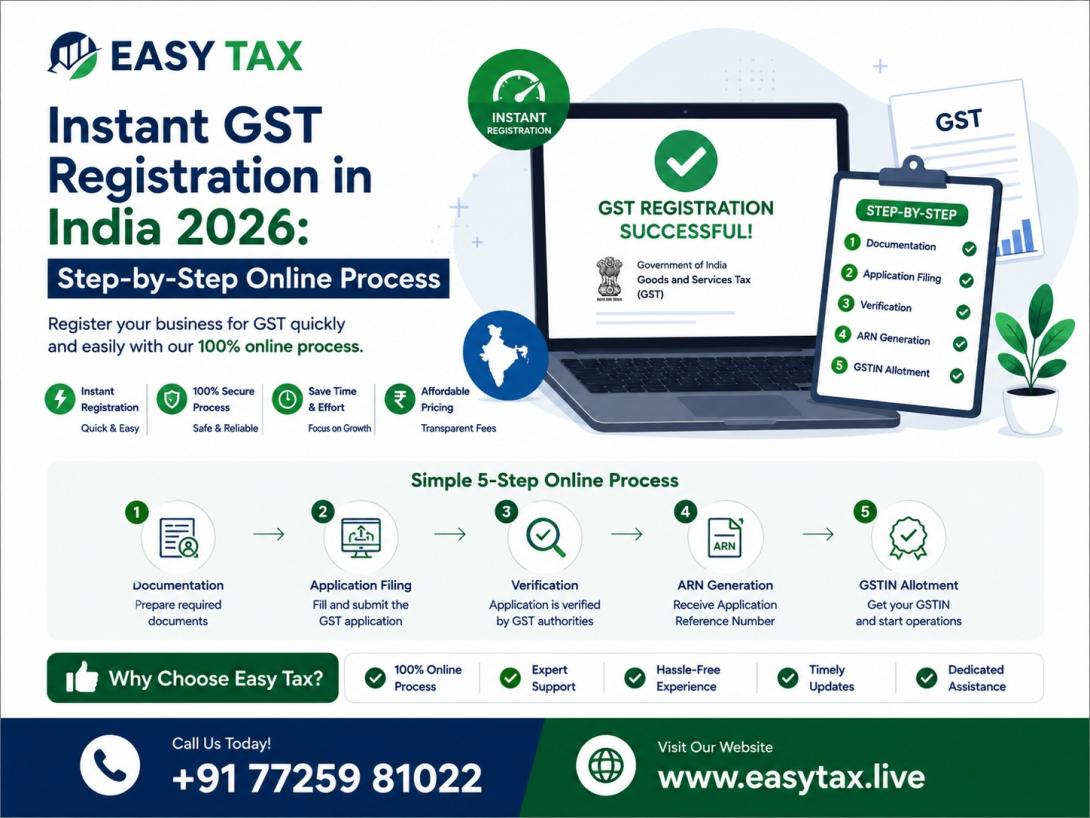
GST Registration in India 2026: Quick Registration Process Online Step-by-Step Guide
Over the past few years, starting a business in India has become much easier because most registration processes are now fully online. One of the most important registrations for businesses today is GST registration. A GST number is often essential for running a legal business and maintaining proper tax compliance, regardless of the industry.
For startups, online businesses, consultants, freelancers, traders, shops, agencies, and service providers, GST registration has become a basic requirement for smooth business operations. With improved digital systems, Instant GST Registration India 2026 is now faster, smoother, and easier than ever before. Business owners can apply online without visiting government offices physically.
However, many people are still confused about GST eligibility, required documents, registration rules, and the actual online application process. This complete GST Registration India Guide 2026 explains everything step-by-step.
What is GST Registration?
GST registration is the process of obtaining a Goods and Services Tax Identification Number (GSTIN) from the GST department. After registration, businesses can legally collect GST from customers and comply with Indian tax laws.
For many businesses, GST registration becomes mandatory based on turnover, business activities, or operational structure.
Today, Online GST Registration India is completely digital and can be completed through the official GST portal.
Why GST Registration is Important
GST registration is not only a legal requirement but also offers several business benefits.
Benefits of GST Registration
- Legal recognition for your business
- Ability to collect GST from customers
- Input Tax Credit (ITC) benefits
- Easier business expansion
- Improved business credibility
- Smooth interstate business operations
- Mandatory for ecommerce selling
- Helpful for loans and business funding
Many startups now prefer GST Registration for Businesses India because it improves professionalism and compliance.
Who Needs GST Registration in India?
Under GST law, registration becomes mandatory in several situations.
Businesses That Need GST Registration
- Businesses crossing the prescribed turnover limit
- Ecommerce sellers
- Freelancers offering taxable services
- Interstate suppliers
- Import-export businesses
- Online service providers
- Businesses selling through Amazon, Flipkart, or Meesho
- Startups and digital agencies
Even when registration is not compulsory, many businesses apply voluntarily to build trust and claim Input Tax Credit benefits.
GST Registration for Small Business 2026
Small businesses are increasingly moving toward GST compliance because online marketplaces and digital payment systems now require proper tax registration.
GST Registration is Useful For:
- Retail shops
- Consultants
- Service providers
- Freelancers
- Home-based businesses
- Ecommerce sellers
- Startup companies
GST registration also improves financial transparency and business credibility.
Documents Required for GST Registration
Before applying online, applicants should keep all required documents ready.
Basic Documents
- PAN card
- Aadhaar card
- Passport-size photograph
- Mobile number
- Email ID
Business Documents
- Business registration proof
- Partnership deed (if applicable)
- Certificate of incorporation for companies
Address Proof
- Electricity bill
- Rent agreement
- Property tax receipt
- NOC from property owner
Bank Documents
- Cancelled cheque
- Bank statement or passbook
Proper documentation helps avoid delays during the Fast GST Registration Process India.
GST Registration Online 2026
Today, GST Registration Online 2026 is fully digital and user-friendly. Most applications can be completed using a laptop or smartphone from home.
The GST portal allows users to:
- Apply for GST online
- Upload documents
- Track application status
- Download GST certificate
- Manage GST compliance
This has made Easy GST Registration Online India much more convenient than previous years.
Step-by-Step GST Registration Process
If you are wondering how to apply GST registration online, follow these steps carefully.
Step 1: Visit the GST Portal
Open the official GST portal and click on “New Registration.”
Select:
- Taxpayer option
- State and district
- Business category
Enter:
- Business name
- PAN number
- Email ID
- Mobile number
OTP verification will be completed.
Step 2: Generate TRN Number
After OTP verification, the portal generates a Temporary Reference Number (TRN). This helps applicants continue the process later if required.
Step 3: Fill Business Details
Enter complete business information, including:
- Trade name
- Business constitution
- Principal place of business
- Nature of business activity
- Bank details
This is an important part of the GST Registration Process Step by Step.
Step 4: Upload Required Documents
Upload scanned copies of the required documents carefully.
Common uploads include:
- PAN card
- Aadhaar card
- Address proof
- Bank proof
- Business registration proof
Incorrect or unclear documents may lead to rejection.
Step 5: Aadhaar Authentication
Most GST registrations now require Aadhaar authentication.
This helps in:
- Faster approval
- Identity verification
- Fraud prevention
- Instant GST processing
Aadhaar authentication has improved Instant GST Registration India 2026 significantly.
Step 6: Verification and Submission
After reviewing all details:
- Submit the application
- Complete DSC or EVC verification
- Receive ARN number
The ARN helps track the application online.
Step 7: GST Certificate Approval
If all information is correct, GST registration gets approved.
Applicants receive:
- GSTIN number
- GST registration certificate
The certificate can be downloaded online.
New GST Registration Rules 2026
Businesses should understand the latest GST rules before applying.
Important GST Rules
Aadhaar Verification Mandatory
Many applicants now require Aadhaar authentication for quick approval.
Physical Verification in Some Cases
Authorities may verify business addresses in suspicious cases.
Ecommerce GST Compliance
Online sellers often need compulsory GST registration regardless of turnover.
Correct Business Classification
Choosing the wrong business category can create future compliance issues.
Understanding New GST Registration Rules 2026 helps businesses avoid rejection and penalties.
GST Registration for Startups India 2026
India’s startup ecosystem is growing rapidly, and GST registration has become an important part of business setup.
GST Registration Helps Startups:
- Open current bank accounts
- Raise funding
- Build business credibility
- Work with large companies
- Claim Input Tax Credit
Most investors and marketplaces prefer working with GST-registered startups.
Common Mistakes During GST Registration
Many applicants make avoidable mistakes during online registration.
Common Errors
Incorrect PAN Details
Wrong PAN information can lead to rejection.
Uploading Wrong Documents
Mismatched or unclear documents delay approval.
Wrong Business Category
Incorrect classification may affect future compliance.
Incorrect Address Details
Address mismatches may trigger verification issues.
Ignoring Aadhaar Verification
This can increase approval time significantly.
Careful filing improves the success rate of Online GST Registration India.
Benefits of Online GST Registration
Businesses now prefer digital registration because of its advantages.
Advantages of GST Registration Online 2026
Faster Processing
Applications are processed quickly online.
Convenience
No physical office visits are required.
Better Transparency
Applicants can track status digitally.
Easy Documentation
Documents can be uploaded instantly online.
Secure Process
Digital systems improve data safety and accessibility.
This is why businesses prefer Easy GST Registration Online India.
Why Businesses Use Professional GST Consultants
Although the process is online, many businesses still choose professional assistance.
Benefits of Professional GST Assistance
- Correct application filing
- Faster approval
- Reduced errors
- GST compliance guidance
- Business classification support
- Notice handling assistance
Professional support is especially useful for startups, ecommerce sellers, and businesses with complex structures.
Tips for Fast GST Registration
Keep Documents Ready
Prepare all scanned documents before applying.
Use Correct Mobile Number and Email
OTP verification depends on active contact details.
Verify PAN and Aadhaar
Ensure all details match official records.
Double-Check Business Information
Incorrect information may lead to rejection.
Use Professional Support If Needed
Experts can simplify complicated applications.
These simple steps help businesses complete the Fast GST Registration Process India smoothly.
Conclusion
Instant GST Registration India 2026 has made business registration easier, faster, and more convenient than ever before. Whether you are a freelancer, startup founder, consultant, ecommerce seller, or small business owner, GST registration is an important step toward legal business growth and tax compliance.
With fully digital systems, businesses can now complete GST Registration Online 2026 from anywhere in India without physically visiting government offices. However, proper understanding of eligibility, documentation, and GST rules remains essential for smooth approval.
By following this complete Step-by-Step GST Registration Process, businesses can confidently apply for GST registration online and avoid common mistakes. As India’s digital economy continues to grow rapidly, proper GST compliance has become an essential part of running a successful business in 2026.
