

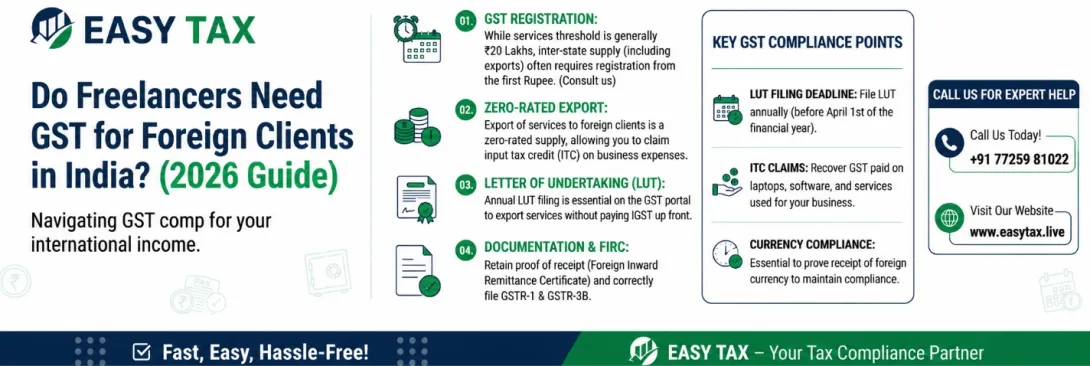
Do Freelancers Need GST for Foreign Clients in India? (2026 Guide)
Do Freelancers Need GST for Foreign Clients in India? (2026 Guide)
By: {{EASYTAX_VERIFIED_AUTHOR_NAME}}. Add the verified author name and profile link before publication. Do not retain an unverified byline.
If you are a freelancer in India and work for clients in the United States, United Kingdom, Canada, Australia, the UAE or another country, you may be wondering whether you need to register for GST or charge GST on your international invoices.
Short answer
Not every Indian freelancer receiving money from a foreign client must register for GST. The answer depends on your aggregate turnover, the nature of your service, the place-of-supply rules and whether your transaction satisfies all five legal conditions for an export of services.
If your service qualifies as an export, it is generally a zero-rated supply. A freelancer who is registered for GST may generally use a valid Letter of Undertaking (LUT) to export eligible services without payment of IGST, subject to the applicable rules.
1. When is freelance work an export of services?
Under section 2(6) of the Integrated Goods and Services Tax Act, 2017 (IGST Act), a supply is treated as an export of services only when all five conditions are satisfied.
- The supplier is in India. You provide the service from India as the supplier.
- The recipient is outside India. The recipient of the service must be located outside India. A foreign payment account by itself does not prove the recipient's location.
- The place of supply is outside India. This is a separate legal test. It is not enough that the client has a foreign address or that you deliver work over the internet.
- Payment is received in an eligible manner. Payment must be received in convertible foreign exchange or in Indian rupees wherever permitted by the Reserve Bank of India.
- The parties are not merely establishments of a distinct person. The supplier and recipient must not simply be establishments of the same person treated as distinct persons under the IGST Act.
These conditions come from section 2(6) of the IGST Act. CBIC Circular No. 202/14/2023-GST also reproduces the five conditions and clarifies the permitted INR settlement route.
Official references: CBIC Circular No. 202/14/2023-GST · IGST Act — CBIC
2. When does a freelancer need GST registration?
For many independent service providers, the starting point is section 22 of the CGST Act, read together with section 24 and the applicable exemption notifications.
Section 22 generally uses an aggregate-turnover threshold of ₹20 lakh in a financial year. A lower ₹10 lakh threshold applies to specified special-category States, subject to the applicable statutory provisions and notifications.
There is also a specific exemption for persons making inter-State taxable supplies of services where their all-India aggregate turnover does not exceed ₹20 lakh in a financial year, or ₹10 lakh in the specified special-category States. This is provided by Notification No. 10/2017–Integrated Tax.
| Situation | General threshold / treatment | What to check |
|---|---|---|
| Freelancer based in Rajasthan, including Jaipur | Generally ₹20 lakh aggregate turnover | Other registration triggers and the nature of all supplies |
| Specified special-category State | Generally ₹10 lakh, subject to applicable notifications | Whether the State and supply fall within the relevant provision |
| Inter-State supply of taxable services | Notification 10/2017 provides a threshold-based registration exemption | All-India aggregate turnover and eligibility for the exemption |
| Registered freelancer exporting eligible services | May generally use the LUT route without payment of IGST | Export conditions, LUT compliance and applicable returns |
Rajasthan is not one of the specified special-category States for this general threshold framework. A freelancer based in Jaipur should not automatically apply the ₹10 lakh threshold simply because the client is overseas.
Important distinction: the threshold is based on aggregate turnover, not your profit, take-home income or the amount left after business expenses.
Read the primary sources: CGST Act, 2017 — sections 2, 22, 23 and 24 · Notification No. 10/2017–Integrated Tax
3. What counts as aggregate turnover?
Section 2(6) of the CGST Act defines aggregate turnover on an all-India basis for persons having the same PAN.
It broadly includes:
- Taxable supplies of goods and services;
- Exempt supplies;
- Exports of goods and services; and
- Inter-State supplies.
The definition excludes GST amounts such as CGST, SGST, UTGST, IGST and cess. It also excludes the value of inward supplies on which tax is payable by the recipient under reverse charge.
Example: calculating a freelancer's turnover
Assume a Jaipur-based freelance designer has the following supplies during one financial year:
| Supply | Amount |
|---|---|
| Design services to Indian clients | ₹7,00,000 |
| Eligible export services to overseas clients | ₹11,00,000 |
| Total illustrative turnover | ₹18,00,000 |
The export receipts are not ignored merely because the clients are outside India. They form part of aggregate turnover when the statutory definition applies.
On these assumptions, the example total is ₹18 lakh. That is below the general ₹20 lakh threshold. However, the freelancer must still check the specific inter-State service exemption, any other registration trigger and all supplies made under the same PAN.
This is an illustration, not a determination of an individual freelancer's liability.
4. Why place of supply matters
The place-of-supply rules determine whether the third condition in the export-of-services definition is satisfied.
Under section 13(2) of the IGST Act, the general rule for services where either the supplier or recipient is outside India is that the place of supply is the recipient's location. However, sections 13(3) to 13(13) contain exceptions for specified categories of services.
Examples of service categories needing closer examination include:
- Services supplied in respect of goods that must be physically made available;
- Services requiring the physical presence of an individual;
- Services directly related to immovable property;
- Admission to or organisation of certain events; and
- Intermediary services, which have a specific place-of-supply rule.
For example, a freelancer providing ordinary remote design or software-development work to a foreign business may fall under the general recipient-location rule, depending on the actual arrangement. A person arranging or facilitating a supply between other parties may need a separate intermediary-services analysis.
The description on your invoice is not conclusive. Review what you actually do, who receives the service and the contract terms before treating the supply as an export.
Official source: IGST Act, section 13 — place of supply of services
5. What is LUT and when is it needed?
LUT means Letter of Undertaking. Under section 16 of the IGST Act and rule 96A of the CGST Rules, an eligible registered person can generally export qualifying goods or services without payment of IGST after furnishing the required LUT.
The prescribed form is FORM GST RFD-11. A bond may apply where the person is not eligible to furnish an LUT under the applicable conditions.
Who needs an LUT?
- A freelancer who is registered under GST and wants to make eligible zero-rated exports without payment of IGST generally needs to furnish an LUT for the relevant period.
- A freelancer who is not required to register and has not voluntarily registered does not file an LUT merely because they receive foreign-client payments.
- A registered freelancer should check LUT validity and compliance before making exports under that route.
General LUT filing process
- Log in to the official GST Portal.
- Open the services area and locate the LUT/bond filing facility.
- Choose the relevant financial year and the LUT option, if eligible.
- Complete the prescribed declaration and verification.
- Submit the application and retain the acknowledgement/reference.
The exact portal screens and workflow can change. Follow the current GST Portal instructions rather than relying only on screenshots from an older guide.
Official references: GST Portal · CBIC Circular No. 2/2/2017-GST · CBIC Circular No. 4/4/2017-GST
6. How to invoice a foreign client
Keep your invoice clear and consistent with the actual contract and service. The applicable GST invoice requirements depend on your registration status and the nature of the supply.
For your business records, an invoice will commonly identify:
- Your legal or business name and address;
- Your GSTIN, if registered;
- A unique invoice number and invoice date;
- The overseas client's name and address;
- A clear description of the service;
- The agreed currency, value and payment terms; and
- Relevant export/LUT wording where appropriate to your registered status and chosen route.
Do not add GST to an invoice merely because you are unsure whether the transaction qualifies as an export. First establish your registration status, place of supply and the correct treatment of the supply.
Also avoid describing a supply as an export under LUT if you have not completed the required registration and LUT steps. Ask a GST professional to review the invoice format where the transaction has unusual contractual or place-of-supply facts.
7. RBI and foreign-payment documentation in 2026
GST treatment and foreign-exchange compliance are related but separate questions. Receiving an overseas payment through a bank or payment platform does not, by itself, establish that every GST and FEMA condition has been satisfied.
The Reserve Bank of India's Foreign Exchange Management (Export and Import of Goods and Services) Regulations, 2026 came into force on 1 October 2026. Regulation 3 contains export-declaration requirements for services, including an Export Declaration Form (EDF) process.
Under regulation 3(2), the general service-export declaration is to be furnished within 30 days from the end of the month in which the service invoice is raised, subject to the provisions and exceptions in the regulations.
The 2026 regulations also prescribe periods for realisation and repatriation of export proceeds. The general period for services invoiced in foreign currency is 15 months from the invoice date. Where the export is invoiced and/or settled in Indian rupees, the stated period is 18 months, subject to the regulations and any permitted extension.
Because the RBI framework has been amended, use the current consolidated regulations and current bank instructions. Do not rely on an old FIRC/e-FIRC checklist as a complete statement of today's FEMA requirements.
Official references: RBI — FEMA Export and Import Regulations, 2026 · RBI — FAQ on the 2026 Trade Regulations · RBI — Second Amendment Regulations, 2026
8. Records freelancers should maintain
Keep a consistent record of the work performed, the recipient, invoices raised and payments received. These records can help support GST reporting, LUT compliance, income-tax reporting and bank queries.
- Signed client contracts, statements of work or written work orders;
- Invoices and credit notes, where applicable;
- Proof of work delivered, such as project approvals or correspondence;
- Bank statements and payment-platform statements;
- Foreign inward-remittance advice or other bank-issued transaction evidence, where provided;
- GST registration and LUT acknowledgement, if registered;
- GST returns and supporting working papers, if registered; and
- Records of exchange rates and amounts used in relevant accounting and tax calculations.
A dedicated business bank account may make reconciliation easier, but do not treat it as a universal GST registration requirement unless a specific rule or bank condition applies.
Payment platforms such as PayPal or Stripe are payment intermediaries. Their involvement does not automatically determine whether your underlying service qualifies as an export. Keep the platform statements and separately review any fees charged by the platform.
9. Income tax on foreign freelance earnings
GST and income tax are separate tax systems. A service may qualify as a zero-rated export for GST purposes and still need to be considered under the income-tax rules applicable to the freelancer.
Income-tax treatment depends on matters such as your residential status, the source and character of the income, the applicable tax year and any relevant treaty or other provisions. It is not accurate to say that every person receiving a foreign payment has identical Indian tax reporting obligations.
There is also an important legislative transition:
- Income for FY 2025–26 is governed by the Income-tax Act, 1961 and is reported for AY 2026–27 under the applicable old-law framework.
- Income for FY 2026–27 is referred to as Tax Year 2026–27 under the Income-tax Act, 2025, which applies from 1 April 2026.
A freelancer should determine residential status for the relevant year and maintain records of business receipts, allowable expenses and tax deducted, if any. Obtain individual advice if you work partly from India and partly overseas, change your country of residence, or have multiple sources of income.
Official guidance: Income Tax Department — Objective and scope of the new Act · Income Tax Department — Non-resident FAQs
10. Common GST mistakes freelancers should avoid
- Assuming every overseas client means an export. Check all five conditions in section 2(6) of the IGST Act.
- Ignoring place-of-supply exceptions. The recipient-location rule is not universal for every service.
- Counting only Indian-client revenue. Export turnover is included in aggregate turnover under the CGST Act definition.
- Confusing zero-rated with exempt. These are different GST concepts with different consequences.
- Filing an LUT without checking registration status. The LUT procedure is for registered persons using the relevant export-without-IGST route.
- Assuming payment in foreign currency is the only permitted method. The IGST Act also recognises INR wherever permitted by RBI.
- Ignoring FEMA and bank documentation. GST compliance does not replace the applicable RBI export-proceeds and declaration requirements.
- Mixing GST and income-tax advice. A zero-rated GST export does not automatically mean that the receipt is outside the income-tax system.
11. Frequently asked questions
Do Indian freelancers need GST for US clients?
Not automatically. Check whether the service meets all five export-of-services conditions and whether your aggregate turnover or another registration trigger makes registration necessary. The client's country alone does not decide the answer.
Can I receive foreign payments without GST registration?
A freelancer may receive foreign payments without GST registration where registration is not required under the applicable provisions and exemptions. Check the turnover threshold, inter-State service exemption and any other compulsory-registration trigger.
Do I have to charge GST on an export invoice?
A qualifying export of services is zero-rated. A registered exporter may generally use the LUT route to make the eligible supply without payment of IGST, subject to the law and rules. Do not apply this treatment until the export conditions are confirmed.
Can a freelancer receive payment in Indian rupees?
The export-of-services definition recognises payment in convertible foreign exchange or Indian rupees wherever permitted by RBI. Check that the specific settlement route is permitted and retain supporting bank evidence.
Is an LUT compulsory for every freelancer?
No. An LUT is relevant to a registered person using the export-without-payment-of-IGST route. A person who is not required to register does not file an LUT merely because they have overseas clients.
Does foreign freelance income count towards GST turnover?
Export supplies are included in aggregate turnover under section 2(6) of the CGST Act. The definition is calculated on an all-India PAN basis and includes taxable supplies, exempt supplies, exports and inter-State supplies, subject to the statutory exclusions.
Does receiving money through PayPal or Stripe make it an export?
No. The payment method does not replace the statutory export-of-services test. Check recipient location, place of supply, permitted payment and the distinct- establishment condition.
What should I do if my annual freelance turnover is close to ₹20 lakh?
Reconcile all supplies under the same PAN, including eligible export supplies. Review the applicable threshold and exemptions with a GST professional before you cross the relevant limit.
Need help reviewing your freelance GST position?
Your registration requirement can depend on your service, client contract, place of supply, turnover and payment route. Have those details reviewed before choosing a GST or LUT process.
Replace the placeholder with a tested EasyTax service/contact URL. Do not publish the placeholder.
Official sources and further reading
The following primary or government sources are used for the legal and procedural explanations in this guide. Always check the latest consolidated law and notifications before acting.
- Central Goods and Services Tax Act, 2017 — especially sections 2(6), 22, 23, 24, 25 and 39.
- Integrated Goods and Services Tax Act, 2017 — especially section 2(6), section 13 and section 16.
- Notification No. 10/2017–Integrated Tax — registration exemption for qualifying inter-State service suppliers.
- CBIC Circular No. 202/14/2023-GST — clarification on INR settlement for export of services.
- CBIC Circular No. 2/2/2017-GST — bond/LUT procedure for exports without payment of IGST.
- RBI FEMA Export and Import Regulations, 2026 — export declaration and realisation requirements.
- RBI FAQ on the 2026 Trade Regulations — operational clarification dated 20 November 2026.
- Income Tax Department — Income-tax Act, 2025 FAQs — tax-year transition and scope.
Disclaimer: This article provides general educational information about Indian GST, export-of-services and related compliance rules. It is not individual tax, legal or FEMA advice. The correct treatment depends on the service, contract, recipient, place of supply, turnover, registration status, payment route and applicable law. Consult a qualified professional for advice on your facts.
Professional review required before publication
Reviewed by: {{VERIFIED_CA_REVIEWER_NAME}}
Credentials/profile: {{VERIFIED_REVIEWER_PROFILE_URL}}
Review date: {{ACTUAL_CA_REVIEW_DATE}}
Applicable period reviewed: {{REVIEWED_TAX_PERIOD}}
Replace these fields only after the named reviewer has approved this exact revised copy. Do not publish a reviewer endorsement or date before approval.







EasyTax • Jaipur
GST Return Filing & Compliance
Timely GSTR-1 & GSTR-3B filing, 100% ITC matching and department notice defense by certified GST experts.