

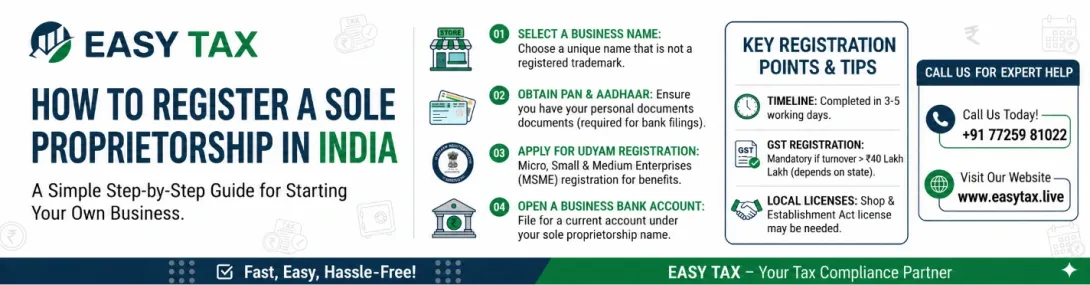
how to register a sole proprietorship in india
Business Registration Guide
How to Register a Sole Proprietorship in India (2026 Guide)
Starting a sole proprietorship in India is generally simpler than incorporating a company. However, there is no single central government certificate that every proprietor must obtain. The registrations you need depend on your business activity, turnover, state, premises, employees and customers.
Quick answer
A sole proprietorship is a business owned by one individual. You generally start by using your own PAN, choosing a business name, arranging proof of your business address and obtaining the registrations that apply to your activity. GST, Udyam and local licences are separate registrations; they are not all compulsory for every proprietor.
Important distinction
Do not apply for GST or a local licence just because you are starting a proprietorship. First check whether the law applicable to your business actually requires it. Voluntary registration can also create ongoing compliance responsibilities.
1. What is a sole proprietorship in India?
A sole proprietorship is a business owned and managed by one individual. The proprietor makes business decisions, receives the business profits and is responsible for the business's obligations.
Unlike a company incorporated under the Companies Act, a proprietorship is not created through a separate company incorporation process. The owner and the business are not separate incorporated legal persons.
Common examples include:
- Independent consultants and freelancers
- Small retail shops and traders
- Home-based businesses
- Digital marketing and design service providers
- Small manufacturing and repair businesses
- Individual online sellers
Advantages and limitations
| Advantages | Limitations |
|---|---|
| Relatively simple to start | The proprietor has personal responsibility for business obligations |
| Owner retains control of decisions | Business continuity may depend on the proprietor |
| Separate company incorporation is not required | Raising equity investment can be difficult |
| Business income is reported by the proprietor | Some customers, lenders or platforms may ask for specific registrations |
A proprietorship may not be the right structure for every business. Consider a partnership, LLP or company if you need co-owners, outside equity investment, a separate incorporated entity or a different liability structure.
2. Is sole proprietorship registration mandatory in India?
There is no single universal central registration called “Sole Proprietorship Registration” that every individual must complete before starting a business.
Instead, a proprietor obtains the registrations and permissions applicable to the business. These may include GST registration, Udyam registration, a state Shops and Commercial Establishments registration, a sector-specific licence or other local approvals.
| Registration or document | When it may be needed | Nature |
|---|---|---|
| Proprietor's PAN | Used for the proprietor's tax identity and relevant business applications | Core identity document |
| GST registration | When a registration trigger under GST law applies, or when voluntarily chosen | Conditional |
| Udyam registration | For an eligible enterprise seeking MSME recognition and related benefits | Optional |
| Shops and Establishments registration | When the relevant state law applies to the premises or establishment | State-specific |
| FSSAI registration or licence | For food businesses covered by food safety law | Activity-specific |
| Import Export Code (IEC) | Where required for import/export activity, subject to applicable exemptions | Activity-specific |
| Business bank account | Useful for separating business and personal transactions; bank requirements vary | Banking arrangement |
The correct sequence depends on your business. A freelance consultant working from home may have different requirements from a shop with employees or a food business operating from commercial premises.
3. Registrations you may need for a proprietorship
3.1 PAN of the proprietor
A sole proprietorship generally uses the proprietor's individual PAN. The business does not receive a separate PAN merely because it operates under a trade name.
If you already have a PAN, do not apply for another PAN for the same individual. Use the existing PAN in the relevant applications. If you do not have a PAN, check the current Income Tax Department application process.
3.2 GST registration
GST registration is required when the business falls within a registration category under the Central Goods and Services Tax Act, 2017, the applicable state GST law and relevant notifications. Turnover is important, but it is not the only factor.
See the detailed explanation in the GST registration section below.
3.3 Udyam registration
Udyam registration is the Government of India's MSME registration system. Eligible proprietorships can register using the proprietor's Aadhaar details. Filing on the official Udyam portal is free.
Udyam registration is not a substitute for GST registration or a state business licence.
3.4 State and local business permissions
Depending on your state, premises and activity, you may need registration under Shops and Commercial Establishments legislation, a municipal trade permission, a fire or building approval, or a sector-specific licence.
Check the relevant state and local government portals before assuming that a licence is required or that a particular fee applies.
4. How to register a sole proprietorship in India: step-by-step
Use the following sequence as a planning guide. Some steps are conditional and may not apply to every business.
Step 1: Choose a business name and activity
Select a name that is appropriate for your products or services. Check whether the name conflicts with an existing trademark or creates a misleading impression about your business.
Choosing a trade name does not, by itself, create a separate incorporated entity or grant trademark rights. Consider a trademark search if the brand is important to your business.
Step 2: Confirm the proprietor's PAN and identity details
Keep the proprietor's PAN and identity details ready. The legal name used in tax applications should match the PAN records. Avoid applying for a duplicate PAN.
Step 3: Arrange proof of the business address
Identify the principal place from which the business will operate. Depending on the registration, accepted evidence may include ownership documents, a rent or lease agreement, a utility bill, a consent letter or other prescribed proof.
The exact documents depend on the portal and the nature of the premises. Do not assume one document list applies to every registration.
Step 4: Check whether GST registration applies
Review your expected and actual aggregate turnover, the goods or services supplied, the states involved, the sales channel and any compulsory-registration provision or exemption.
If registration is required, apply through the official GST Portal. The portal's registration manual explains the online application process.
Step 5: Apply for Udyam registration if eligible and useful
If your enterprise meets the MSME classification criteria, you may complete Udyam registration through the official Government portal. The registration process is free.
Keep the proprietor's Aadhaar and PAN details available. Check the portal's current requirements before submitting the self-declaration.
Step 6: Obtain applicable state or sector-specific licences
Check the law applicable to your location and activity. A shop, restaurant, food manufacturer, transport operator and home-based consultant may have different permissions to consider.
Do not use a licence process from one state as a nationwide procedure.
Step 7: Arrange business banking and accounting
Ask your bank which documents it accepts for opening an account in the trade name of a proprietorship. Banks may have their own KYC and business-proof requirements.
Maintain records of sales, purchases, expenses, invoices, receipts and business payments from the beginning.
Step 8: Set up ongoing compliance
Identify the tax returns, GST returns if registered, TDS obligations where applicable, employee-related requirements, licence renewals and accounting records relevant to your business.
5. Documents to prepare
The following is a preparation list, not a claim that every document is compulsory for every application.
| Purpose | Possible documents or information | Important note |
|---|---|---|
| Identity and tax details | Proprietor's PAN, Aadhaar and contact details | Use matching and current details |
| Business address | Utility bill, ownership proof, rent/lease agreement or consent document | Accepted evidence depends on the application |
| GST application | PAN, proprietor details, address proof, business details and applicable authorisation | Follow the GST Portal's current checklist |
| Udyam application | Proprietor's Aadhaar, PAN and enterprise information | Online self-declaration; no document upload is generally required by the portal |
| Bank account | KYC documents and accepted proof of business activity or trade name | Requirements vary by bank |
| State/local licence | Application-specific identity, premises, establishment and fee details | Check the relevant state or local authority |
For GST, use the official GST Portal registration manual and its document checklist.
6. Is GST registration required for a sole proprietorship?
Not automatically. GST registration depends on the proprietor's supplies, aggregate turnover, state, sales channel and the registration provisions and exemptions that apply.
6.1 General turnover threshold
Section 22 of the CGST Act provides a general registration threshold of ₹20 lakh of aggregate turnover in a financial year for most states, with a ₹10 lakh threshold for specified special-category states. The law also permits a higher threshold, up to ₹40 lakh, for suppliers engaged exclusively in supplying goods, subject to government notification and conditions.
The applicable state notification and the nature of the supplies must be checked before applying a threshold to an individual business. Do not assume that the goods-only threshold applies to a business supplying services or mixed supplies.
6.2 What is aggregate turnover?
Aggregate turnover is generally computed on an all-India basis for persons having the same PAN. It includes taxable supplies, exempt supplies, exports and inter-State supplies, subject to the statutory definition and exclusions.
This means a proprietor should not look only at the sales from one shop, one GST state registration or one product line when assessing the threshold.
6.3 Inter-State supplies and services
Section 24 of the CGST Act lists categories that can require compulsory registration, including certain inter-State taxable suppliers. However, this section must be read with applicable exemptions.
For example, Notification No. 10/2017–Integrated Tax exempts qualifying persons making inter-State supplies of taxable services from registration where their all-India aggregate turnover does not exceed the specified threshold, subject to the notification's terms.
6.4 Selling through an e-commerce marketplace
Do not assume that every online seller must obtain GST registration in every situation, or that every marketplace follows the same onboarding policy.
Notification No. 34/2023–Central Tax provides a conditional exemption from compulsory registration for certain small suppliers of goods through electronic commerce operators. The exemption has conditions, including restrictions relating to inter-State supplies and a prescribed enrolment process.
The notification is not a blanket exemption for all online businesses. Service providers, sellers making inter-State supplies and businesses outside the stated conditions must assess their position separately.
6.5 When should you apply?
Under section 25 of the CGST Act, a person liable to registration under section 22 or section 24 generally has to apply within 30 days from the date on which the person becomes liable. Special rules apply to certain categories, such as casual and non-resident taxable persons.
Before applying
- Calculate aggregate turnover using the statutory definition.
- Identify whether you supply goods, services or both.
- Check the state from which the supplies are made.
- Review inter-State and e-commerce rules and exemptions.
- Check whether voluntary registration is commercially appropriate.
Apply through the official GST Portal. The GST Portal registration manual explains the application steps, PAN validation and Aadhaar authentication process.
7. Udyam registration for a sole proprietorship
Udyam is the Government of India's online MSME registration system. An eligible proprietorship can register as a micro, small or medium enterprise if it meets the applicable classification criteria.
7.1 Is Udyam registration compulsory?
Udyam registration is generally an optional MSME registration. It is not a universal incorporation certificate and does not replace GST, state or sector-specific permissions.
7.2 Is Udyam registration free?
Yes. The official Udyam Registration Portal states that filing is free, online and paperless. Do not confuse a private consultant's assistance fee with a government registration fee.
7.3 What are the current MSME classification limits?
From 1 April 2025, the revised classification uses both investment and turnover criteria:
| Category | Investment in plant, machinery or equipment | Annual turnover |
|---|---|---|
| Micro | Not more than ₹2.5 crore | Not more than ₹10 crore |
| Small | Not more than ₹25 crore | Not more than ₹100 crore |
| Medium | Not more than ₹125 crore | Not more than ₹500 crore |
The classification uses both criteria. Check the current notification and portal instructions for the applicable calculation rules and treatment of investment and turnover.
7.4 How to apply for Udyam
- Visit the official Udyam Registration Portal.
- Choose the new registration option, if applicable.
- Enter the proprietor's Aadhaar details for a proprietorship.
- Complete the required PAN and enterprise information.
- Review the declarations and submit the application.
- Save the Udyam Registration Number and certificate issued by the portal.
Official portal: udyamregistration.gov.in. The portal warns users that private websites are not authorised to undertake official MSME registration.
8. State and local licences: why location matters
State and local permissions depend on where the business operates, the premises, the number of employees and the activity carried on. A process applicable in one state should not be presented as a nationwide rule.
Example: Rajasthan Shops and Commercial Establishments registration
Rajasthan has a state-specific registration process under the Rajasthan Shops and Commercial Establishments Act, 1958. The Rajasthan Labour Department's handbook describes the online application process through its Labour Department Management System (LDMS), including establishment registration, document submission, payment of the prescribed fee and downloading the certificate.
The applicable requirement and fee should be checked against the current Rajasthan rules and official portal for the particular establishment. Do not use Rajasthan's process or fee schedule for another state.
Official resource: Rajasthan Labour Department Registration/Renewal Handbook.
Other activity-specific permissions
- Food business: Check the registration or licensing requirements under food safety law through FSSAI's FoSCoS portal.
- Import or export: Check whether an Import Export Code is required and whether an exemption applies through the Directorate General of Foreign Trade.
- Employees: Review applicable labour, establishment, social security and professional tax requirements based on the establishment and workforce.
- Premises and local activity: Check municipal, fire, building-use and other local permissions where relevant.
You can also use the Government's National Single Window System to identify certain central and state approvals relevant to your proposed business.
9. Do you need a current account for a proprietorship?
A separate business bank account can make it easier to track sales, expenses, customer receipts and supplier payments. However, do not describe a current account as a universal statutory condition for every proprietorship.
Banks set their own account-opening and KYC requirements. They may ask for the proprietor's PAN and identity documents, address proof and evidence of business activity or registrations. Ask the chosen bank for its current proprietorship account document list before applying.
Keep personal and business transactions clearly identifiable in your books, even where the bank's product or account requirements differ.
10. Income tax and accounting for a sole proprietor
A sole proprietorship's business income is generally reported by the proprietor as an individual. The applicable tax provisions, return requirements and deductions depend on the nature of the income, the taxpayer's circumstances and the relevant tax period.
10.1 Income-tax law changed from 1 April 2026
The Income-tax Act, 2025 came into effect on 1 April 2026. For income earned in FY 2026–27 onwards, the new Act uses the term Tax Year instead of the previous-year terminology used under the Income-tax Act, 1961.
Earlier tax years and proceedings relating to periods before 1 April 2026 continue to be dealt with under the applicable transitional provisions. When reading older tax material, check which Act and period it covers.
Official explanation: Income Tax Department — Objective and scope of the New Act FAQs.
10.2 Maintain business records
Keep organised records of:
- Sales invoices and receipts
- Purchase bills and supplier invoices
- Business expenses and payment evidence
- Bank statements and cash transactions
- Inventory and stock records, where relevant
- GST returns and tax payment records, if registered
- Employee and contractor payment records, where relevant
10.3 Tax audit and other compliance
A tax audit is not automatically required merely because a business is a proprietorship. Audit requirements depend on the applicable law, turnover or receipts, business or professional activity and other conditions.
The Income Tax Department's current guidance should be checked for the applicable Tax Year and the relevant audit provisions. Do not rely on an old threshold or section reference without confirming that it applies to the period being discussed.
11. How much does it cost to register a sole proprietorship?
There is no single fixed government fee for “sole proprietorship registration” because there is no one universal registration application. Your cost depends on which separate registrations and permissions apply.
| Item | Cost treatment | What to verify |
|---|---|---|
| Udyam registration | Official filing is free | Use the official Government portal |
| GST registration | No government application fee for normal GST registration | Check whether registration is required; professional assistance is separate |
| Shops and Establishments registration | Varies by state and applicable fee schedule | Check the relevant state portal and current rules |
| Sector-specific licence | Depends on the licence, activity and category | Check the issuing authority's current fee schedule |
| Bank account | Depends on the bank and account product | Check minimum balance, service charges and KYC terms |
| Professional assistance | Private service fee, if engaged | Obtain a written scope and fee quote |
Do not confuse government fees with service fees.
A consultant may charge for preparing forms, reviewing documents or assisting with an application. That is a professional service fee, not necessarily a government registration charge.
12. Sole proprietorship startup checklist
Before commencing or expanding operations, review this list:
- Choose a suitable business name and define the activity.
- Confirm the proprietor's PAN and identity information.
- Identify the principal place of business.
- Keep appropriate address and premises documents.
- Check GST turnover thresholds and compulsory-registration rules.
- Review marketplace and inter-State supply conditions if selling online.
- Decide whether Udyam registration is appropriate.
- Check state and local licensing requirements.
- Check sector-specific permissions, if applicable.
- Ask the bank for its proprietorship account requirements.
- Set up invoices, bookkeeping and record retention.
- Identify tax return, GST and employee compliance obligations.
13. Frequently asked questions
1. Can I start a sole proprietorship without company incorporation?
Yes. A proprietorship is not a company incorporated under the Companies Act. You still need to obtain any tax, state or sector-specific registrations that apply to your business.
2. Is GST compulsory for every sole proprietor?
No. GST registration depends on aggregate turnover, the type and location of supplies, compulsory-registration provisions and applicable exemptions. Check the current GST law before deciding.
3. Can a sole proprietor use a business name?
Yes. A proprietor can trade under a business or trade name. Using a trade name does not automatically incorporate a separate legal entity or provide trademark protection.
4. Does a sole proprietor need a separate PAN?
Generally, no. The proprietorship uses the proprietor's individual PAN. A separate PAN is not issued merely because the individual starts a proprietorship.
5. Is Udyam registration mandatory?
Udyam registration is generally optional. It is available to eligible enterprises and may be useful when seeking MSME recognition or benefits. Official filing through the Udyam portal is free.
6. Is a current account compulsory?
Do not assume that every proprietorship is legally required to open a current account. A separate business account can help with bookkeeping, but the bank's onboarding rules and account terms should be checked.
7. Can a sole proprietor hire employees?
A proprietor can employ staff. Applicable employment, wage, social security, establishment and other labour requirements depend on the business, location and workforce. Check the relevant rules before hiring.
8. Does a sole proprietorship have limited liability?
A sole proprietorship is not a separate incorporated entity. The proprietor may be personally responsible for business debts and obligations. Consider the appropriate legal structure and professional advice if liability exposure is a concern.
9. Can a sole proprietor sell through an online marketplace?
A proprietor may sell through online marketplaces, but GST registration and seller onboarding requirements depend on the goods or services, sales locations, applicable GST notifications and the marketplace's own policies.
10. How is proprietorship income taxed?
Business income is generally reported by the proprietor as an individual. The applicable tax provisions and filing requirements depend on the tax period and the proprietor's circumstances. For Tax Year 2026–27 onwards, refer to the Income-tax Act, 2025.
Need help choosing the right registrations?
The registrations required for a proprietorship depend on your business activity, location, turnover and sales model. Get your requirements reviewed before applying.
Official government sources and references
Use the official source relevant to the registration you are considering. Always check the current version, amendments, state notifications and applicability to your circumstances.
- Central Goods and Services Tax Act, 2017 — Section 22: Persons liable for registration and turnover thresholds. Read section 22.
- Central Goods and Services Tax Act, 2017 — Section 24: Compulsory registration in certain cases. Read section 24.
- Central Goods and Services Tax Act, 2017 — Section 25: Procedure and time limit for registration. Read section 25.
- Notification No. 10/2017–Integrated Tax: Exemption for qualifying inter-State suppliers of taxable services. Read notification.
- Notification No. 34/2023–Central Tax: Conditional exemption for certain suppliers of goods through electronic commerce operators. Find the official notification in the GST Council archive.
- GST Portal: Registration application manual. Read the registration manual.
- Udyam Registration Portal: Registration requirements, proprietor Aadhaar details and no-fee filing. Read official Udyam guidance.
- Ministry of MSME: Revised MSME classification clarification. Read the 24 October 2025 circular.
- Rajasthan Labour Department: Registration and renewal handbook. Read the Rajasthan handbook.
- Income Tax Department: Objective and scope of the Income-tax Act, 2025 FAQs. Read the official FAQs.
- National Single Window System: Government business approval discovery portal. Visit NSWS.






EasyTax • Jaipur
GST Return Filing & Compliance
Timely GSTR-1 & GSTR-3B filing, 100% ITC matching and department notice defense by certified GST experts.