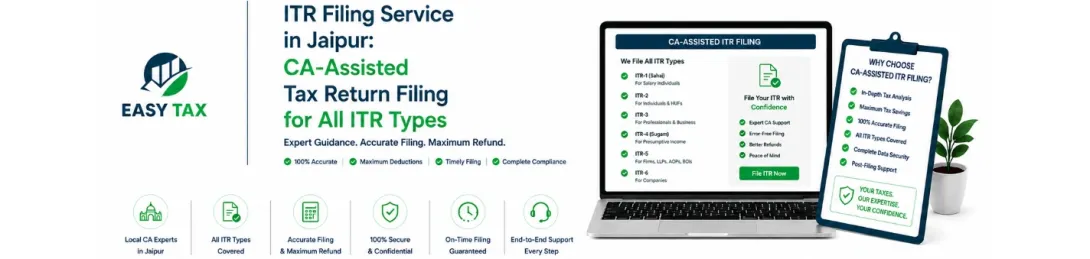
ITR Filing Service in Jaipur: CA-Assisted Tax Return Filing for All ITR Types
ITR Filing Service in Jaipur: CA-Assisted Tax Return Filing
Choosing the correct income tax return form is only one part of filing accurately. A careful review also checks your income sources, tax credits, deductions or other claims that apply, supporting records and final e-verification.
Quick answer: A CA-assisted ITR service can help assess which return form may apply, organise income and tax information, identify inconsistencies and prepare the return for your review and submission. The correct form depends on your taxpayer status, residence, income heads, transactions and the rules for the relevant assessment year or tax year. No single ITR form is suitable for everyone.
Who may need to file an income tax return?
Return-filing obligations depend on the law applicable to the relevant period and the taxpayer’s circumstances. Salary, pension, business or professional income, capital gains, house-property income and other sources can all affect the form and reporting requirements. Certain statutory conditions can require a return even where a person’s income profile is not captured by a simple salary-only test.
For returns under the Income-tax Act, 2025, section 263(1) contains the mandatory-filing provisions. For income earned in FY 2025–26, the return is filed for AY 2026–27 under the Income-tax Act, 1961, including its applicable transition rules. Refer to the Income Tax Department’s Income Tax Returns FAQs for the transition explanation.
If you are unsure whether filing is mandatory, do not rely only on a general online threshold or a previous year’s return. Have the relevant facts checked against the current statutory provisions and official instructions.
First confirm the applicable year: AY 2026–27 or Tax Year 2026–27
The Income-tax Act, 2025 came into effect from 1 April 2026. This creates an important distinction for returns being prepared during the transition:
- Income earned in FY 2025–26: file the return for Assessment Year (AY) 2026–27 under the Income-tax Act, 1961. Select the assessment year on the e-filing portal.
- Income earned in FY 2026–27: this belongs to Tax Year 2026–27 under the Income-tax Act, 2025. The return obligation arises after that tax year ends.
These are not two returns for the same income. Keep records, tax payments and supporting information clearly separated by the applicable period. The Department’s official transition FAQ explains which Act governs AY 2026–27 and how the Tax Year framework applies.
Understanding ITR forms: which one may apply?
“All ITR types” does not mean that every taxpayer can choose any form. The form is selected after reviewing the legal status of the taxpayer, residence, income heads, business or professional activity, specified transactions and the current form instructions. The table below is a high-level orientation for AY 2026–27, not a substitute for the notified form and eligibility rules.
| Form | General purpose | Important qualification |
|---|---|---|
| ITR-1 (Sahaj) | Specified resident individuals with eligible salary/pension, house-property and other-source income, subject to the form conditions. | Not suitable for several income types and circumstances, including business/professional income, certain capital gains and specified foreign-asset or director/shareholding situations. Check the current eligibility list. |
| ITR-2 | Individuals and HUFs who do not have income chargeable under “Profits and Gains of Business or Profession” and are not eligible for ITR-1. | May apply where there are capital gains, multiple house properties or other specified income. Confirm the detailed exclusions. |
| ITR-3 | Individuals and HUFs with business or professional income who are not eligible for ITR-4. | Business structure, income type and other conditions determine applicability. |
| ITR-4 (Sugam) | Eligible resident individuals, HUFs and firms other than LLPs with qualifying presumptive business/professional income and within the form’s conditions. | Presumptive taxation alone does not automatically make a taxpayer eligible; turnover/income limits and exclusions must be checked. |
| ITR-5 | Specified persons other than individuals, HUFs, companies and persons filing ITR-7. | Entity status and the applicable return category determine whether this form is appropriate. |
| ITR-6 | Companies other than companies claiming exemption under section 11. | Company status and exemption claim need to be reviewed. |
| ITR-7 | Persons, including specified companies, required to file under the provisions identified in the form instructions, including specified sections 139(4A) to 139(4D). | Applicable to specified trusts, institutions and other entities; check the relevant statutory category and form instructions. |
For the exact AY 2026–27 descriptions, use the Department’s official ITR downloads and form descriptions. Its guidance explains, for example, that ITR-2 is for individuals and HUFs without business/professional income, while ITR-3 is relevant for individuals and HUFs with such income who are not eligible for ITR-4. See the Department’s pages for ITR-2, business and professional income, ITR-4 and ITR-1.
Documents and information to keep ready
The exact documents depend on your income sources and claims. A useful starting checklist is:
- PAN and the personal details needed to access the e-filing account.
- Form 16, salary or pension statements, where applicable.
- Bank account statements and interest certificates.
- Form 26AS, Annual Information Statement (AIS) and Taxpayer Information Summary (TIS), reviewed for relevant entries.
- Details of tax deducted at source (TDS), tax collected at source (TCS), advance tax and self-assessment tax payments.
- Capital-gains statements, broker reports and supporting transaction records, where applicable.
- House-property rent, interest and ownership details, where applicable.
- Business or professional income records, books, expense details and presumptive-tax information, where applicable.
- Evidence for deductions, exemptions or reliefs that are legally available and actually being claimed.
- Prior-year return and tax records where they are relevant to brought-forward items or disclosures.
Do not share passwords, OTPs or e-filing login credentials with an adviser. Share only the documents needed through a secure, agreed channel and retain your own copies.
How CA-assisted ITR filing works
- Understand your profile. Record taxpayer status, residential status, applicable year, income sources, business activity and significant transactions.
- Choose the form after checking eligibility. Compare your facts with the current official form instructions; do not select a form only because it was used last year.
- Reconcile income and tax information. Compare records with Form 16, Form 26AS, AIS/TIS, bank information and other supporting documents. Resolve differences before preparing the return.
- Review claims and disclosures. Check that deductions, exemptions, losses, tax credits and other disclosures are supported and permitted for the applicable year and regime.
- Prepare the return for taxpayer review. Review the draft for correct personal details, bank account, income heads, tax computation, tax payments and disclosures before submission.
- Submit and preserve the acknowledgement. Keep the filed return, acknowledgement number and a copy of the submitted information.
- Complete verification and follow-up. E-verify the return or submit ITR-V in the prescribed manner, then monitor processing and any communication from the Department.
After filing: do not miss e-verification
Uploading the return is not the only step. The Income Tax Department states that e-verification or submission of ITR-V must be completed within 30 days from filing. If verification is completed after that period, the verification date may be treated as the date of furnishing the return, and applicable late-filing consequences can follow. Read the Department’s 30-day ITR-V and e-verification FAQ.
After verification, save the confirmation and acknowledgement. Check the e-filing account for processing status, refund-related communication or notices. A refund is not guaranteed merely because tax was deducted; it depends on the return, tax credits, adjustments and processing outcome.
How to choose an ITR filing service in Jaipur
Before appointing a tax professional, ask how the service handles these practical points:
- Form selection: Will the adviser explain why a particular ITR form fits your facts and identify any exclusions?
- Reconciliation: Will income and tax credits be checked against Form 16, Form 26AS, AIS/TIS and your supporting records?
- Review and approval: Will you receive a draft or computation to review before filing?
- Scope and fees: Are the service fee, included work, additional charges and any government fee clearly separated in writing?
- Post-filing help: Does the service explain e-verification, acknowledgement retention and how follow-up notices or defects are handled?
- Data handling: Is there a secure way to provide documents, and are OTPs and passwords kept under your control?
EasyTax lists a Jaipur advisory desk for individual tax and ITR assistance. You can confirm the current service scope, documents required and quotation directly through the EasyTax contact page. Ask for a written scope and fee quote before sharing documents or authorising work.
Frequently asked questions
Can a CA help with all ITR forms?
A tax professional can assess which form may apply to your taxpayer category and income profile, and assist with preparation within the agreed scope. Eligibility is determined by the law and current form instructions, not by the service provider. Some forms apply to individuals, while others apply to entities or specified institutions.
Can I use the same ITR form every year?
Not necessarily. Your income sources, residence, transactions, taxpayer status and changes to form rules can affect the correct form each year. Recheck eligibility for every return.
Which year should I select for income earned between April 2025 and March 2026?
That income belongs to FY 2025–26 and is reported in AY 2026–27 under the Income-tax Act, 1961. Income earned in FY 2026–27 is reported under Tax Year 2026–27 using the new Act framework. Refer to the official transition FAQ.
Is my return complete once it is uploaded?
No. Complete e-verification or submit ITR-V within the prescribed 30-day period and keep the confirmation. See the official ITR verification guidance.
Does filing an ITR guarantee a tax refund, loan or visa approval?
No. A refund depends on the tax position and processing of the return. Lenders and visa authorities set their own requirements; filing a return does not guarantee approval.
How do I get a quote for ITR filing in Jaipur?
Contact EasyTax with a brief description of your taxpayer type, applicable year and income sources. Request a written scope and fee quote before proceeding. Do not send passwords or OTPs.
Need help with ITR filing in Jaipur?
Discuss your taxpayer profile, the applicable return year and the records you have. EasyTax can confirm whether the service fits your requirements and explain the proposed scope before you proceed.
Contact EasyTax for an ITR filing consultation · Call +91 77259 81022
Official references
- Income Tax Department — Income Tax Returns FAQs (Income-tax Act, 2025 section 263 and transition between AY 2026–27 and Tax Year 2026–27).
- Income Tax Department — ITR downloads and form descriptions (AY 2026–27 forms and utilities).
- Income Tax Department — ITR-1 FAQs (eligibility and exclusions).
- Income Tax Department — ITR-2 FAQs (eligibility).
- Income Tax Department — Individual business/professional income (ITR-3 and ITR-4 overview).
- Income Tax Department — ITR-4 FAQs (eligibility and exclusions).
- Income Tax Department — 30-day ITR-V/e-verification FAQ.
Important: This article provides general information, not individual tax or legal advice. The applicable law, forms, filing deadlines and eligibility must be checked for the taxpayer and period concerned. A qualified tax professional should review this article and approve the exact published revision before it is represented as CA-reviewed. Service availability, fees and scope should be confirmed directly with EasyTax.






EasyTax • Jaipur
Expert Assisted ITR Filing
Dedicated CA prepares, verifies, and files your ITR. Maximum refund, accurate deductions, zero notices.