
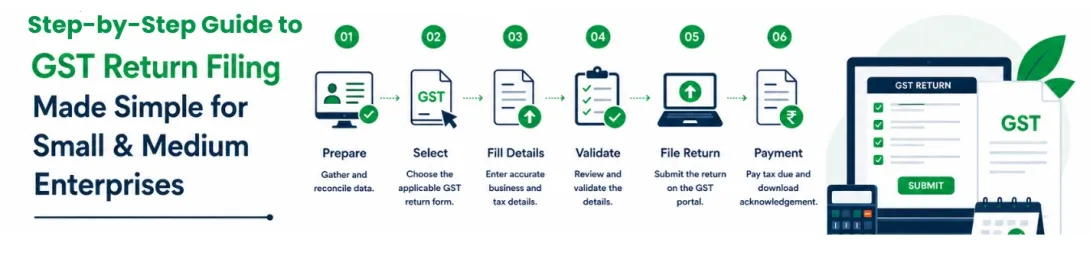
Step-by-Step Guide to GST Return Filing for Small and Medium Enterprises
Essential Aspects of Tax
GST Return Filing for SMEs: Complete Step-by-Step Guide to Stay Compliant (2026) This process directly involves Tax Compliance. This process directly involves Tax Compliance.
For small and medium enterprises (SMEs), GST return filing is one of the most important compliance responsibilities under the Indian tax system. Proper and timely GST filing ensures legal compliance, smooth business operations, accurate tax reporting. And avoidance of penalties or input tax credit (ITC) losses.
However, many SMEs struggle with GST compliance due to complex return types, documentation requirements, and reconciliation challenges. This guide explains the complete GST return filing process step-by-step, along with key rules, benefits, common mistakes, penalties. And practical compliance tips for SMEs.
Understanding GST Return Filing
A GST return is a statement submitted to the tax authorities containing details of:
- Sales (outward supplies)
- Purchases (inward supplies)
- Output tax collected
- Input tax credit (ITC) claimed
- Tax payable and paid
Every registered business under GST must file returns based on its turnover, registration type, and business activity.
For SMEs, GST filing is usually monthly or quarterly, with an annual return at the end of the financial year.
Why GST Compliance is Important for SMEs
GST compliance is not just a legal requirement—it directly impacts business stability.
Key benefits include:
Essential Aspects of Tax Compliance
- Avoiding penalties and late fees
- Ensuring smooth input tax credit flow
- Maintaining clean financial records
- Improving business credibility
- Supporting loan and investment approvals
- Enabling interstate trade without restrictions
Non-compliance can lead to penalties, blocked ITC, and even GST registration cancellation in serious cases.
Step 1: GST Registration on the GST Portal
The first step in compliance is GST registration.
Visit the official GST portal: https://www.gst.gov.in
Once registered, your business receives a GST Identification Number (GSTIN),. This is required for all transactions and filings.
Documents required for registration:
- PAN card of business and owner
- Aadhaar card
- Business registration certificate
- Address proof of business
- Bank account details
- Digital signature (for companies/LLPs)
Step 2: Understand Types of GST Returns
Different GST returns apply depending on your business type.
GSTR-1 (Outward Supplies)
- Details of sales invoices
- Filed monthly or quarterly
- Reports taxable and exempt sales
GSTR-3B (Summary Return)
- Monthly summary of sales and purchases
- Tax liability and ITC calculation
- Mandatory for most businesses
GSTR-2A / 2B (Auto-generated)
- Purchase data from suppliers
- Used for ITC reconciliation
GSTR-9 (Annual Return)
- Summary of entire financial year
- Filed once annually
Understanding the correct return type is essential for compliance accuracy.
Step 3: Maintain Proper Accounting Records
Accurate bookkeeping is the foundation of GST compliance.
SMEs should maintain:
- Sales invoices
- Purchase bills
- Expense records
- Credit and debit notes
- Bank statements
Using accounting software can significantly reduce errors and improve reconciliation accuracy.
Step 4: Prepare GST Return Data
Before filing, all data must be verified and organized.
For GSTR-1:
- Upload invoice-wise sales data
- Ensure GST rates are correct
- Match buyer details carefully
For GSTR-3B:
Essential Aspects of Tax Compliance
- Calculate total sales
- Calculate ITC available
- Determine net tax liability
Errors in data preparation are one of the biggest reasons for GST notices.
Step 5: Input Tax Credit (ITC) Management
ITC is one of the biggest advantages of GST for SMEs.
Businesses can claim tax paid on purchases such as:
- Raw materials
- Office supplies
- Business services
- Capital goods
Conditions for claiming ITC:
- Supplier must file GST return
- Invoice must be valid
- Goods/services must be used for business
Mismatch in ITC data can lead to blocked credit and cash flow issues.
Step 6: GST Return Filing Process
Once data is ready, follow these steps:
- Login to GST portal using GSTIN
- Select relevant return (GSTR-1 or GSTR-3B)
- Enter invoice and summary details
- Validate tax calculation
- Submit return
- Pay tax liability (if applicable)
Payment can be made via:
- Net banking
- UPI
- NEFT/RTGS
Step 7: File and Verify Return
After submission, the return must be verified.
Verification methods:
- Aadhaar OTP
- Digital Signature Certificate (DSC)
- EVC (Electronic Verification Code)
Once verified, you receive an ARN (Application Reference Number) as proof of filing.
Common Challenges Faced by SMEs in GST Filing
1. Incorrect GST Rate Selection
Different goods and services have different GST slabs. Errors can lead to penalties.
2. ITC Mismatch
Mismatch between purchase records and supplier filings can block credit.
3. Missed Deadlines
Late filing leads to penalties and interest charges.
4. Poor Record Keeping
Incomplete documentation causes errors during filing.
5. Lack of Expertise
Many SMEs do not have in-house tax professionals.
GST Penalties for Non-Compliance
Failure to comply with GST rules can lead to:
Essential Aspects of Tax Compliance
- Late filing fees
- Interest on unpaid tax
- Penalties for incorrect filing
- Blocking of input tax credit
- Legal notices from tax authorities
Timely compliance helps avoid unnecessary financial burden.
Benefits of Professional GST Filing Support
Many SMEs prefer professional tax assistance for GST compliance.
Advantages include:
- Accurate return filing
- ITC optimization
- Error-free documentation
- Timely compliance
- Reduced risk of notices
- Better tax planning
Professional services like Easy Tax Jaipur help SMEs manage GST efficiently and focus on business growth.
How Easy Tax Jaipur Helps SMEs
Easy Tax Jaipur provides end-to-end GST support services including:
- GST registration assistance
- Monthly and quarterly return filing
- ITC reconciliation
- Error correction and rectification
- Compliance monitoring
- Advisory on GST rules
Their expertise ensures SMEs avoid penalties and maintain smooth tax operations.
Best Practices for GST Compliance
To ensure smooth GST filing:
- Maintain monthly bookkeeping
- Reconcile ITC regularly
- File returns before deadlines
- Use accounting software
- Review GST rates carefully
- Consult professionals for complex cases
Frequently Asked Questions (FAQs)
What is GST return filing?
GST return filing is the submission of sales, purchases, tax paid. And ITC details to the government.
How often should SMEs file GST returns?
Most SMEs file monthly or quarterly returns depending on their turnover and scheme.
What happens if GST return is not filed on time?
Late fees, penalties, and interest are charged on delayed filing.
Can SMEs claim ITC?
Yes, SMEs can claim ITC on business-related purchases if conditions are met.
Is professional help necessary for GST filing?
Not mandatory. But highly recommended for accuracy and compliance.
Conclusion
Essential Aspects of Tax Compliance
GST return filing is a critical responsibility for SMEs in India. Proper compliance ensures smooth operations, financial accuracy, and legal protection. However, due to frequent rule updates and technical requirements, many SMEs face challenges in filing correctly.
By following a structured process—registration, record keeping, ITC management. And timely filing—businesses can avoid penalties and improve efficiency.
For hassle-free compliance, professional guidance from experts like Easy Tax Jaipur can help SMEs manage GST returns accurately and focus on business growth.
For more detailed assistance, explore our professional tax services or check official updates on the Income Tax Department website.
EasyTax • Jaipur
GST Return Filing & Compliance
Timely GSTR-1 & GSTR-3B filing, 100% ITC matching and department notice defense by certified GST experts.