
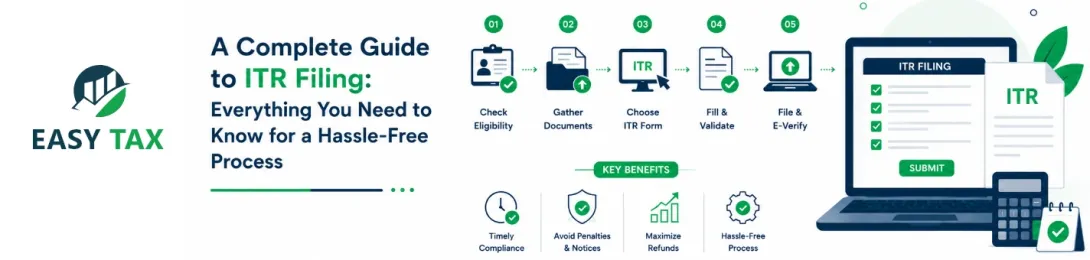
A Complete Guide to ITR Filing: Everything You Need to Know for a Hassle-Free Process
Essential Aspects of Tax
Income Tax Return Filing in India: Complete Step-by-Step Human Guide (2026) This process directly involves Tax Compliance. This process directly involves Tax Compliance. This process directly involves Tax Compliance.
Filing Income Tax Returns (ITR) is one of the most important financial responsibilities for every taxpayer in India. It is not just a legal requirement but also an essential part of financial planning. A properly filed ITR helps you stay compliant with the Income Tax Department, claim refunds, apply for loans. And build strong financial credibility.
Despite being a routine process, many individuals still find ITR filing confusing due to changing tax rules, multiple income sources, and technical compliance requirements. This guide explains everything in a simple, human. And practical way, so you can file your income tax return without stress.
What is Income Tax Return (ITR)?
Income Tax Return (ITR) is a form used to declare your income, expenses, deductions, and taxes paid to the Income Tax Department of India.
It includes:
- Income from salary or business
- Income from house property
- Capital gains from shares or property
- Interest income from savings or fixed deposits
- Deductions under various sections
Once submitted, the government calculates whether:
- You need to pay additional tax, or
- You are eligible for a refund
In simple terms, ITR is your annual financial statement to the government.
Why Filing ITR is Important
Essential Aspects of Tax Compliance
Many people think ITR filing is only for high-income earners. But that is not true. Filing ITR has several benefits even for individuals below the taxable limit.
Key reasons:
1. Legal Compliance
Filing ITR ensures you are following Indian tax laws and avoiding penalties.
2. Tax Refunds
If excess TDS has been deducted, you can claim a refund only after filing ITR.
3. Loan Approval
Banks require ITR documents for home loans, car loans, and business loans.
4. Visa Applications
Many countries require ITR records for visa processing.
5. Financial Proof
ITR acts as official income proof for freelancers, business owners. And professionals.
Who Should File Income Tax Returns?
You must file ITR if:
- Your income exceeds the basic exemption limit
- You have income from multiple sources
- You are a freelancer, business owner, or consultant
- You earn income from investments or capital gains
- You want to claim a tax refund
- You are applying for loans or visas
- You have foreign income or assets
Even if your income is low, filing ITR is still beneficial for financial records.
Documents Required for ITR Filing
Before starting the filing process, keep all documents ready. This helps avoid mistakes and delays.
Basic Documents:
- PAN Card
- Aadhaar Card
- Bank Account Details
- Mobile Number linked with Aadhaar
Income Documents:
- Form 16 (salary details)
- Salary slips (if needed)
- Bank statements
- Interest certificates (FD, savings)
- Rental income proof
Investment Documents:
- LIC premium receipts
- ELSS mutual fund statements
- PPF contribution details
- Health insurance receipts
Other Documents:
- Capital gains statements
- Home loan interest certificate
- TDS certificates (Form 26AS / AIS)
Step-by-Step Process to File ITR
Filing your income tax return becomes easy when you follow the correct steps.
Essential Aspects of Tax Compliance
Step 1: Choose Correct ITR Form
Selecting the correct form is very important:
- ITR-1 → Salaried individuals
- ITR-2 → Capital gains / multiple properties
- ITR-3 → Business income
- ITR-4 → Presumptive income
Wrong form selection can lead to rejection.
Step 2: Login to Income Tax Portal
- Register using PAN
- Set password
- Login to dashboard
Step 3: Check AIS and Form 26AS
AIS (Annual Information Statement) shows:
- Salary income
- Bank interest
- TDS details
- Investments
Always match your income with AIS to avoid mismatch errors.
Step 4: Enter Income Details
Add all income sources:
- Salary
- Freelance income
- Business income
- Interest income
- Capital gains
Never hide any income, as it may trigger a notice later.
Step 5: Claim Deductions
You can reduce taxable income using deductions:
Section 80C:
- LIC
- PPF
- ELSS
- Tuition fees
Section 80D:
- Health insurance
Other deductions:
- Home loan interest
- Donations (80G)
Proper deductions help reduce tax liability legally.
Step 6: Calculate Tax Liability
After entering income and deductions:
- System calculates tax automatically
- Verify manually if needed
- Check if tax is payable or refundable
Step 7: Pay Pending Tax (If Any)
If tax is due:
- Pay using Challan 280
- Use net banking, UPI, or debit card
Step 8: Submit ITR
Once everything is verified:
- Submit return online
- Download acknowledgment
Step 9: E-Verify Your Return
E-verification is mandatory.
Methods:
- Aadhaar OTP
- Net banking
- Bank account verification
Without verification, your ITR is invalid.
Many taxpayers make avoidable mistakes that lead to penalties or notices.
1. Missing Deadline
Late filing leads to penalties under Section 234F.
2. Wrong ITR Form
Each income type requires a different form.
3. Incorrect Income Reporting
Not showing all income sources leads to mismatch.
4. Ignoring AIS Data
AIS mismatch is a major reason for notices in 2026.
Essential Aspects of Tax Compliance
5. Wrong Bank Details
Refund delays occur due to incorrect account numbers.
6. Not Verifying Return
Unverified returns are considered invalid.
Challenges Faced by Taxpayers
1. Complex Income Structure
Freelancers and business owners face multiple income sources.
2. Technical Errors
Portal issues and incorrect data entry.
3. Lack of Knowledge
Most people are unaware of tax rules.
4. Changing Tax Laws
Rules change frequently, making compliance difficult.
Benefits of Professional Tax Assistance
Many taxpayers prefer professional help for accuracy and peace of mind.
A tax consultant helps with:
- Correct ITR selection
- Accurate income calculation
- Tax saving strategies
- Error-free filing
- Notice handling support
Professional services like Easy Tax Jaipur make the process simple and stress-free.
Why Easy Tax Jaipur Helps You File ITR Easily
Easy Tax Jaipur provides expert tax filing services for individuals, freelancers. And businesses.
They help with:
- ITR filing for all income types
- Tax planning and deductions
- AIS and TDS reconciliation
- Error-free filing process
- Support during tax notices
This ensures smooth and compliant tax filing without confusion.
Tips for Smooth ITR Filing
- Start early before deadline
- Keep documents organized
- Match AIS with income
- Claim only valid deductions
- Avoid last-minute filing
- Seek expert help for complex cases
Frequently Asked Questions (FAQs)
1. What is the last date to file ITR?
Usually July 31 for individuals (subject to government updates).
2. Can I file ITR without Form 16?
Yes, using salary slips and bank statements.
3. What happens if I don’t file ITR?
You may face penalties and lose refund eligibility.
Essential Aspects of Tax Compliance
4. Is ITR filing mandatory for everyone?
Only if income exceeds exemption limit. But it is still beneficial for others.
Conclusion
Filing Income Tax Returns is not just a yearly formality—it is a key part of financial discipline and legal compliance. With increasing digital tracking and stricter tax rules in 2026, accuracy in ITR filing is more important than ever.
By following the correct process, maintaining proper documents. And avoiding common mistakes, you can ensure smooth and error-free filing.
If your tax situation is complex or you want hassle-free filing, expert guidance from professionals like Easy Tax Jaipur can help you save time, reduce errors, and maximize benefits.
For more detailed assistance, explore our professional tax services or check official updates on the Income Tax Department website.
EasyTax • Jaipur
Expert Assisted ITR Filing
Dedicated CA prepares, verifies, and files your ITR. Maximum refund, accurate deductions, zero notices.