
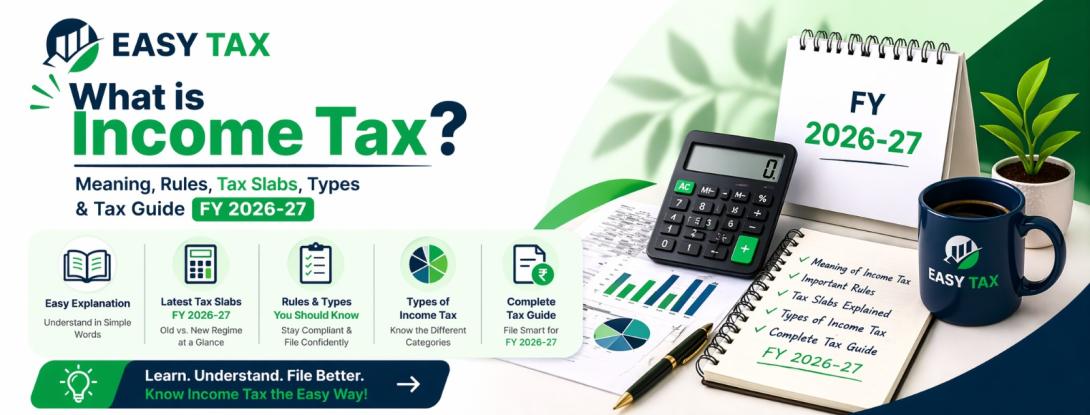
What is Income Tax? Meaning, Rules, Tax Slabs, Types & Tax Guide FY 2026-27
Essential Aspects of Tax
This is because most of us listen to the term income tax every year and nod our heads. But when someone requests you to elaborate on it, you would most likely stop thinking. That's completely normal. In India, income tax is something you will have to contend with whether you like it or not, as long as you are earning. And here is a decent breakdown that does make sense. This process directly involves Tax Compliance. This process directly involves Tax Compliance.
Income tax is the amount of money you pay to the government based on your income. It is also employed in financing social amenities such as roads, hospitals, schools and national development.
In case you make money by means of a job, business, rent. And investment, you might be required to pay income tax according to the amount of money you make.
The Government of India manages the Income Tax in India through the Income Tax Department. All people and companies are obliged to declare their earnings and pay tax accordingly.
The tax is computed on the basis of your income during a financial year. In this blog, we are making reference to Income Tax FY 2026-27.
The various kinds of income should be known before the computation of tax:
Essential Aspects of Tax Compliance
- Salary income (monthly job income)
- Income from house property (rent)
- Business or professional income
- Capital gains — basically the profit you make when you sell something like property or shares. And then there's everything else — interest, dividends. And other odds and ends that count as income too.
All these incomes are added together to calculate your total taxable income.
Income tax in India is calculated using slab rates. This means different portions of your income are taxed at different rates.
The New Tax Regime is now the default option.
- Up to ₹3 lakh – No tax
- ₹3 lakh to ₹6 lakh – 5%
- ₹6 lakh to ₹9 lakh – 10%
- ₹9 lakh to ₹12 lakh – 15%
- ₹12 lakh to ₹15 lakh – 20%
Anything above ₹15 lakh gets taxed at 30%. With the Old Tax Regime, you can actually bring that taxable income down — through deductions like 80C, HRA. And a handful of others that most salaried people qualify for.
- Up to ₹2.5 lakh – No tax
- ₹2.5 lakh to ₹5 lakh – 5%
- ₹5 lakh to ₹10 lakh – 20%
- Above ₹10 lakh – 30%
You can choose either using New Tax Regime or Old Tax Regime. This will save you more tax.
Tax Rebate (Section 87A) is used in reducing the tax of those with low income.
In the New Tax Regime, you could be tax-free due to this rebate on your income provided your income is up to 7 lakh.
Under the Old Tax Regime, the rebate is applicable when your income does not exceed 5 lakh.
This rebate is very useful for salaried individuals and small earners.
Types of Taxes You Should Know
Under income tax, there are various forms of tax:
1. TDS (Tax Deducted at Source).
Essential Aspects of Tax Compliance
This gets taken out of your salary before the money even hits your account.
2. Advance Tax
If your total tax liability is high, you need to pay tax in parts during the year instead of waiting till the end.
3. Self-Assessment Tax
Self-Assessment Tax is paid after calculating your total income and tax liability. If any tax is still pending after TDS and advance tax, you pay it before filing your return.
The following are a few of the rules that you are supposed to take into consideration:
- You should file your income tax return (ITR) annually.
- Record your revenues and expenditures.
- Select the appropriate tax regime.
- Pay tax on time to avoid penalties
- Report all sources of income honestly
- New Tax Scheme versus Previous Tax Scheme
Choosing between the New Tax Regime and the Old Tax Regime depends on your situation.
If you have many deductions (like insurance, investments), the old regime may help
If you want a simple process with lower rates, the new regime is better
It is always good to compare both before filing your return.
Why is Understanding Income Tax Important?
Understanding income tax helps you:
- Avoid penalties
- Save money legally
- Plan your finances better
- Stay stress-free during tax season
Most individuals do not pay much attention to taxes until the very end and this causes confusion and errors.
Essential Aspects of Tax Compliance
The income tax need not be complex. It is much easier to manage once you have grasped the fundamentals of Income Tax in India and tax slabs and regulations.
For Income Tax FY 2026-27, make sure you check the latest slabs, choose between the New Tax Regime and Old Tax Regime. And use benefits like Tax Rebate (Section 87A) if applicable.
Record your income, remit any outstanding payments of Self-Assessment Tax and submit your return within the stipulated time.
Even some planning can help you have an easy, stress-free ride with taxes.
For more detailed assistance, explore our professional tax services or check official updates on the Income Tax Department website.
EasyTax • Jaipur
Expert Assisted ITR Filing
Dedicated CA prepares, verifies, and files your ITR. Maximum refund, accurate deductions, zero notices.