

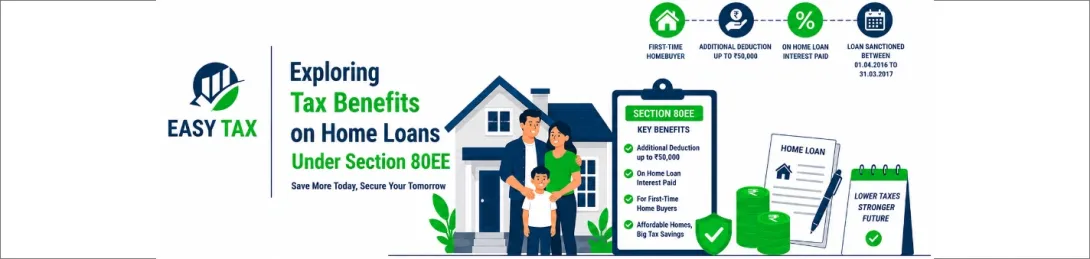
Exploring Tax Benefits on Home Loans Under Section 80EE
Essential Aspects of Tax
Tax Benefits of Home Loans Under Section 80EE: Complete Guide (2026) This process directly involves Tax Compliance. This process directly involves Tax Compliance.
Buying a home is one of the biggest financial decisions in a person’s life. To encourage homeownership, the Government of India provides several tax benefits on home loans under different sections of the Income Tax Act.
One such important provision is Section 80EE, which allows first-time homebuyers to claim additional deductions on home loan interest payments.
This guide explains Section 80EE in detail, including eligibility, benefits, limitations, examples, comparison with other sections. And tax-saving strategies.
What is Section 80EE of Income Tax Act?
Section 80EE provides an additional tax deduction of up to ₹50,000 per year on interest paid on home loans.
This deduction is available over and above Section 24(b), making it extremely beneficial for first-time homebuyers.
It was introduced to make housing more affordable for middle-income taxpayers.
Key Features of Section 80EE
- Additional deduction on home loan interest
- Maximum benefit: ₹50,000 per financial year
- Applicable only to individuals
- Only for first-time homebuyers
- Available over and above Section 24(b)
Eligibility Criteria for Section 80EE
To claim benefits under Section 80EE, the taxpayer must meet the following conditions:
1. First-Time Homebuyer
The taxpayer must not own any residential property at the time of loan sanction.
This is a strict requirement.
2. Loan Amount Limit
The home loan amount must be:
Essential Aspects of Tax Compliance
- ₹35 lakh or less
3. Property Value Limit
The value of the property must not exceed:
- ₹50 lakh
4. Loan Sanction Period
The loan must be sanctioned by a financial institution or housing finance company during the eligible period defined by the government.
5. Individual Taxpayer Only
- Available only for individuals
- Not applicable to HUF, firms, or companies
Deduction Benefits Under Section 80EE
Additional Interest Deduction
You can claim up to:
- ₹50,000 per year on home loan interest
This is in addition to:
- Section 24(b) deduction (₹2 lakh limit)
Example of Tax Saving
Suppose:
- Home loan interest paid = ₹2.3 lakh
- Section 24(b) claimed = ₹2 lakh
- Remaining interest = ₹30,000
Under Section 80EE:
- Additional deduction = ₹30,000 (within ₹50,000 limit)
Total tax benefit increases significantly.
Section 80EE vs Section 24(b)
Feature
Section 24(b)
Section 80EE
Deduction type
Interest deduction
Additional interest deduction
Maximum limit
₹2,00,000
₹50,000
Eligibility
All homeowners
First-time buyers only
Applicability
Self-occupied property
First-time purchase only
Section 80EE vs Section 80EEA
Many taxpayers confuse these two sections.
Section 80EE
- Earlier scheme
- Limited eligibility
- ₹50,000 deduction
Section 80EEA
- Introduced later
- Higher deduction up to ₹1.5 lakh
- Applicable for affordable housing
- Stricter date and price conditions
Key Difference Summary
Feature
80EE
80EEA
Deduction
₹50,000
₹1.5 lakh
Applicability
First-time buyers
Affordable housing
Moderate
Higher
How to Claim Deduction Under Section 80EE
Step 1: Collect Loan Documents
You need:
- Loan sanction letter
- Interest certificate from bank
- Property documents
Step 2: Calculate Eligible Interest
Separate:
- Principal repayment
- Interest component
Only interest qualifies.
Step 3: Claim in Income Tax Return
You can claim deduction while filing:
- ITR-1 (simple cases)
- ITR-2 (capital gains/property cases)
Mention under “Income from House Property”.
Essential Aspects of Tax Compliance
Step 4: Submit Supporting Proof
Keep documents ready in case of verification.
Advantages of Section 80EE
1. Extra Tax Savings
You get additional ₹50,000 deduction beyond normal limits.
2. Reduces EMI Burden (Indirectly)
Lower tax liability improves cash flow.
3. Encourages First-Time Home Ownership
Supports affordable housing goals.
4. Works Along with Other Sections
You can combine:
- Section 24(b)
- Section 80C (principal repayment)
- Section 80EE
Limitations of Section 80EE
1. Only First-Time Buyers
Not available for second homes.
2. Loan & Property Value Restrictions
Strict eligibility limits apply.
3. Limited Deduction Amount
₹50,000 is relatively small compared to Section 80EEA.
4. Time-Bound Availability
Applicable only during specific loan sanction periods.
Common Mistakes Taxpayers Make
1. Claiming Without Eligibility
Many people wrongly claim without checking first-time buyer condition.
2. Confusing 80EE and 80EEA
Both are different schemes.
3. Not Taking Full 24(b) Benefit First
80EE is additional, not replacement.
4. Incorrect Documentation
Missing interest certificates leads to rejection.
Tax Planning Strategy for Homeowners
To maximize savings:
- Claim Section 24(b) first
- Use Section 80C for principal repayment
- Apply Section 80EE if eligible
- Consider Section 80EEA for affordable housing cases
Role of Easy Tax in Home Loan Tax Planning
Managing home loan taxation can be complex. Easy Tax helps taxpayers with:
- Eligibility verification for Section 80EE
- Home loan interest calculation
- ITR filing assistance
- Tax-saving optimization
- Documentation and compliance support
With expert guidance, taxpayers can maximize deductions legally and efficiently.
Frequently Asked Questions (FAQs)
1. Can I claim both Section 24(b) and 80EE?
Yes, Section 80EE is an additional deduction over Section 24(b).
Essential Aspects of Tax Compliance
2. Is Section 80EE still available?
It is applicable only for eligible loan cases based on government conditions.
3. Can I claim 80EE for second home?
No, it is only for first-time homebuyers.
4. What is the maximum benefit?
₹50,000 per financial year.
5. Which is better: 80EE or 80EEA?
80EEA offers higher benefits. But depends on eligibility.
Conclusion
Section 80EE is a valuable tax-saving provision for first-time homebuyers in India. It provides an additional deduction on home loan interest, helping reduce overall tax burden.
However, understanding eligibility conditions, comparing it with Section 80EEA. And correctly claiming deductions is essential to fully benefit from it.
When used properly along with Section 24(b) and Section 80C, home loan tax planning can significantly improve financial efficiency.
Professional guidance can make the process even easier. Easy Tax helps homeowners maximize tax benefits, ensure compliance, and file accurate returns without errors.
For more detailed assistance, explore our professional tax services or check official updates on the Income Tax Department website.
EasyTax • Jaipur
Expert Assisted ITR Filing
Dedicated CA prepares, verifies, and files your ITR. Maximum refund, accurate deductions, zero notices.