
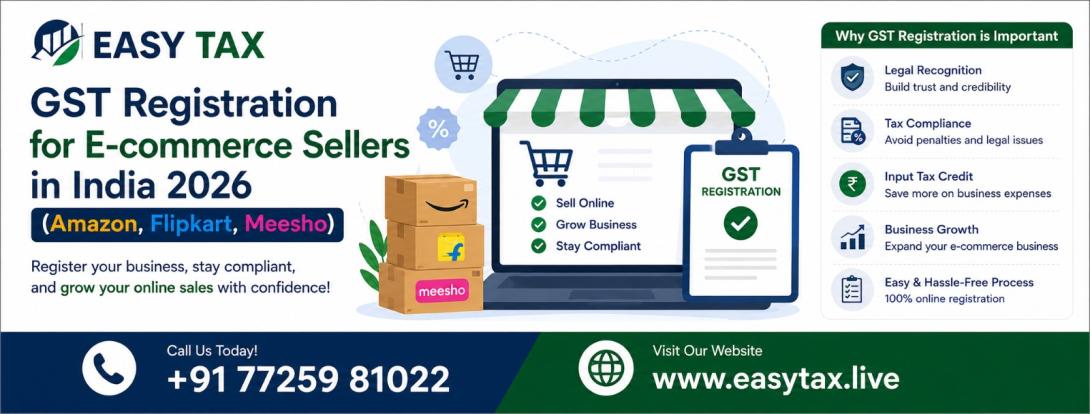
GST Registration for E-commerce Sellers in India 2026 (Amazon, Flipkart, Meesho)
Essential Aspects of Tax
GST Registration for E-commerce Sellers in India 2026 (Amazon, Flipkart, Meesho) This process directly involves Tax Compliance. This process directly involves Tax Compliance.
The ecommerce industry in India is growing rapidly. And thousands of people are now starting online businesses through platforms like Amazon, Flipkart, and Meesho. Whether you are a small business owner, reseller, dropshipper, startup founder, or large ecommerce company, online selling has become one of the fastest-growing business models in India.
However, many new sellers are still unaware of the GST rules, registration requirements, compliance process, invoice management. And tax filing responsibilities involved in ecommerce selling.
Before starting your online business journey, it is very important to understand GST Registration for E-commerce Sellers in India 2026. If you sell products through Amazon, Flipkart, Meesho, Shopify, or your own website, GST registration helps your business remain legally compliant and professionally organized.
This complete guide explains GST rules for ecommerce sellers, registration procedures, required documents, compliance requirements, and important tips for online businesses in India.
Why GST Registration is Important for Ecommerce Sellers
GST registration is one of the most important legal requirements for online sellers in India today.
Unlike many offline businesses, ecommerce sellers often cannot avoid GST registration even if their turnover is low.
Essential Aspects of Tax Compliance
Benefits of GST Registration for Ecommerce Sellers
- Sell legally on online marketplaces
- Generate GST invoices
- Claim Input Tax Credit (ITC)
- Avoid penalties and GST notices
- Build business credibility
- Expand business across India
This is why most online sellers now require Ecommerce GST Registration India 2026.
Is GST Registration Mandatory for Ecommerce Sellers?
One of the most common questions beginners ask is whether ecommerce businesses require GST registration.
GST Rules for Ecommerce Sellers India
Under GST law, many ecommerce sellers must register for GST even if their turnover is below the normal threshold limit because they sell through ecommerce platforms.
This commonly applies to sellers using:
- Amazon
- Flipkart
- Meesho
- Myntra
- Ajio
- JioMart
- Shopify stores
Because of this, GST Registration for Online Sellers India becomes mandatory in many situations.
GST Registration for Amazon Sellers India
Amazon is one of India’s largest ecommerce marketplaces, and GST compliance is extremely important for sellers operating on the platform.
Amazon Seller GST Rules 2026
Amazon sellers generally require:
- GST registration
- GSTIN verification
- Proper tax invoices
- Regular GST return filing
Amazon also deducts TCS (Tax Collected at Source) from seller transactions under GST rules.
Why GST is Important for Amazon Sellers
GST registration helps Amazon sellers:
- List products legally
- Sell products across states
- Claim Input Tax Credit
- Maintain proper tax compliance
Without GST registration, sellers may face restrictions while operating their Amazon business.
GST Registration for Flipkart Sellers
Flipkart sellers must also follow GST regulations while selling online.
Flipkart GST Registration Process
To start selling on Flipkart, businesses usually need:
- PAN card
- Aadhaar card
- GST registration
- Bank account
- Address proof
Flipkart verifies GST details during seller onboarding.
GST Compliance for Flipkart Sellers
Flipkart sellers must regularly:
Essential Aspects of Tax Compliance
- File GST returns
- Maintain invoices
- Report sales correctly
- Reconcile TCS deductions
Proper GST compliance helps sellers avoid future tax problems.
GST Registration for Meesho Sellers
Meesho has become very popular among small businesses, resellers, and home-based entrepreneurs.
Meesho Seller GST Registration Guide
Many sellers on Meesho require GST registration depending on:
- Product category
- Business type
- Sales model
- Interstate supply
Some exempt categories may not require GST immediately. But many sellers eventually need registration as their business grows.
Benefits of GST Registration for Meesho Sellers
GST registration helps Meesho sellers:
- Scale business professionally
- Work easily with suppliers
- Avoid legal complications
- Improve customer trust
This is why GST Registration for Meesho Sellers is becoming increasingly common in 2026.
GST for Ecommerce Business India
Ecommerce taxation is slightly different from traditional offline business taxation.
Special GST Features for Ecommerce Businesses
TCS Deduction
Ecommerce platforms collect TCS on behalf of sellers.
Interstate Selling
Online businesses often sell across multiple states, making GST registration important.
Digital Invoice Tracking
Sales data is digitally monitored and shared with GST authorities.
Higher Compliance Monitoring
Online sellers are more visible to tax systems compared to local offline businesses.
Understanding GST for Ecommerce Business India helps sellers avoid future compliance issues.
GST Registration for Small Online Businesses
Many small businesses and home-based sellers think GST registration is only for large companies.
However, GST Registration for Small Online Business is becoming increasingly important because:
- Ecommerce marketplaces often require GST
- Customers prefer GST invoices
- Interstate selling rules apply
- Business expansion becomes easier
Even small online sellers should understand GST obligations carefully.
Essential Aspects of Tax Compliance
Documents Required for GST Registration
Before applying for GST registration, ecommerce sellers should keep all required documents ready.
Personal Documents
- PAN card
- Aadhaar card
- Passport-size photograph
Business Documents
- Business address proof
- Electricity bill or rent agreement
- NOC from property owner (if rented)
Banking Documents
- Cancelled cheque
- Bank statement
Additional Documents
- Incorporation certificate (for companies or LLPs)
- Partnership deed (for partnerships)
Accurate documentation helps ensure faster Online Seller GST Registration India approval.
How to Apply GST for Ecommerce Business
The GST registration process is completely online.
GST Registration Process for Ecommerce Sellers
Step 1: Visit GST Portal
Open the official GST portal.
Step 2: Submit PAN and Mobile Details
Verify mobile number and email through OTP.
Step 3: Fill Business Information
Provide:
- Business name
- Business type
- Address
- Nature of activity
Step 4: Upload Documents
Upload all required scanned documents carefully.
Step 5: Aadhaar Authentication
Complete Aadhaar OTP verification.
Step 6: ARN Generation
Application Reference Number (ARN) is generated for tracking.
Step 7: GST Approval
After successful verification, GSTIN is issued.
This is the standard GST Registration Process for Ecommerce Sellers in India.
GST Compliance for Ecommerce Sellers
Getting GST registration is only the first step. Ecommerce businesses must also maintain proper GST compliance.
Important GST Compliance Requirements
GST Return Filing
Regular GST returns must be filed on time.
Invoice Generation
Invoices should contain:
- GSTIN
- Tax breakup
- HSN codes
- Buyer details
TCS Reconciliation
Marketplace TCS data should match GST returns.
Record Maintenance
Businesses should maintain:
- Purchase records
- Sales invoices
- Expense documents
- GST filings
Good GST compliance helps businesses avoid penalties and notices.
GST for Dropshipping Business India
Essential Aspects of Tax Compliance
Dropshipping businesses are also growing rapidly in India.
GST Rules for Dropshipping
Many dropshipping businesses require GST registration because they:
- Sell online
- Supply products across states
- Use ecommerce systems
Proper GST compliance is important even if products are shipped directly by suppliers.
Understanding GST for Dropshipping Business India is important for online entrepreneurs in 2026.
Common GST Mistakes Ecommerce Sellers Should Avoid
Many online sellers make avoidable mistakes during GST registration and compliance.
Common GST Errors
Wrong GST Details
Incorrect PAN or address details may create verification problems.
Ignoring GST Returns
Even nil returns must sometimes be filed.
Incorrect Product Classification
Wrong HSN codes may affect taxation.
Ignoring TCS Reconciliation
Mismatch between marketplace data and GST returns may create notices.
Mixing Personal and Business Finances
Separate business banking records improve compliance.
Avoiding these mistakes helps ensure smooth ecommerce operations.
Benefits of GST Registration for Ecommerce Sellers
Although GST compliance may initially seem technical, it offers several advantages.
Major Benefits
Sell Across India
GST makes interstate business expansion easier.
Build Customer Trust
GST-registered businesses appear more professional.
Claim Input Tax Credit
Businesses can legally reduce tax burden through ITC.
Work with Bigger Platforms
Most major marketplaces prefer GST-compliant sellers.
Better Financial Documentation
GST records help during:
- Loan applications
- Funding
- Business partnerships
Why Professional GST Support Helps Ecommerce Sellers
Many online sellers now prefer professional GST consultants because ecommerce taxation is becoming more technical.
Essential Aspects of Tax Compliance
Benefits of Professional GST Assistance
- Accurate registration
- Proper return filing
- Invoice guidance
- TCS reconciliation support
- Compliance management
- Notice handling
Professional guidance helps ecommerce businesses remain compliant and stress-free.
Future of Ecommerce GST Compliance in India
India’s digital tax systems are becoming more advanced every year.
Future GST systems may include:
- AI-based compliance checks
- Real-time invoice tracking
- Automated reconciliation
- Stronger ecommerce monitoring
Online businesses must adapt to these evolving tax systems for long-term business growth.
Conclusion
Understanding GST Registration for E-commerce Sellers in India 2026 is essential for anyone planning to sell online through Amazon, Flipkart, Meesho, Shopify, or other ecommerce platforms.
As GST compliance rules become stricter and digital monitoring increases, online sellers must ensure accurate GST registration, proper invoicing, timely GST return filing. And correct TCS reconciliation.
Whether you are a small online seller, dropshipper, startup founder, reseller, or growing ecommerce brand, proper GST registration helps your business operate legally, professionally, and confidently across India.
By understanding GST Rules for Ecommerce Sellers India, maintaining proper compliance, and following the correct GST registration process, ecommerce businesses can avoid penalties, improve credibility, and focus on long-term business growth in 2026.
For more detailed assistance, explore our professional tax services or check official updates on the Income Tax Department website.
EasyTax • Jaipur
GST Return Filing & Compliance
Timely GSTR-1 & GSTR-3B filing, 100% ITC matching and department notice defense by certified GST experts.