

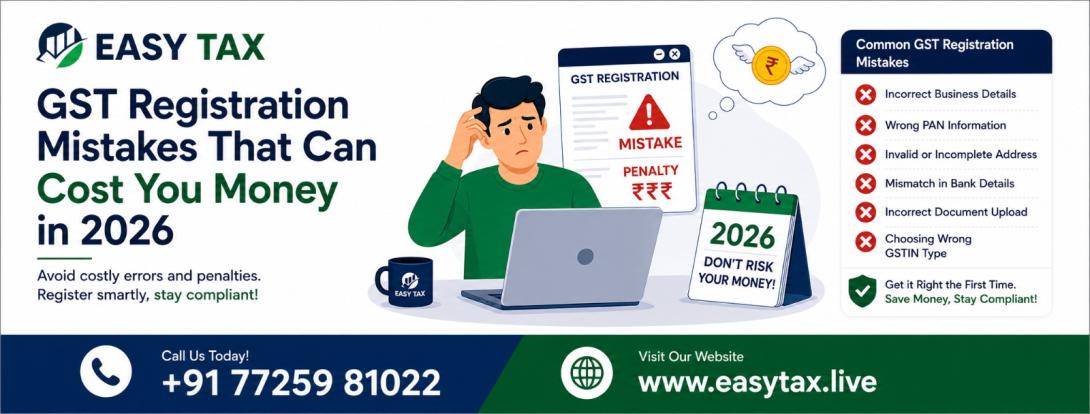
GST Registration Mistakes That Can Cost You Money in 2026
10 GST Registration Mistakes to Avoid in India (2026)
Applying for GST registration is an important step for many businesses. But an incorrect PAN, a mismatched business address, incomplete documents or a misunderstanding of registration eligibility can lead to clarification notices, delays or rejection of an application.
The Central Board of Indirect Taxes and Customs (CBIC) issued Circular No. 257/03/2026-GST dated 26 October 2026, setting out guidance on common registration application deficiencies and the handling of applications. The guidance highlights problems such as incomplete information, inconsistent details and illegible documents.
This guide explains ten mistakes to check before applying, what to do when a clarification notice arrives, and how to avoid treating a conditional GST rule as a rule that applies to every business.
Key takeaways
- Check whether GST registration is legally required before applying.
- Use the correct PAN, legal name and business constitution.
- Match the principal place of business details with valid premises evidence.
- Upload complete, legible and relevant documents.
- Understand Aadhaar authentication and possible verification requirements.
- Respond to a FORM GST REG-03 notice through FORM GST REG-04 within the prescribed time.
- Remember that bank details may be optional at application stage but can be required after registration under Rule 10A.
10 GST registration mistakes that can cost your business time and money
1. Selecting the wrong business constitution
The business constitution selected in the GST application should match the entity that is actually carrying on the business. Common categories include proprietorship, partnership, Hindu Undivided Family (HUF), limited liability partnership (LLP), private limited company, public limited company, trust and other recognised entities.
For example, a proprietorship should not be described as a partnership. A company should not be registered using the proprietor's personal identity as though the company and individual were the same applicant.
Why it matters: The constitution determines which identity and supporting documents are relevant to the application. Incorrect or inconsistent information can lead to a clarification request or rejection.
How to avoid it:
- Confirm the legal form of the entity before starting the application.
- Use the correct PAN associated with the applicant.
- Keep the partnership deed, incorporation certificate or other constitution evidence ready, as applicable.
- Ensure the authorised signatory is properly identified.
CBIC Circular 257/03/2026-GST explains the constitution-related information and documents to be furnished with FORM GST REG-01.
2. Entering an incorrect PAN or legal name
GST registration is linked to PAN. The legal name entered in the application should match the PAN database. A spelling difference, incorrect PAN or inconsistent entity name can create validation and verification problems.
How to avoid it:
- Check the PAN before entering the application details.
- Use the legal name recorded against the applicant's PAN.
- For a company or LLP, check the entity's official incorporation and PAN records.
- Check the names and details of promoters, partners and authorised signatories before submission.
Do not assume that a trade name and legal name are interchangeable. Enter the information in the correct fields.
3. Applying without checking whether registration is required
Not every business needs GST registration from its first sale. The registration requirement depends on aggregate turnover, the nature and location of supplies, the applicant's category and applicable exemptions or notifications.
Section 22 of the CGST Act contains the general turnover-based registration framework. Section 24 lists categories that may require compulsory registration, while section 23 and notifications provide exclusions and exemptions.
Important: Do not rely on a single national turnover number without checking the applicant's State or Union Territory and the type of supply.
A person may also be required to register under section 24 even when turnover is below the usual threshold, unless a specific exemption applies.
How to avoid it:
- Calculate aggregate turnover on the correct PAN basis.
- Identify whether the business supplies goods, services or both.
- Check the State or Union Territory from which taxable supplies are made.
- Review compulsory-registration categories and relevant notifications.
- Take advice where the business has interstate, export, e-commerce or reverse-charge transactions.
4. Assuming every e-commerce seller must register
E-commerce registration rules are frequently misunderstood. Section 24 contains a compulsory-registration provision for certain suppliers making supplies through an electronic commerce operator (ECO) required to collect tax at source under section 52. However, exemptions have been notified for qualifying categories.
For example, Notification No. 34/2023-Central Tax provides a conditional exemption for specified small suppliers of goods through qualifying e-commerce operators. The conditions include:
- Aggregate turnover in the preceding and current financial years must remain within the applicable section 22 threshold.
- The supplier must not make inter-State supplies of goods.
- The supplier must not make supplies through an ECO in more than one State or Union Territory.
- The supplier must have a PAN.
- The supplier must declare the required PAN, business address and State/UT details on the common portal and obtain an enrolment number before making supplies through the ECO.
This is a conditional exemption, not a blanket exemption for every online seller. Separate provisions may apply to specified service suppliers using e-commerce operators.
How to avoid it: Identify the product or service, the ECO's role, whether the ECO is required to collect TCS, the location of supplies and the exact notification that may apply.
5. Using incomplete or incorrect principal place of business details
The principal place of business (PPoB) is an important part of a GST registration application. An incomplete address, incorrect PIN code, mismatch between the application and address proof, or an unclear premises description can lead to a clarification request.
The address should be accurate, complete and supported by documents appropriate to the nature of the premises. A Post Office Box or courier-only address should not be used as a substitute for a verifiable business premises address.
How to avoid it:
- Enter the full address, including unit, floor, building, street, locality, district and PIN code as applicable.
- Check that the address matches the premises documents.
- Choose the correct nature of possession, such as owned, rented, leased or consent-based premises.
- Use the appropriate supporting documents for that category.
A residential address being in a different city or State from the declared business premises does not, by itself, make the business address invalid. The details must nevertheless be accurate.
6. Uploading the wrong premises documents
One of the most avoidable GST registration errors is uploading a document that does not establish the applicant's right to use the declared premises or does not match the address in the application.
Circular 257/03/2026-GST gives different document guidance for different premises arrangements.
| Premises arrangement | Documents described in the CBIC guidance |
|---|---|
| Owned by applicant | A clear, legible copy of an accepted document in the applicant's name, such as a latest property tax receipt, municipal khata, property identification document, electricity bill or water bill. |
| Owned by a family member or another person | Appropriate premises ownership/address evidence and a consent letter from the owner, in accordance with the circular. |
| Rented or leased with a registered agreement | A clear, legible copy of the registered rent or lease agreement corresponding to the declared address. |
| Rented or leased without a registered agreement | The rent or lease agreement and an accepted premises document in the landlord's name, as specified in the circular. |
| No rent or lease agreement | The prescribed undertaking and accepted premises evidence described in the circular. |
| Co-working space | Membership or occupancy evidence showing the allocated desk, seat, suite or area and full address, together with the additional premises documents applicable to the provider's ownership or lease arrangement. |
This table is a summary, not a substitute for the complete circular and its annexures. Check the exact document requirements for the premises arrangement before uploading.
Before submitting:
- Check that every page is readable.
- Make sure the applicant or relevant owner's name is visible.
- Confirm the address corresponds to the PPoB or APoB declared.
- Use the latest utility bill where the circular requires it.
- Do not upload unrelated documents as a substitute for required proof.
7. Selecting an inaccurate business activity or supply description
The registration application asks for details about the goods and services supplied by the business. Selecting an inaccurate activity or entering incomplete supply information can create inconsistencies with the business's actual operations.
How to avoid it:
- Describe the actual business activity.
- Identify the principal goods or services supplied.
- Check the relevant HSN or SAC classification where required.
- Review whether the business has additional places of business.
- Keep the application consistent with the entity's actual operations.
Do not assume that selecting a particular activity in the registration form automatically determines the applicable GST rate or input tax credit entitlement. Rates depend on the relevant classification and rate notifications. ITC entitlement is governed separately by section 16 and other applicable provisions and restrictions.
8. Ignoring Aadhaar authentication or biometric verification instructions
Aadhaar authentication is part of the GST registration process for relevant applicants. The GST Portal provides an Aadhaar authentication option in the registration application. The authentication and verification route can depend on the applicant's circumstances and system-based risk parameters.
Depending on the applicable process, an applicant may receive an OTP-based authentication link or may be required to attend a designated GST Suvidha Kendra for biometric authentication, photograph capture or document verification.
How to avoid it:
- Enter accurate identity details.
- Use accessible mobile and email contact details.
- Monitor messages and instructions from the GST Portal.
- Complete the required authentication within the applicable time.
- If asked to attend a Facilitation Centre, carry the required original documents and follow the appointment instructions.
9. Missing a clarification notice or replying incorrectly
If the proper officer finds incomplete, inconsistent or illegible information or documents, a clarification notice may be issued in FORM GST REG-03 in the circumstances prescribed by the rules and the CBIC guidance.
The applicant should not ignore a notice or respond with unrelated documents. The reply is submitted through FORM GST REG-04 with the requested clarification and supporting evidence.
How to avoid it:
- Check the GST Portal application status regularly.
- Read each point in the REG-03 notice carefully.
- Identify the exact information or document requested.
- Prepare a clear response addressing each point.
- Upload complete and legible supporting documents.
- Submit the response in FORM GST REG-04 within the prescribed period.
- Save the acknowledgement and monitor the application status.
Under the guidance in Circular 257/03/2026-GST, the applicant is required to submit the clarification in FORM GST REG-04 within seven working days from receipt of the REG-03 notice. Failure to respond within the prescribed time may result in rejection.
10. Forgetting post-registration requirements, including bank details
Receiving a GSTIN is not the end of the registration process. Applicants should check the registration certificate and keep their registration information accurate.
Bank account details are optional at the time of submitting the registration application according to the GST Portal guidance available in November 2026. However, Rule 10A generally requires the relevant bank account details to be furnished within 30 days of the grant of registration or before furnishing the details of outward supplies in FORM GSTR-1 or using the Invoice Furnishing Facility (IFF), whichever is earlier, subject to applicable exceptions.
After registration, check the following:
- Download and verify the FORM GST REG-06 registration certificate.
- Check the legal name, GSTIN and principal place of business.
- Review additional places of business and authorised signatory details.
- Furnish bank account details within the applicable Rule 10A period.
- Understand the applicable return-filing and tax-payment obligations.
- Keep registration and business records up to date.
How to check GST registration eligibility before applying
Before preparing documents, establish whether registration is compulsory, optional or not currently required. The answer depends on the CGST Act, the nature of the supplies and applicable notifications.
Turnover-based registration
Section 22 uses aggregate turnover in a financial year as a registration trigger. The applicable threshold can depend on the State or Union Territory and whether the supplier deals exclusively in goods or supplies services or both.
Aggregate turnover is not simply the sales recorded in one local branch. It is calculated on the statutory PAN-based basis and includes relevant supplies across India, subject to the Act's definitions and exclusions.
Compulsory registration and exceptions
Section 24 lists categories that may be required to register irrespective of the section 22 threshold. These include specified interstate taxable suppliers, casual taxable persons, persons liable under reverse charge, specified agents, Input Service Distributors and certain suppliers through e-commerce operators.
However, read section 24 together with section 23 and the applicable exemption notifications. For example, specified small suppliers of goods through qualifying e-commerce operators may be exempt if they satisfy Notification 34/2023-Central Tax. Certain service suppliers may also qualify for specific exemptions.
GST registration document checklist
The documents required depend on the constitution of the business, the authorised signatory and the nature of the premises. The following is a preparation checklist, not a universal list of documents required in every case.
- PAN: PAN of the applicant or entity, as applicable.
- Identity details: Details of the proprietor, partners, directors or other relevant persons.
- Constitution proof: Partnership deed, incorporation certificate or other applicable proof.
- Authorised signatory: Details and authorisation evidence, where applicable.
- Principal place of business: Appropriate ownership, consent, rent, lease or other premises evidence.
- Additional places of business: Relevant details and supporting documents for each declared location.
- Goods and services: Accurate description of the business's supplies.
- Contact details: Accessible mobile number and email address for the primary authorised signatory.
- Bank information: Keep the relevant account information ready for the post-registration requirement under Rule 10A, even though furnishing it at initial application stage is optional under current GST Portal guidance.
Always refer to Circular 257/03/2026-GST and its annexures for the current premises-specific and constitution-specific document guidance.
How to apply for GST registration online
The normal taxpayer registration process is completed through the official GST common portal.
- Visit www.gst.gov.in.
- Open Services → Registration → New Registration.
- Select the appropriate taxpayer type and State/UT.
- Enter the legal name as per PAN, PAN, email and mobile number.
- Complete the OTP verification process.
- Use the Temporary Reference Number (TRN) to continue Part B.
- Complete the business, promoter/partner, authorised signatory, premises, goods and services and other relevant sections.
- Upload the applicable supporting documents.
- Complete the applicable Aadhaar authentication or verification steps.
- Submit the application and retain the acknowledgement/reference details.
Forms you should recognise
| Form | Purpose |
|---|---|
| FORM GST REG-01 | Application for registration by a normal taxpayer and specified categories. |
| FORM GST REG-02 | Acknowledgement of the registration application. |
| FORM GST REG-03 | Notice seeking additional information, clarification or documents. |
| FORM GST REG-04 | Reply to the clarification notice. |
| FORM GST REG-05 | Order rejecting the registration application. |
| FORM GST REG-06 | Registration certificate. |
The form applicable to a particular applicant can differ. For example, tax deductors, tax collectors and non-resident taxable persons may use different forms. Check the current GST Portal guidance for the relevant category.
Aadhaar authentication: what applicants should know
The GST Portal's registration manual explains the Aadhaar authentication process and the circumstances in which applicants may be required to complete OTP-based or biometric-based authentication.
Where the applicant does not opt for Aadhaar authentication, or where authentication is not completed, the applicant may be required to complete photograph capture and document verification at a designated Facilitation Centre in accordance with the applicable procedure.
Separately, risk-based selection can result in biometric authentication or physical verification even where an applicant has opted for Aadhaar authentication.
Is approval guaranteed within three working days?
No. Do not treat three working days as a universal GST registration guarantee. Specific electronic grant routes and the optional Rule 14A simplified scheme have their own eligibility conditions. Ordinary applications may follow a different processing route, including additional authentication, clarification or physical verification.
Circular 257/03/2026-GST explains that where Aadhaar authentication is opted for and successfully completed, the application is generally to be processed by the proper officer within seven working days. It also describes a different process and timeline for cases where Aadhaar authentication is not completed or physical verification is required. The applicable rules and circumstances matter.
What to do after receiving your GST registration certificate
- Download FORM GST REG-06 from the GST Portal.
- Verify the GSTIN, legal name, trade name and registered address.
- Check the additional places of business and authorised signatory details.
- Complete the bank account details requirement within the applicable Rule 10A period.
- Understand which GST returns apply to your taxpayer category.
- Maintain invoices, purchase records and other supporting documents.
- Review whether amendments are required when business details change.
A change in business constitution, PAN or other material facts can have consequences under the registration provisions. Do not make an informal correction where the law requires a formal amendment or a fresh registration.
Need help with your GST registration?
If you are unsure about your registration eligibility, business constitution or premises documents, review the requirements before submitting the application.
Frequently asked questions about GST registration mistakes
1. What are the most common GST registration mistakes?
Common mistakes include selecting the wrong business constitution, entering incorrect PAN or legal name details, using incomplete premises information, uploading unclear documents, misunderstanding registration eligibility and missing a clarification notice.
2. Can incorrect GST registration documents lead to rejection?
Incomplete, inconsistent or illegible documents can lead to a clarification request. If the applicant does not provide a satisfactory response within the prescribed process and time, the application may be rejected.
3. Is Aadhaar authentication compulsory for every GST applicant?
The GST Portal provides an Aadhaar authentication process and the applicable verification route depends on the applicant's circumstances and current rules. Applicants who do not complete the relevant authentication may be required to undergo other verification steps. Check the current portal instructions.
4. Is bank proof compulsory when applying for GST registration?
Current GST Portal guidance states that furnishing bank account details at the initial registration stage is optional. However, Rule 10A generally requires bank account details after registration within 30 days of grant or before furnishing GSTR-1/IFF, whichever is earlier, subject to applicable exceptions.
5. What should I do if I receive FORM GST REG-03?
Read the notice carefully, identify each requested clarification or document and submit a complete reply through FORM GST REG-04 within the prescribed period. Circular 257/03/2026-GST describes a seven-working-day response period from receipt of the notice.
6. Do all e-commerce sellers need GST registration?
Not necessarily. Section 24 and the applicable notifications must be read together. Notification 34/2023-Central Tax provides a conditional exemption for specified small suppliers of goods through qualifying e-commerce operators. Eligibility depends on the notification's conditions.
7. Can I use my home as the principal place of business?
A residential premises may be used where the applicant has the appropriate right to use the premises and supplies the relevant supporting documents. If the property belongs to a family member, the applicable consent-based premises documents should be checked.
8. Is GST registration always approved within three working days?
No. Certain simplified or electronic grant routes have specific eligibility conditions. Other applications may require additional authentication, clarification or physical verification. The applicable process and rules determine the timeline.
Official GST sources and further reading
The following primary government sources and portal guidance support the legal and procedural explanations in this article. Check the latest applicable version before relying on a provision for a particular business.
- CGST Act, 2017 — Section 22: Persons liable for registration
- CGST Act, 2017 — Section 24: Compulsory registration in certain cases
- CGST Act, 2017 — Section 25: Procedure for registration
- CGST Act, 2017 — Section 29: Cancellation or suspension of registration
- CGST Act, 2017 — Section 16: Eligibility and conditions for input tax credit
- Notification No. 34/2023-Central Tax — Conditional exemption for specified goods suppliers through e-commerce operators
- EasyTax: GST Registration Documents Guide
- EasyTax: GST Registration Complete Guide
- GST Portal: Apply for Registration — Normal Taxpayer
- GST Portal: Non-Core Fields and Bank Account Details
- Government GST circular listing — Circular No. 257/03/2026-GST, dated 26 October 2026
- GST Council: FAQs on recommendations of the 57th GST Council meeting






EasyTax • Jaipur
GST Return Filing & Compliance
Timely GSTR-1 & GSTR-3B filing, 100% ITC matching and department notice defense by certified GST experts.